Autumn is always bad, trees down, floods… Now we endure trains with not enough coaches, hitting commuters and weekend trippers. Not everyone clings to their cosy car. Train overcrowding is an issue even on Sundays.
We see two-car trains on the Blackpool-York line and other segments of our service. “Normal” should be three, four or more on what should be Northern’s top link, and on other Calder Valley trains such as Leeds-Chester.
Hadrag’s been busy since our 40th anniversary meeting in Brighouse (June). We’ve called for an action plan on Halifax station, not an indefinite wait for revival of a shelved “gateway” scheme. We want all present trains to call at Sowerby Bridge.
And we’ve reiterated ambitions for Bradford-Calderdale-Sheffield trains: Brighouse to Sheffield little more than 50 minutes – capacity permitting! Projects that will deliver in our lifetimes must be prioritised over very long-term plans for new lines. Could recent trains Halifax-Leeds via Brighouse be another easy model to take forward? Read on for more on all that.
Latest station footfall statistics are just out – more analysis to follow in Spring issue. Among Calderdale’s top 5 stations, Halifax comes top with 1,803,014 passenger comings and goings in year ending March 2025, just a little below pre-pandemic best. Sowerby Bg, Hebden Bg and Todmorden now exceed pre-pandemic performance with Brighouse just a little behind.
If you want to do your own analysis see link to table-1415-time-series-of-passenger-entries-and-exits-and-interchanges-by-station.ods in the ORR statistics.
We just wish Northern could get our trains running on time. York-Blackpool, marred by lateness, cancellations and lack of carriages should be a premier service. It’s not all Northern’s fault: delays get knocked on from other train operators and Network Rail – including climate events. The Hadrag Survey recorded some of the best performance 30 years ago. Train running and overcrowding now feel as bad as ever. Again more in next issue – meanwhile, read on and join us!
Hadrag’s September committee meeting asked me to write to Northern about service performance. Both reliability – whether trains in the timetable actually run – and punctuality – how close the trains that do run are to scheduled time. As I write this I have still to write that specific letter, but there will be little in it that has not already been raised with Northern’s managers and mentioned to our new MPs in recent month.
A friend of a friend reported recently on commuting travails. Points failure one week, next week signal failure – both times an hour late to work. “Tree down on line, no trains. Travelled to Manchester and had to pay twice… revenue inspector would not accept ticket despite Northern website saying they would. Still not got money back. Generally all my trains are late especially in the morning.” One in ten were on time – sounds like 50% were around 5 or 10 minutes late and a substantial number more than 15 minutes late.
A frequent Halifax passenger who commutes on Wednesday evenings for a choir practice in Todmorden reports (OK, this one is me) that trains that are often now five minutes or so late – used to be closer to time. Last week the 2143 back to Halifax was cancelled – the second time in, I think, three weeks. On the first occasion I went for the bus – a slow and miserable journey – but this time waited on Tod station. Next train was 20 minutes late, so I got back to Hfx at 2253, 49 late on original schedule. Actually it turned out my usual 2143 train had eventually run but arrived in Hfx 58 minutes late. I count that as effectively cancelled. Next week the train ran, but was 21 min into Halifax, result of slippery rails, and a signal stop to allow the 2221 to Leeds to leave first. It should be noted that poor rail conditions mean drivers proceed with greater caution, a need highlighted by the recent fatal collision in mid-Wales.
No staff on stations late at night of course. Frequent electronic PA messages at Todmorden were as usual electronically broken up, defying comprehensibility. We did gather the disruption was result of a teatime incident when a person had been taken ill on a train. We can only sympathise with the passenger involved and with train staff on hand to help. We hope all is now well with them. Station screens at both Halifax and Todmorden continued to refer to the disruption throughout the evening as if it had just happened. Obviously, we realise that disruption after an incident may last several hours. We also totally appreciate that this disruption did not originate with Northern staff or management. The data below may be of interest for that day.
One day in November: departures from Halifax (information from “RTT” Realtime Trains (www.realtimetrainsco.uk) Formatted so higher figure means better performance. Northern trains only included. Includes trains normally via Bgh and Dew to Leeds diverted due to TP route upgrade work
Time period
Number of trains in timetable
Not cancelled (or late enough to be so considered)
On time or up to 5min late
On time (= 0 late)
Other points
0545-1159
70
69 = 98.6%
62 = 88.6%
44 = 32.3%
Not bad for time of year!
1200-1759
66
65 = 98.4%
57 = 86.4%
1800-2359
61
52 = 85.2%*
38 = 62.3%
12 = 19.7%
* 9 cancellations include 1 train that ran but was more than an hour late (i.e. effectively cancelled). Evening affected by passenger taken ill on train.
All day
197
186 = 94.4%
157 = 79.7%
56 = 28.4%
Note that in the first two thirds of the day less than a third of trains were precisely on time (= 0 minutes late). This is considerably worse than results we obtained in the days of The HADRAG Survey though autumn results always reflected poor rail conditions. However for up to 1800 hrs when the disruption started the “up to 5 min late” percentages are not too bad. The Survey always yearned for improvement!
We looked again at the data on RTT for the following Saturday. Brighouse-Leeds should have been running normal route from Wigan and Manchester, but lo and behold they were diverted via Halifax as they are at present whilst work is taking place on the Dewsbury route Mon-Fri). And no trains on the Bradford-Huddersfield line, nor freights on the Sowerby Bridge to Mirfield route. On the Monday we noticed a temporary speed restriction in place on the river bridge at Elland.
Bradford-Huddersfield has always felt like a soft target for cancellations. And of course the York-Blackpools, not least at weekends, and the Chester trains which change crews along on the way and have a complex route prone to other operators running late. We have seen York- Blackpools running empty all the way, presumably because there was no guard (conductor) available, though again these trains seem to change crews en route. There has been a lot of talk about industrial relations issues and people not working weekends. (Would you want to?) But weekend services are becoming more and more important. So there need to be agreements that mean train staff do work weekends – with an acceptable deal of course.
Are more staff are needed? New (interim) rest-day working agreements were put forward soon after October’s Rail North Committee. Northern was taken to task by Andy Burnham, GM metro mayor. A month later Northern revealed plans to get cancellations down to 2% (under 5% on Sundays) and get punctuality above 90% by 2027. Burnham said: “We cannot wait until 2027. That cannot happen. We do not understand why the answers are so vague regarding improvement and we need a better working relationship to bring that target down because 2027 is completely unacceptable.”
Back on the Calder Valley line in September the Warings came close to missing a concert in Blackburn when not one but two Saturday morning Blackpool trains were cancelled. Shouldn’t the York-Blackpools be four coaches not three? We got the train in between that actually ran. Was it crowded – you bet! If you needed the toilet, you’d better be standing next to it. Another was the time we were on our way back from Todmorden on that 2143. Normally 4 coaches – lots of space! – it was two coaches and absolutely rammed on this Saturday night. The one toilet was out of service.
Weekend trains are often very busy. People have to stand. Why should they have to grin and bear it? They paid enough for their tickets.
The toilet issue needs to be dealt with. The new(ish) 195 class trains have two or three coaches per unit but one toilet per unit. Not too bad if you can get to it, But if you are on a train that’s two pairs of 2-car units and one toilet is not working you may be stuck. Are toilet failures increasing? Not long ago we were on a train – toilet not working – that had to make a special stop of Hebden Bridge so people could use the facilities there.
Above all, access must be improved so that people with disabilities can board and alight easily. It may not work at every station platform yet, but if trains are designed for level boarding that is a start. It also means access to decent toilets. We also need:
space for cyclists so they are not competing with disabled people.
comfortable spaces for family groups.
and a view out of the window! (Next time you get on a “195” train notice which seats people avoid.)
Trains need to be fit for the growing cohort who want to use them, but just hope that one day they will be able to rely on the service, expecting a comfortable journey. We contribute through taxes to the cost of our transport system. That system must be available to all.
“Class195 Interior” by Superalbs is licensed under CC BY-SA 4.0.
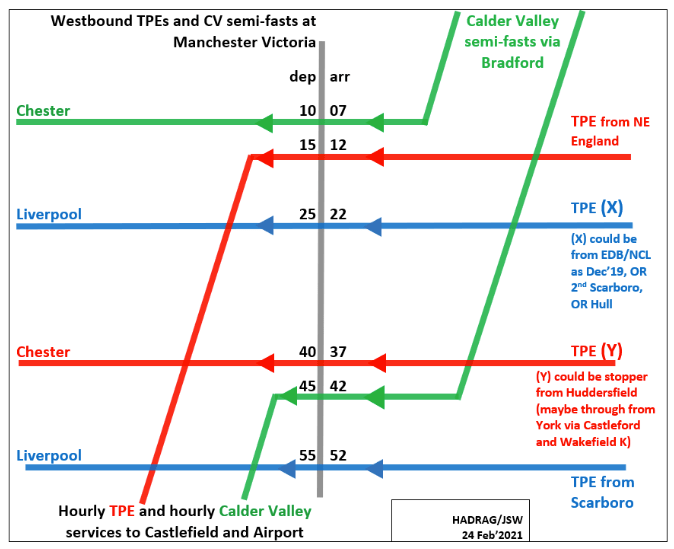
There remains the former franchise promise of a service from Bradford to Manchester Oxford Rd, Piccadilly and the airport. Responding to the MRRTF report, we asked for this to be included in the recast expected next year. We showed how the Calder Valley line to Bradford serves a similar population to the Bolton line to Preston, but has a much less well-connected service. Demanding a new link when other routes in the area are having to accept cuts is a big ask, but we ask for a fair approach, saying Calder Valley and TransPennine Express could both have an hourly path round the “Ordsall Chord” to Castlefield, with connections at Man Vic – see our diagram (times are illustrative only). We also say that is that if there is to be a wider recast of the timetable next year the opportunity must be taken to deal with the faults in the present Calder Valley service pattern. Fast trains timed to go slow following freight trains. Missing late night stops for Sowerby Bridge and Mytholmroyd. And no Manchester trains at Mytholmroyd on Sundays. We need more trains to stop at Sowerby Bridge including the York-Blackpools. And a better service on the Brighouse/Elland line – including more trains going up the valley on Sundays for leisure trips. Keeping up the struggle – JSW
The next November 2015 downpour is about to start as the Manchester-Leeds train heads towards Mytholmroyd. Recent weather, rail conditions, floods and landslips played havoc with our service recently, not helped by a timetable that is barely fit for purpose. Our trains have miniscule turn-round times at Manchester and Leeds so if a train is delayed going one way it has little chance of setting off back on time. Arriva say they have tough targets and will design a robust timetable. But not even German efficiency can instantly improve the British weather in a grimly changing climate.
Our line needs infrastructure upgrades to cope with more trains including freight. The scene in the picture was once four-track, a place where fast trains could pass slower ones. Before restoration of loops is even considered Network Rail has to complete linespeed and capacity improvements all the way from Manchester to Bradford. These improvements are needed to support the faster and more frequent service planned by 2019. The DfT has promised us that work will start on the ground in January 2016. But this is the “west” work around Rochdale. The Hendy Review of Network Rail projects is now out, but it is still unclear whether Hebden Bridge-Bradford capacity and linespeed, and capacity improvements at Bradford will be sorted by the end of “CP5”, the 2014-19 control period. It is also rumoured that construction of extra through platforms at Manchester Piccadilly – on the route to be used by our Manchester Airport services – will be delayed into CP6 (2019-24).
The works at our end of the CVL are vital if the franchise is to deliver what is promised. We hope to have a further update in our next newsletter.




 Halifax and District Rail Action Group