WYCA agrees rail strategy
In line with our Electric Railway Charter!
It is good to record that West Yorkshire Combined Authority (WYCA) is sticking to its guns on electrification. The Metro rail strategy was formally agreed at WYCA’s full meeting in March, and includes as top-ranked (Tier 1) schemes:
- The Calder Valley line extending the government’s Leeds-Bradford proposal to Calderdale, Preston and Manchester. The routes through Elland and Brighouse linking with Huddersfield routes are also included. York-Blackpool, Leeds-Manchester (and maybe on to Chester) could be electric all the way, as could trains via Brighouse. The Calder Valley network is noted as one of the busiest routes in the region. Full electrification would release a lot of diesel vehicles, and maximise the benefits of the Leeds-Bradford scheme – make sense of it in fact. We say track upgrades could be carried out along with – or preferably before – electrification.
- The Harrogate line, already linked with electrified Airedale and Wharfedale routes, enabling large numbers of diesel trains to be removed. Electrification through to York would also link up with the electrified East Coast Main Line.
- The Dearne Valley line linking Wakefield Westgate with soon to be electrified Sheffield-London, enabling service improvements on potentially fastest Leeds-Sheffield route.
Tier 2 includes the lines through Castleford and Wakefield to Knottingley (onwards to Goole), and Sheffield via Barnsley – where Northern currently routes its twice hourly fast (or fastish) trains from Leeds to Sheffield. Tier 3 would fill in gaps such as the Penistone line and Ravensthorpe-Wakefield.
The assumption is that the TransPennine Route Upgrade will electrify from Stalybridge through Huddersfield and Leeds to Church Fenton1, effectively completing wiring from Manchester Airport and Liverpool to York. Also assumed is that already announced schemes not only for Leeds-Bradford (the New Pudsey route) but also for Leeds-Hull will be there. Leeds-Hull is a government Network North proposal, as is Leeds-Sheffield (which latter we assume means the Dearne Valley route).
Rolling programme. But one project for our line!
The document gives equal ranking to Harrogate, Calder Valley and Dearne Valley routes. But Harrogate is always mentioned first, maybe just because it is less complex. Some of us would like to see our line at the top, as it was in Northern Sparks, the task force report that will celebrate its tenth anniversary next year. Then again, the Harrogate line is much simpler; could it even start before the Huddersfield main line is finished? Either way, the plan for full electrification is in line with our Electric Railway Charter, launched six years ago in Halifax (Electric Railway Charter). The Charter website lists several other reports that advocate, in one form or another, rolling electrification. The Calder Valley is always there.
It is vitally important the Calder Valley is seen as one project with Leeds-Bradford. Almost all trains from Leeds to Bradford Interchange continue to Calderdale and beyond. It would seem ludicrous to have to change traction from electric to batteries (or hydrogen) at Bradford. Bi-mode, even tri-mode trains might seem sexy to some engineers, but with two or more traction systems on board there is a lot of extra mass, more things to go wrong, less reliability and lower energy efficiency than pure electric. The Calder Valley also carries heavy freight trains for which the only sensible decarbonisation plan is full electrification. The strategy says batteries or hydrogen could be valuable as interim solutions on some lines including use of hybrid trains. But “the limited range and performance of such trains is likely to suit only low density, low traffic, low speed and shorter distance passenger routes,” says the strategy. As electric car drivers know, batteries are heavy2. And hydrogen, though the lightest gas, takes up a large volume.
Service frequencies need improving
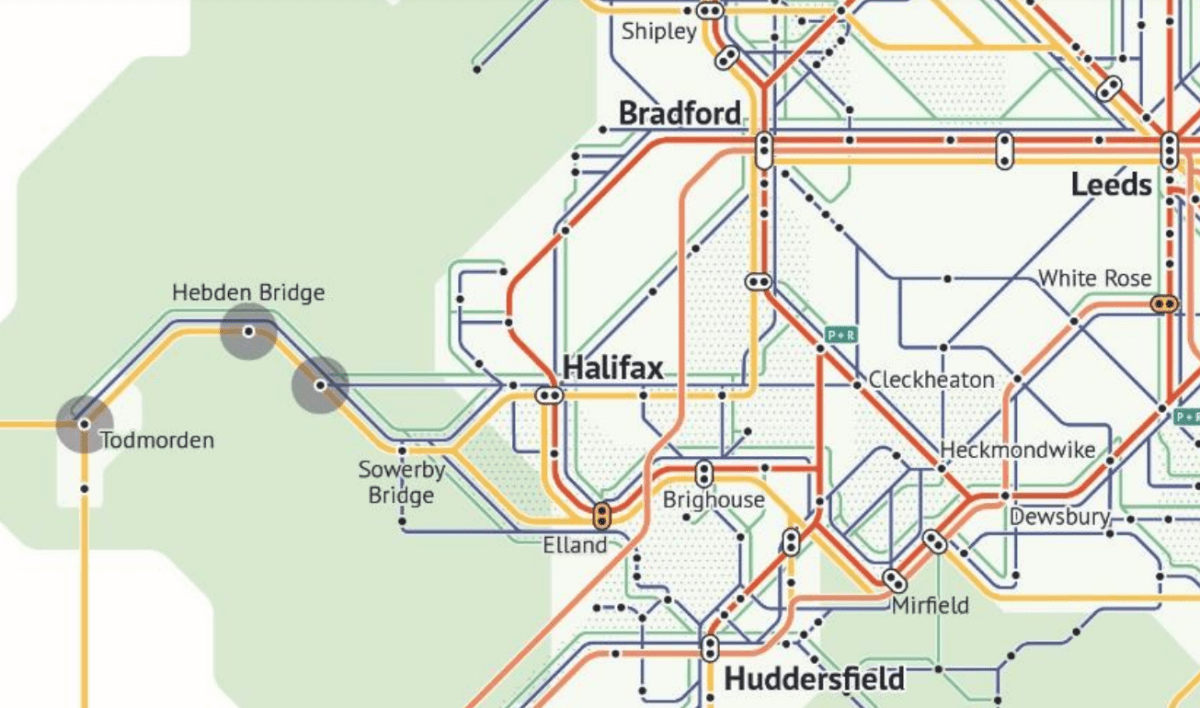
Our line – including the route from Brighouse to Leeds via Batley – is shown by one of the maps in the strategy as having nine stations where service frequency needs improving. HADRAG agrees. We shall keep on pressing for all trains passing through Sowerby Bridge stop there (at present just 2/hr compared with Hebden Bridge’s 4/hr). Halifax and Bradford Interchange (currently 5/hr) are both shown as needing improvement. Walsden’s present 1 train/hr is marked “not acceptable”.
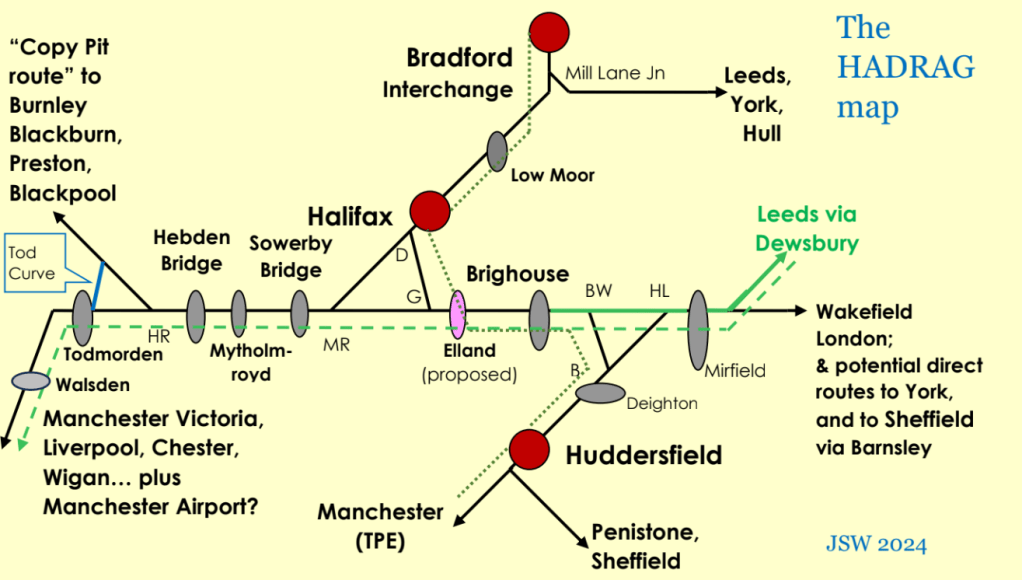
Brighouse’s twice hourly pattern is also shown needing an upgrade. We have pointed out that the nominal 2 trains/hr at Brighouse is effectively only a single train on each of the two routes E-W (Wigan-Leeds) and N-S (Bradford-Hud). Two an hour – at least! – is needed on all arms. And we say they should connect, to give reliable upper Calderdale-
Huddersfield connectivity (if not through trains). Brighouse-Leeds is proposed to be semi-fast, just one or two stops. We say target journey time should be 20 minutes. Elland-Leeds would be about 23 minutes. At half-hourly that would be a very attractive service.
There is little if any more on suggested new routes including the “Crigglestone curve” one linking the Calder Valley line south of Dewsbury with Barnsley and Sheffield. We think a Bradford-Halifax-Sheffield service could offer some attractive journey times, our headline being Brighouse-Sheffield in 55 minutes, maybe less. Spen Valley reopening through Cleckheaton could be a later phase, cutting off the corner to give a direct inter-city link.
Bradford-Huddersfield is described as part of strategic evidence for CV line enhancements. “Network North” (last autumn’s government statement) is invoked here with its suggested (optimistic?) 12 minute journey time, non-stop, presumably via a new route. But this would not improve the service for Halifax, and not, we guess, for Brighouse either. Clearly any Network North new line is some years away. We need our lines improving now.
A further complication is service disruption for the TransPennine Route upgrade.
Network North proposed a 30 minute timing Bradford-Manchester. And yes, it does seem optimistic. Business case must be dubious if it’s a new line for only 2 trains an hour. Better surely to upgrade the Calder Valley line and aim initially for a half-hourly fast service. This might take as little as 42 minutes Bradford-Manchester and would also serve Halifax and Rochdale. Complementary services in between would serve intermediate stations. Track -and capacity – interventions are pencilled by the WYCA strategy over the Sowerby Bridge to Rochdale section.
This could mean passing loops, for example between Mytholmroyd and Hebden Bridge or further up the route. Longer trains are suggested through Halifax and Brighouse.
Tunnel to high speed?
Away from the WYCA spotlight, Colin Elliff, experienced railway civil engineer, has suggested a new route across the Pennines involving a 15 kilometre tunnel from Halifax to Littleborough. A 30 minute journey time is proposed from Bradford to Manchester.
Elliff’s proposal is part of a portfolio of schemes that also go under the banner “Network North Ltd”, not to be confused with the government’s more recent adoption of a similar brand! It scores higher for us than Transport for the North’s publicly unspecified high speed plans, because it actually serves the big towns on our line. Could it be a later phase? It is certainly a generation way. We need to develop the lines we already have – now!
Back in the WYCA strategy, talk continues of a new Bradford station. This could be outside the present city centre – maybe 10 minutes’ walk. It would be a through station eliminating the age-old need for trains to reverse in Interchange. This would ease “pathing” of trains in and out of the station and increase capacity.
Could other, more convenient, sites be possible?
We must add that Bradford’s vision is for the city centre to expand and include the new station site.
An alternative cross-city route stretches the definition of feasibility: the new(ish) Broadway shopping centre blocks the way. Bradford to Leeds via Shipley is 13 miles, compared with 10 miles via New Pudsey. And junction conflicts at both Interchange and Shipley would constrain timetabling. Colin Elliff’s diagram suggests Bradford-Leeds via Shipley would take 15 minutes, compared with 12 minutes currently predicted via New Pudsey (we assume both of these are non-stop). It all adds up. With the new station, Halifax-Leeds could come down to 25 minutes or less. – JSW





 Halifax and District Rail Action Group