Autumn is always bad, trees down, floods… Now we endure trains with not enough coaches, hitting commuters and weekend trippers. Not everyone clings to their cosy car. Train overcrowding is an issue even on Sundays.
We see two-car trains on the Blackpool-York line and other segments of our service. “Normal” should be three, four or more on what should be Northern’s top link, and on other Calder Valley trains such as Leeds-Chester.
Hadrag received an encouraging initial reply from Northern Trains on our shopping list of urgent needs for Halifax station. We also had a good opening conversation with West Yorkshire Combined Authority (WYCA) people who were at a recent stakeholder conference run by Northern, followed by a written response.
Key demands are summarised in the table below. Hadrag’s six-page report is based on observations at the station by Hadrag’s secretary Peter Stocks, and chair Stephen Waring.
Hadrag’s early action points
Improved safety all areas
Traffic and tripping hazards on approach bridge. Crowding on platform. Stairway needs clear one-way system and central handrail. Narrow section of P2 curves the “wrong” way. Hazard when passing crowds. People need to move along.
More information screens
Existing one on P2 invisible from most of platform. Needs coordinating with where passengers are asked to wait. Additional info screens (3 or 4 extra are needed) at S end of platform showing both next trains info and list of next few trains. Maybe one outside station entrance.
Better toilets
Present single unit is modern in a sense but vary basic. We suggest replacing with modern unit at station entrance or improved facility next to waiting room.
Better access – lift
Compares unfavourably with other stations. Out-of-service periods have caused lack of confidence. Lift needs to be replaced for reliability and modern feel. Could alternative ramped access be provided?
Staff roles
Best part of station is ticket and information office – staff roles much appreciated. Welcoming, human presence. Shop is also strong feature.
The thing was – every time you visited the station you seemed to spot something else. In the end we had to “freeze” our thoughts and get on with submitting to Northern (who operate the station), track authority Network Rail, West Yorkshire Combined Authority, key stakeholder Calderdale Council and Kate Dearden MP (Halifax).
Of course there has been some history to all this. Some years ago there was a series of consultations on a station “gateway” project. That would have created a new entrance, new pedestrian approach bridge, and car parking (including disabled) at ground level. There would have been lifts so passengers could get “up and over” to and from their trains. Hadrag successfully argued bridge access should be retained to facilitate foot access from town and bus stops.
But little as far as we could see was proposed to improve surroundings for train passengers down on the platform. There was talk of Northern replacing the existing lift, as well as providing new lifts to get up from ground-level entrances. A new ticket office was proposed but on the ground floor in the new entrance building, not too convenient for people arriving on foot. New toilets were also to be on the ground floor.
After the pandemic, bodies such as WYCA found themselves short of funding as that snap of inflation took bite. And the Halifax station gateway project was “paused” (not quite cancelled), meaning an indefinite wait for further progress. (Elland station has been paused getting on for 30 years!)
Hadrag says we cannot be expected to wait for a revived “gateway” scheme. We need a new project that can be done in easy and affordable early stages focusing on items that will directly benefit train users. Our table sums up what we have in mind.
We highlight the need to improve safety. Manoeuvring past crowds of people waiting on the narrow part of Platform 2 can be frightening. (Some of us have taken to shouting “excuse me please”!) But this problem could be addressed if P2 trains were to stop further back where it is wider. Signs and announcements could politely direct people to move along.
An exit from the waiting room to the wide south end of the island platform would help. This would mean moving the passenger toilet recently refurbished been but you’d be skilled to spot the difference. Would a modern unit at the station entrance be better?
The glazed platform level sliding doors have never worked. They are out of keeping with the 19th century architecture and need to be removed and the whole area tidied up.
The station entrance becomes very congested. The interaction between pedestrians arriving from the direction of Halifax Piece Hall and cars steering onto the station forecourt is a hazard.
The best thing about the station is its ticket office, staffed by excellent people, friendly and helpful in a way that online sources, vending machines or the dreaded AI can never be. Staff must be retained, whatever hi-tech ticketing solutions arise. Halifax station boasts a footfall getting on for 2 million a year. Booking office staff can help in all sorts of ways. So let’s value them. Human contact makes rail journeys better.
Hadrag’s been busy since our 40th anniversary meeting in Brighouse (June). We’ve called for an action plan on Halifax station, not an indefinite wait for revival of a shelved “gateway” scheme. We want all present trains to call at Sowerby Bridge.
And we’ve reiterated ambitions for Bradford-Calderdale-Sheffield trains: Brighouse to Sheffield little more than 50 minutes – capacity permitting! Projects that will deliver in our lifetimes must be prioritised over very long-term plans for new lines. Could recent trains Halifax-Leeds via Brighouse be another easy model to take forward? Read on for more on all that.
Latest station footfall statistics are just out – more analysis to follow in Spring issue. Among Calderdale’s top 5 stations, Halifax comes top with 1,803,014 passenger comings and goings in year ending March 2025, just a little below pre-pandemic best. Sowerby Bg, Hebden Bg and Todmorden now exceed pre-pandemic performance with Brighouse just a little behind.
If you want to do your own analysis see link to table-1415-time-series-of-passenger-entries-and-exits-and-interchanges-by-station.ods in the ORR statistics.
We just wish Northern could get our trains running on time. York-Blackpool, marred by lateness, cancellations and lack of carriages should be a premier service. It’s not all Northern’s fault: delays get knocked on from other train operators and Network Rail – including climate events. The Hadrag Survey recorded some of the best performance 30 years ago. Train running and overcrowding now feel as bad as ever. Again more in next issue – meanwhile, read on and join us!
Huddersfield-York Sunday train calls at Low Moor station on the recent new station’s first day. In not too many years time this train should also serve Elland. Time for an update on this summer’s good news:
HADRAG welcomes this summer’s major step forward in planning Elland station as an ambitious transport hub, and calls for the Northern train operator to rise to the challenge of upgrading train services on the line. We say with a decent timetable Elland-Leeds by train could take just over 20 minutes.MORE BELOW…
In June the combined authority’s West Yorkshire and York investment committee recommended allocation of up to £22million from the West Yorkshire Plus Transport Fund (WY+TF) to an ambitious project that should make the new station at Elland a local transport hub, with pedestrian, bus, park & ride and cycle links, by 2022.
This is a major step forward for Elland, the town that has been waiting for its own railway station since Brighouse opened 17 years ago. The scheme will now move forward towards the next hurdle, outline business case, which should be completed by the end of next year. By then the project will have achieved what Network Rail calls “GRIP 4” – single option development, with detailed design (GRIP 5) following over the next two years.
The £22M (which includes allowance for 20% overrun in delivery costs) buys considerably more than just a simple train station. The key elements of the ambitious project are:
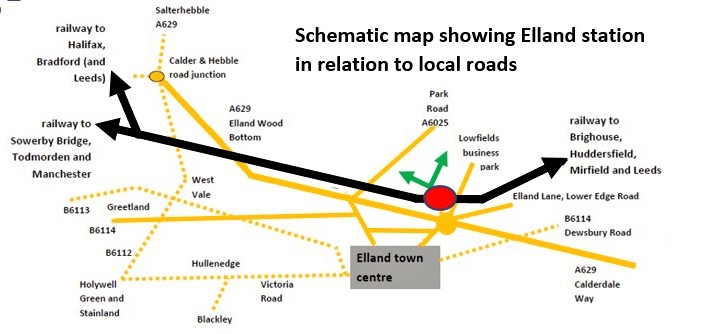
The new station itself, located at Lowfields Way. This would be next to the big “figure of eight” roundabout off the A629 bypass road;
Pedestrian, cycle and public realm improvements to link the new station to Elland town centre as well as to surrounding areas of planned employment and housing growth;
New footbridge over the River Calder. This will link to the Calder Valley Greenway on the canal bank (Route 66). It will also give good links to the station from the north and west where the Local Plan suggests significant housing growth. Current employers in the area could also benefit with opportunities for “intensification” of activity;
New bus infrastructure to enable bus-train interchange at the station, providing sustainable access from a wider catchment area; and
Dedicated station car park and highway access to bring in park & ride to bring in passengers from existing and new housing area around the periphery of the town.
This sounds very much like the sort of local transport hub that HADRAG called for just four years ago after we held our 2013 annual meeting in Elland .
We understand the car park could be built on two levels, and hope bus operators will be persuaded to provide services linking the station and all the surrounding communities. Sustainable commuting and leisure also look to be encouraged by the scheme. We look forward to being able to access the station on foot or with a bike from the canalside “green” route.
The station also has an obvious potential role in hospital transport for staff, patients and visitors. Could shuttle buses linking the two NHS sites at Calderdale (Salterhebble) and Huddersfield (Lindley) be developed to call at Elland station?
In terms of the local community, HADRAG says Elland station, with good park & ride and sustainable transport links should be seen as serving not just Elland itself but also Greetland and Stainland, a total “Greater Elland” population of more than 20,000. As such the station will have a catchment as populous as the areas served by stations like Brighouse or Sowerby Bridge. In fact we reckon any one of Sowerby Bridge, Elland or Brighouse stations potentially serves as big a population as the two main upper Calderdale stations – Todmorden and Hebden Bridge – combined.
Upper valley-Elland-Brighouse rail corridor: we hope for timetable improvements!
But of course Todmorden and Hebden Bridge, along with Halifax, currently have almost double the train service level of either Sowerby Bridge or Brighouse. Sowerby Bridge (and Mytholmroyd) should see some improvement next year with the Blackpool-York trains stopping. We really hope Northern will build on that at the end of 2019 when the next big timetable recast comes. And of course HADRAG continues to argue the case with train operator Northern for a better deal for the Brighouse corridor. In our response to Northern’s timetable plans we have specifically asked for future timetables to include make allowance for all trains that currently stop at Brighouse also to serve Elland. We have also want the Manchester-Rochdale-Brighouse-Leeds “valley bottom service” to run later at night and on Sundays, something that does not, so far, seem to feature in Northern’s plans.
As an ambitious transport hub, Elland station will be another reason to upgrade the timetable. Opening 22 years after neighbouring Brighouse, the new station may still seem frustratingly in the future. But at least by 2022 we hope there may be further timetable improvements. Under the existing service patterns, Elland would be served by hourly trains on the Manchester-Brighouse-Leeds and Huddersfield-Bradford-Leeds routes, effectively an hourly stopping service to key destinations. We have joined our colleagues in the Upper Calder Valley Renaissance Sustainable Transport Group in calling for a service from the upper Calder Valley to Huddersfield, meeting commuting, educational and other sources of demand. That would give an additional service along the Sowerby Bridge-Elland-Brighouse corridor. But we also need better services Elland/Brighouse-Leeds.
Potential for fast journey to Leeds
We want Northern, Network Rail and their train planners to rise to the challenge of providing an upgraded timetable for Elland/Brighouse rail corridor. It probably needs some capacity improvements in the Huddersfield and Mirfield area as well as a more ambitious approach by the train operator.
Finally, HADRAG has repeatedly, over may years, pointed out the potential to speed up trains on the direct Brighouse-Dewsbury-Leeds route. At present Brighouse-Leeds takes about 34 minutes, calling at nearly all stations. So that would be 37-38 minutes from Elland. A fast service, with maybe just intermediate stop, would easily cut the Brighouse-Leeds journey to 20 minutes. So stations all the way up the valley would get a Leeds service that could be 10-15 minutes faster than at present. Elland-Leeds could be about 23 minutes.
What could go wrong? One complication is the TransPennine Route Upgrade. This is the project that was meant to include Huddersfield Line electrification, though it sounds increasingly as though it may not. With or without electrification there is likely to be upgrade work to improve capacity that will mean diversions of TransPennine Express via the Calder Valley line while the work is going on. The plan seems to be that this will be completed before Elland opens. Fingers crossed, then. -JSW
Campaigners in HADRAG, the Halifax & District Rail Action Group, are calling for Elland to be next new railway station in West Yorkshire following opening of Low Moor earlier this month. We want the Northern train operator (Arriva Rail North) and Network Rail (who oversee tracks and timetables) to declare their commitment to Elland station and ensure provision is made for trains to stop in new timetables planned for the next 2-3 years. Meanwhile we continue to argue for a better deal for Calder Valley stations currently missed out by “semi-fast” or “express” services. We say Brighouse and Sowerby Bridge deserve something more like the service level and quality enjoyed by Hebden Bridge and Todmorden. More below:
First call by a Northern service at brand new Low Moor Station, Sunday 2 April 2017. This 0832 Sunday train to Halifax comes back as a York service at 0852. Weekday services start earlier! HADRAG says the next new station in West Yorkshire has got to be Elland.
Low Moor station is on the Calder Valley Line between Halifax and Bradford. HADRAG joined with other groups including the Bradford rail users (BRUG), and the Friends of Low Moor Station (FOLMS) in celebrating the first trains at Low Moor station on the first Sunday in April (02/04/17). Low Moor is served by hourly trains on the Leeds-Bradford-Halifax-Brighouse-Huddersfield route. It also has intercity services to London operated by the Grand Central open access operator. With the other groups, HADRAG wants to see a better service at the new station and we hope a Manchester service can be arranged to stop every hour by the end of 2019.
December 2019 is the second of two big timetable change dates when services are expected to be transformed under the Northern trains franchise under Arriva. By then Bradford-Manchester should have 3 trains/hour (compared with 2/hour at present) and we say that should be an opportunity to boost the service at intermediate stations, not just provide an extra fast train that misses out a lot of stops.
If increasing usage is the measure (Office of Road and Rail station usage statistics, 2016), Brighouse and Sowerby Bridge should be the Calder Valley Line’s top two stations. (See also our newsletter piece: Two Cinderella stations again top table!)
Usage of Sowerby Bridge station has risen steadily and now stands at 392,000 passengers/year, an increase of 132% on ten years ago. Although passenger numbers are historically higher at Hebden and Tod, their ten-year percentage increase is somewhat less than Sowerby Bridge’s. Sowerby Bridge station serves not just the town itself but also the Ryburn valley and the eastern side of Luddendenfoot. This represents a catchment area of more than 20,000 population, and probably more than that of Hebden Bridge and Todmorden combined. Yet the basic half-hourly service at Sowerby Bridge is only about half the frequency enjoyed by the upper valley stations. HADRAG continues to argue that all of the York-Blackpool semi-fast trains should call at Sowerby Bridge (at present just a few do at peak hours). We also say that when an extra service every hour is introduced between Bradford and Manchester at the end of 2019, that train should also serve Sowerby Bridge.
Brighouse line – and Elland! Brighouse has an even better case for more trains, but apart from some increase to peak hour and Sunday services to be introduced by May 2018, little extra seems to be promised for Brighouse under the Northern franchise. This is in stark contrast to Halifax, Hebden Bridge and Todmorden on the Bradford-Manchester route which will benefit from “Northern Connect” branded regional express services by 2019. Like Sowerby Bridge, Brighouse serves a population covering at least two local council wards – 20,000 plus. The ORR’s figures show a ten-year increase of 476% at Brighouse station which now sees footfall of over 400,000 entries and exits annually. No better than Sowerby Bridge, Brighouse’s best local service frequency is hourly on each of two routes (Leeds-Brighouse-Todmorden-Manchester and Leeds-Bradford-Brighouse-Huddersfield). The Sunday service is at present 2-hourly (on the Bradford route only); the commitment is to increase this to hourly. HADRAG has been pressing for a speed-up of the Leeds-Brighouse-Manchester trains which we say should also run on Sundays. We hope that changes to stopping patterns may see these trains running semi-fast west of Todmorden in the next year or so. A few peak-hour trains on the Brighouse-Manchester route are planned to run non-stop Rochdale-Manchester from December 2017. We do not yet know whether this will become the pattern for all of these trains. Beyond 2019 and Northern’s initial franchise commitments we hope that the Brighouse-Leeds service will also be improved with fast or semi-fast operation. Non-stop running time Brighouse-Leeds is about 17 minutes but the current stopping service takes double this time. This is very much an area where we expect the train operator to deliver beyond its basic franchise commitment.
Which brings us to Elland, one of the top three sites in the West and North Yorkshire new stations study (now getting on for three years ago). The October 2014 Atkins report forecast demand at Elland as 240,000 annually. In the latest feasibility studies, consultants report a strong business case and confirm the buildability of an impressive-looking new station on the strategic site next to the A629 and Lowfields. HADRAG believes this could work well as a park and ride serving the whole “Greater Elland” settlement – again, a population of 20,000 plus. We understand the money for building Elland station (price-tag maybe £14 million) could come from West Yorkshire Plus Transport Fund, though there may be further hoops to jump before that can happen.
And the train timetable must be designed to allow trains to stop at Elland. So HADRAG calls on the Northern train operator (Arriva Rail North) and on Network Rail to declare their commitment now to operating Elland station with a good train service. Every local train that stops at Brighouse must also stop at Elland! There looks to be slack in the current timetable to allow that to happen but obviously with major timetable recasts in May 2018 and December 2019 that allowance must also be built in for the future. Faster line speeds on the Bradford-Manchester route and hopefully a semi-fast pattern for the Brighouse-Manchester trains should make this easier. The railway – train operators and infrastructure managers – should commit to this without further delay or equivocation. What’s to stop them? HADRAG is clear that after massively successful Apperley Bridge and Kirkstall Forge, and now Low Moor:
It’s got to be Elland next!
– JSW
Low Moor, Sunday 2nd April 2016. First train to call at the new station was actually the 0802 Grand Central service to London King’s Cross here seen accelerating away with passengers onboard enjoying the historic moment. Northern’s first local service followed half an hour later.
“Just call us Northern” says our train operating company under the 9-month old franchise. It’s what it says on the “partly refurbished” Class 158 train that’s been running on our line and on the “we are Northern” posters that punningly promote the new franchise. We were politely corrected when we called them “Northern Railway”, though the web branding stands out on posters, leaflets etc. The logo, of course has a lower case initial “n”, a kind of inverted horseshoe (hope the good luck doesn’t run out of the ends). Legally, the new franchise holder is Arriva Rail North Ltd. So (just) Northern is (just) a trading name. And don’t confuse Arriva Rail North with Rail North. The former is part of a group owned by German Railways (but firmly grounded in north-east England). Rail North is the body of nearly 30 local and combined authorities that, in partnership with the Department for Transport (DfT), supervises both Northern and TransPennine Express train franchises. It seems train operators’ parent company names —Arriva or First— are no longer applied to public branding. So (First) Great Western is just Great Western Railway and (First) TransPennine Express is just Transpennine Express (web tpexpress.co.uk). Did somebody say “Bring back British Rail”? Let’s not go there right now!





 Halifax and District Rail Action Group