UPDATE March 2017. HADRAG hopes to make Halifax station plans a central topic at this year’s Annual General Meeting, being planned for Saturday 13th May in Halifax. We should have a presentation from Calderdale council officers, and we are also inviting West Yorkshire Combined Authority and the Northern train operator. Watch out for details of time and venue. Meanwhile here are some points to ponder (just slightly expanded) from our newsletter earlier this year:
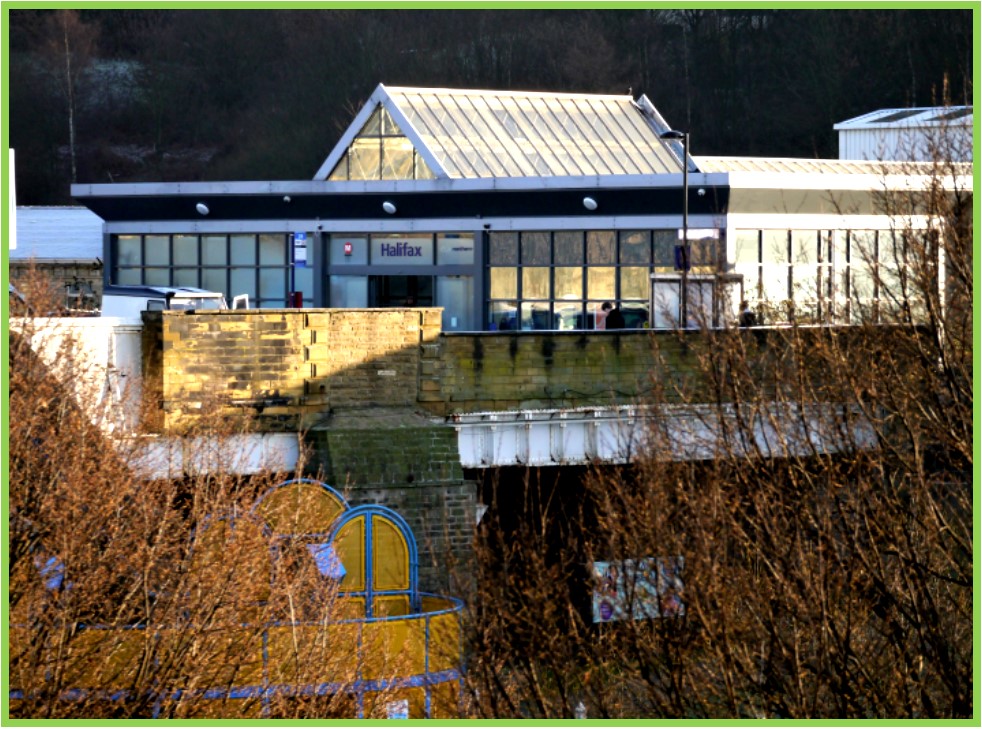
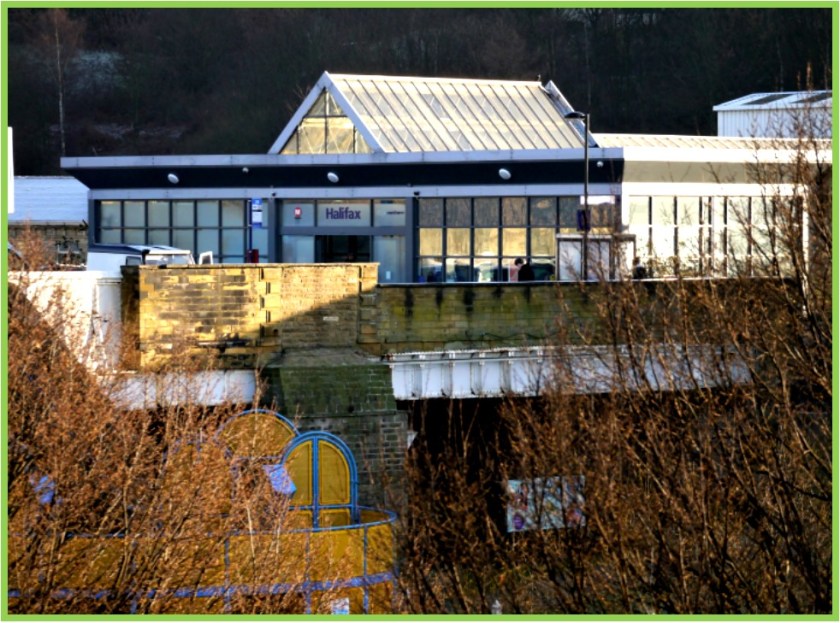
HALIFAX station is a mixture of old and new that somehow works. Could it work better? The road approach bridge that once spanned a railway goods yards now separates car-parking from play area on the Eureka childrens’ museum site. It’s a good level access for pedestrians between town and the modern station entrance. Rail users’ car-parking is demonstrably inadequate, and competes with taxis and drop-off/pick-up for space. Viewed from ground level the bridge may be seen as a historical feature that tells a story — or as a barrier between the Eureka site and town-centre attractions. We’ve heard it called an eyesore. With a jocular twinkle in the eye, one HADRAG committee member recently dubbed it a “cast iron leviathan”. Arriving train passengers come out of the entrance and take in a true panorama of notable and some truly great structures—India Buildings, the Imperial Crown Hotel, Square Chapel and the Piece Hall both nearing transformed rebirth, the new Library, Industrial Museum, Halifax Minster.
But the existing bridge funnels people towards Horton Street, dreaded approach that fails to show our great town at its best.
Plans linked to town centre development should move rail-users’ parking to ground level and hopefully create a bus mini-interchange. Beyond that a masterplan hints at what might be done with the approach bridge removed to create an open “station gardens” with pedestrian as well as bus and car links radiating towards the wider attractions. A low-level station entrance could work well with restoration of Platform 3. A third platform would give more space for growing crowds of passengers. But the railway authorities seem to have been at best lukewarm towards the idea. The wider masterplan is truly transformational, potentially linking town and station with a regenerated area around the Nestlé site east of the railway.
The regenerated Piece Hall has potential to attract thousands of visitors to events and many of these could arrive by train. So station access must be adequate to deal with crowds potentially even larger than those of today’s commuters who fill the island platform.
Rail users’ needs foremost, HADRAG is committed to campaigning for retention of level pedestrian access between the bottom of Horton St and the footbridge that leads to platforms. (There is perhaps a small assumption here that the footbridge itself is adequate for future needs.) But does that have to mean keeping the existing road approach bridge? How about a new iconic pedestrian bridge linking to a station with both high and low level entrances. What we do not want to see is the station made less convenient for the large number of existing local train users who access the station on foot via the present bridge. We are actively engaging with Calderdale council officers and elected members to get the best solution for train users whilst putting the station at the heart of our town. —JSW
“Just call us Northern” says our train operating company under the 9-month old franchise. It’s what it says on the “partly refurbished” Class 158 train that’s been running on our line and on the “we are Northern” posters that punningly promote the new franchise. We were politely corrected when we called them “Northern Railway”, though the web branding stands out on posters, leaflets etc. The logo, of course has a lower case initial “n”, a kind of inverted horseshoe (hope the good luck doesn’t run out of the ends). Legally, the new franchise holder is Arriva Rail North Ltd. So (just) Northern is (just) a trading name. And don’t confuse Arriva Rail North with Rail North. The former is part of a group owned by German Railways (but firmly grounded in north-east England). Rail North is the body of nearly 30 local and combined authorities that, in partnership with the Department for Transport (DfT), supervises both Northern and TransPennine Express train franchises. It seems train operators’ parent company names —Arriva or First— are no longer applied to public branding. So (First) Great Western is just Great Western Railway and (First) TransPennine Express is just Transpennine Express (web tpexpress.co.uk). Did somebody say “Bring back British Rail”? Let’s not go there right now!
Network Rail say rail passenger numbers have doubled nationally over 20 years and will double again by 2041. But the top stations on our line can better that! Halifax station usage has doubled in just 10 years. Latest batch of station usage estimates from the Office of Rail and Road reinforce previous years’ results. ORR’s estimates are based on ticket sales. Refinements of methodology over the years mean caution is required when identifying trends. But some trends are clearly significant.
We have again done our homework on the ORR spreadsheet and calculated increases in estimated footfall over the last ten years (up to last spring), as well as the latest year-on-year figures. Our Calder Valley Line (CVL) table is ranked by 10-year growth, and once again Brighouse and Sowerby Bridge come out top. Brighouse has had another growth spurt (8.1% over last year), consolidating a spectacular 476% over ten years. Sowerby Bridge may have levelled off slightly this time — sign of demand starting to be suppressed by service limitations? — but 132% over ten years is still double the national average. These are of course our “Cinderella” stations; they serve medium-size towns comparable with Todmorden and Hebden Bridge but have significantly fewer trains. As we keep telling people, better services at Brighouse and Sowerby are surely overdue.
10-year growth exceeds the national average at all Calder Valley stations within West Yorkshire except Walsden and Mytholmroyd, the latter a significant village halt where untapped potential may emerge when the new car park opens. Overall, CVL stations are a little behind national growth figures, more significantly so on the latest year-on-year results. Again, is this the limitations of provided service suppressing demand?
Walsden is interesting with a sudden apparent spurt against declining trend. Look also at New Pudsey where morning peak trains regularly leave passengers behind. And Bramley, third from the top, last station before Leeds (but compare with Moston at the other end of the line). Any theories?
CVL station usage statistics: entries and exits
(extracted from Office of Road and Rail station usage estimates, December 2016 – growth calculations added for HADRAG by JSW)
As part of the rail investment in the North, Network Rail are investing over £1 billion on targeted upgrades to the rail network, helping to support and grow the regional economy.
The Calder Valley Route Upgrade is part of this investment programme. The route upgrade will deliver faster services and improve connections between key towns and cities across the North.
As part of the upgrade plan, we will be carrying out track and signal upgrades along the Calder Valley route, this will pave the way for faster journeys.
We have already completed the upgrade to signals and track between Manchester Victoria and Littleborough. We are currently working on upgrades between Littleborough and Bradford Interchange.
From 19 March until 15 May 2017 (excluding Easter and Tour de Yorkshire weekends), we will be working weekends to renew and lower track in locations along the route. We’re working closely with train operators to communicate changes to services with passengers and advising passengers to check before you travel at www.nationalrail.co.uk
We understand that our work will also impact on communities (especially people who live and work nearby the railway); we will notify in advance of working, explain what work is planned and when we expect our work to be noisy.
We’re working with businesses, local authorities, media and politicians to make sure the general public know what is happening and when.
We are holding a series of community information sessions about the Calder Valley Route Upgrade; we would like to invite you to attend. Representatives from Network Rail and our contractors will be on hand to answer any questions about this planned work.
New trains, faster journeys, more seats, more often: “Four in 44” — four broad objectives in 44 months from the start of the Arriva Rail North franchise last April, taking us to December 2019. On the Calder Valley Line we are promised a good share of the new trains (which could start to appear next year); and of the faster services, branded Northern Connect (including all Leeds/Bradford-Manchester and York-Blackpools); and of the more often. New destinations will include Chester, Liverpool and Manchester Airport, with an extra train every hour between Bradford and Manchester.
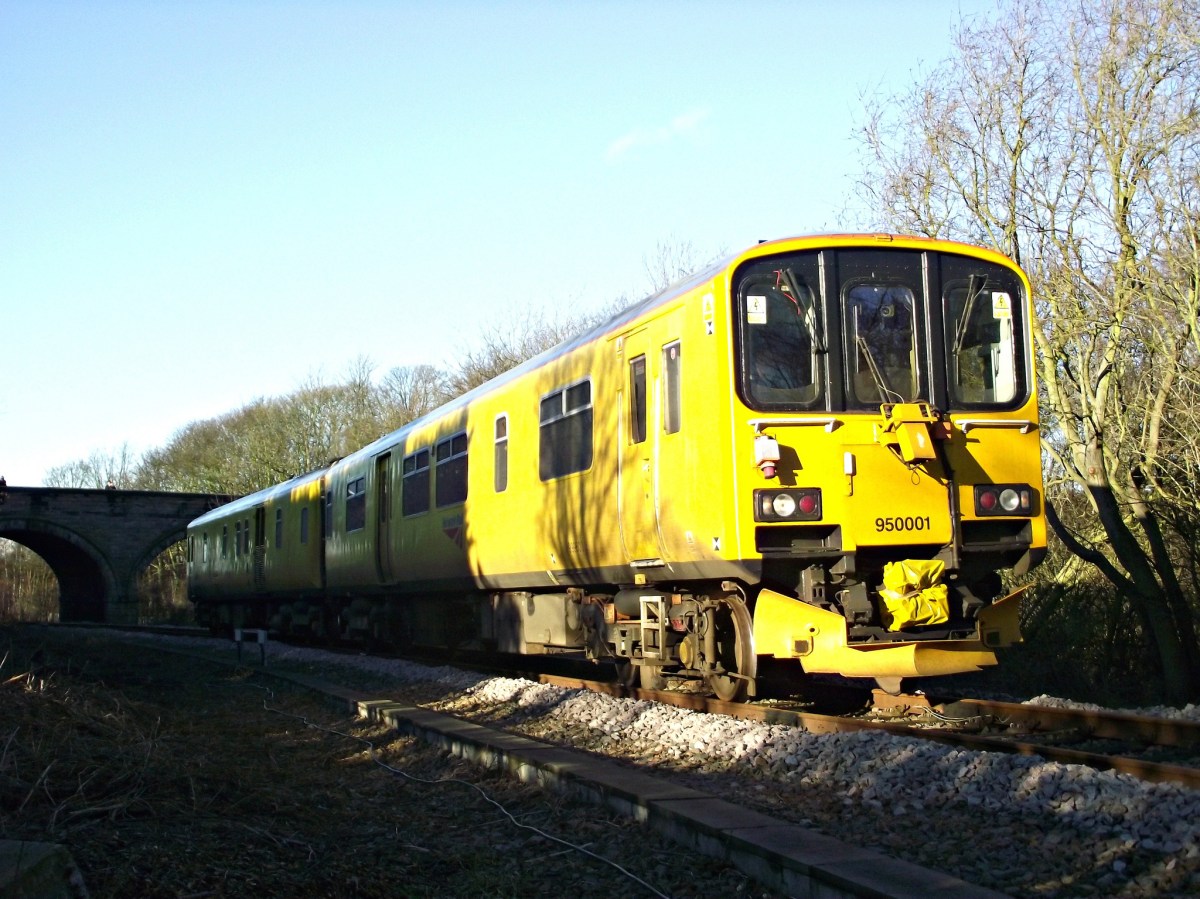
The more seats promise is globally a 37% increase in peak capacity for “31,000 extra customers”. That, we repeat, is by 2019, by which time most of the new trains will be delivered. There will also be lots of units “cascaded” from other train operating companies (TOCs), all of which are to be refurbished to be good as new—which means even better than “partially refurbished” Class 158 train that has been running on our line over recent months, and which Northern admits is work in progress. The cascaded trains will include modern Class 170s from Scotland (promised for the Harrogate and Leeds-Brighouse-Manchester lines) as well as more 30-year old Class 150s. We are excited by the prospect of a “good as new” Class 150.
All the above we knew already. But we do have some simmering worries, to be voiced in more detail in our New Year message to Northern managing director Alex Hynes. In summary.
Worry One. We need more capacity now!
A 37% increase for 31000 “extra” passengers in three years time sounds great unless you are one of thousands of existing Calder Valley Line commuters who, right now, daily endure trains that seem more like 100% overcrowded. People who depend on the train to access employment pay the highest fares to travel on peak-hour trains, but often seem to get the worst service, as they find themselves packed like canned sardines in trains so full that sometimes passengers are left behind.
Northern actually had rolling stock taken off it last summer in a knock-on effect when TransPennine Express lost decent Class 170 trains to Chiltern Railways. One consequence was halving of capacity on two morning Calderdale-Leeds trains. Northern worked with sister Arriva company Grand Central to get a 5-car train running an extra Bradford-Leeds train. That (after some nagging by HADRAG) has now been extended to start at Halifax. We are grateful to Northern for this initiative and their positive response to or suggestion.
But we know, and they know, that a lot more is needed to help with intolerable overcrowding on other trains.
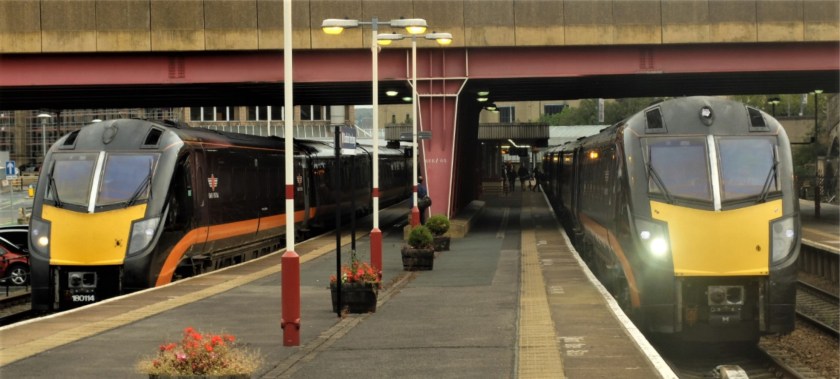
The 0744 Northern service from Bradford to Leeds began last July, operated by a Grand Central intercity train, here seen alongside the 0752 to London. It used to come empty through Halifax causing annoyance to Leeds-bound commuters on the station who couldn’t get on! HADRAG pressed for the new service to serve Calderdale. Arriva Rail North agreed with us but with industry consultations seemingly non-optional for even the simplest, most obviously beneficial changes, it took until December to get the train starting from Halifax at 0728. Northern and Grand Central are both, of course, Arriva-owned companies. Good result! More needed!
Worry Two. Even if we can bear to wait until 2019, how is 37% more capacity going to be enough?
We understand the Arriva Rail North has an option to order more of the new trains —diesels and electrics— that are being built by CAF in Spain.
It is be hoped that when the current order for 281 vehicles is complete, more will be built! …
Worry Three. Delays to the rolling stock cascade affecting planned improvements
Last November, Network Rail issued a media statement announcing that certain improvements to Northern and TPE services scheduled for December 2017 would be “phased”, which of course means “delayed” (though some regional media interpreted the story as good news). We struggled to get clarification on this. It seems projects like the Ordsall Curve —critical to North of England service development— are OK. But late-running infrastructure projects elsewhere, like Great Western Electrification, mean the cascade of rolling stock to Northern could be held up. An email sent out by Northern in the North West suggested December 2017 improvements could be delayed until May’18.
It is not yet clear whether this will affect introduction of the CVL Chester service or Sunday Bradford-Manchester Airport trains, both of which were planned for December 2017.
Worry Four. Refurbishment means pain before gain as trains go out of service for the work to be done. Can’t we draft in more trains to cover?
Northern is still working out what the “good as new” refurbished trains will look like. When the programme is under way, covering everything apart from Pacers (which have to go), it will mean more trains out if service for the work to be done. Which will temporarily reduce capacity even more.
Some have suggested Northern’s rolling stock problems could be addressed by drafting in rakes of locomotives and coaches. Other TOCs have done this and Northern is doing it on the Cumbrian Coast route using old Class 37 diesel locos and rakes of Mk 2 coaches. But that sort of train could not keep up to “sprinter” timings on the CVL, and we hear there have been reliability problems on the Cumbrian Coast. However there may be sets of coaches available if suitable modern traction can be found to pull them. In particular the former “Wessex Electrics”, later Gatwick Express trains of Class 442 are lying idle in want of a new use. Two other Arriva companies have already expressed interest. Alliance Rail wants some for a proposed open access Southampton-London service, whilst Arriva Trains Wales is reportedly proposing to run them with diesel haulage as crowd-busters. There are 24 of these trains, not brand new but decent modern 5-car units that would be much better than a 2-car “150” or Pacer. So how about some for Northern? Modifications would be required; is cost a barrier for a franchise that is otherwise promising so much?
Worry Five. Will innovative rolling stock solutions work?
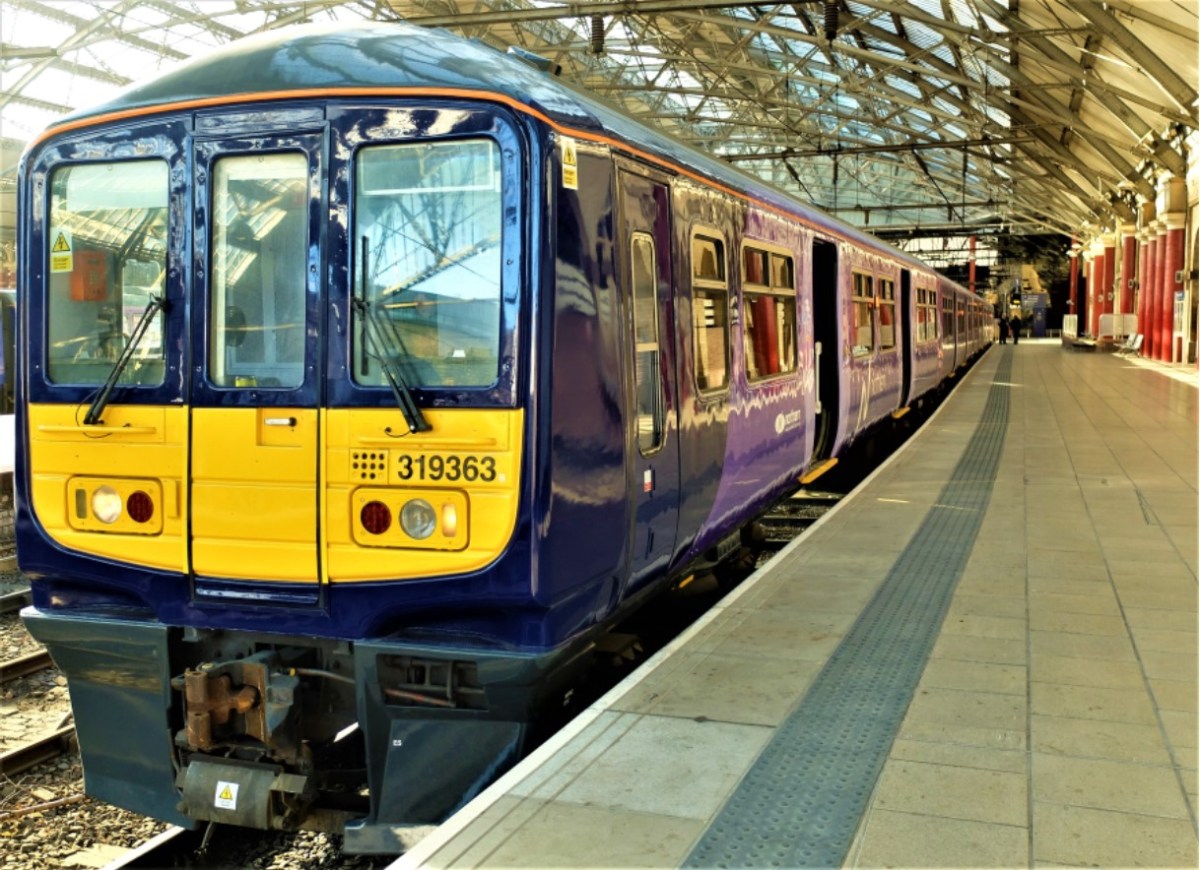
With delays expected to diesel train cascades, rolling stockleasing company Porterbrook announced with Northern and Rail North just before Christmas that it intends to fit some Class 319 electrics with diesel-generator modules and put in service with Northern by Spring next year. Northern has been using pure-electric 319s for a couple of years on newly electrified lines in the North-West. As “bi-modes” they could be used more widely across the North. Like the Vivarail Class 230 “D-train” which uses former London Underground D78 trains, it is thought the “Class 319 Flex” would have automotive diesel alternator modules installed under the carriages. On 30 December one of the power modules on Vivarail’s “230” prototype caught fire whilst on trial near Coventry. Public trials of the “230” are therefore postponed pending an investigation report. Of course the 230 and the 319 Flex are not the same train and we may be worrying unduly. But don’t blame us for being concerned.
Worry Six. Service development. The Northern Connect promise is excellent, but what about our “Cinderella stations”?
This was HADRAG’s big strategic issue for 2016 and we are not giving up. Latest station usage estimates (next page) confirm the increase in Brighouse and Sowerby Bridge passengers over ten years. Sowerby Bridge is earmarked a Northern Connect station (meaning all-day staffing), but it is still not clear whether there will be any significant increase in trains stopping. Brighouse is to get a modest increase in Sunday trains and earlier first trains during the week, but what else we are not sure. We await detailed plans for service stopping patterns 2017- 2019 with great interest.
The Train Service Requirement commits Northern to a 55 minute Bradford-Manchester semi-fast journey time by 2019. We say this could include a Sowerby Bridge stop giving the station an “express” as well as “stoppers”. And we have of course been saying for years that all the York-Blackpools should serve Sowerby Bridge.
We still hope the Brighouse-Manchester trains may be speeded up with a semi-fast pattern.
Beyond 2020, we hope Arriva will commit to the 4 trains/hour Bradford-Manchester that is West Yorkshire Combined Authority’s aspiration, as well as more trains through Brighouse and fast Brighouse-Leeds journeys.
Northern knows we are their supporters, not naturally complainers. We trust them to deliver. We look forward to good news. —JSW
Network Rail’s HADRAG presentation was about projects in the current 2014-19 control period (CP5) and our guests preferred not to be drawn on any more ambitious aspirations that might be considered in the future. There are obvious projects, some that we have called for in the past and that our friends in the UCV Renaissance Sustainable Transport Group included in a list of priorities published a year ago. Much of this is not so much investment in new railways but more about restoring valuable infrastructure short-sightedly taken away over the last few decades, such as:
Loops/four tracking between Hebden Bridge and Mytholmroyd to allow freight trains to be overtaken.
Putting back four tracks in the Huddersfield/Mirfield/Dewsbury area creating capacity for more trains through Brighouse as well as on the Huddersfield line.
Halifax platform 3 as through loop.
The “Crigglestone Curve” linking the lower Calder Valley and Barnsley routes for a service through Brighouse to Sheffield —advocated years ago by HADRAG!
And of course CVL electrification via both Bradford and Brighouse.
Sorry Northern (Arriva Rail North), we support all the good things you are doing and planning to do to improve services, but there’s no polite way to say this. Your new line timetable booklets are a dismally poor substitute for the excellent former Metro booklets. As expected, the train operating company has taken over publication from West Yorkshire Combined authority. There seems little point WYCA expending resources on duplicating a role given to the TOCs. Sadly, however, whilst WYCA/Metro’s single Calder Valley Line booklet showed all trains running on our line between Leeds and Blackpool/Manchester plus the Brighouse line, that information is now spread across three or four separate publications. Booklet 8 shows York-Blackpool services only. Booklet 36 shows Leeds-Todmorden-Manchester services.
New Booklet 45 shows all Northern services Leeds-Huddersfield and Hebden Bridge including Brighouse trains. This is a sensible idea. But there are no times shown for stations outside that area, through trains to York, Blackpool and Manchester being indicated only by footnotes with no indication of journey time or intermediate stops such as Rochdale or Blackburn. It’s good to see that Grand Central services are shown. But TPExpress trains on the Huddersfield Line are left out which means there is no timetable booklet showing the complete train service between Leeds and Huddersfield. Surely ridiculous. It’s doubly strange because we were told TPE and Northern would be cooperating, and because Northern’s Wakefield Line booklet (42) also shows East Coast and Cross Country trains. We’d actually like timetables that show all trains on a given route. A separate mini-timetable (44) shows Blackburn-Man Vic “Tod Curve” trains—one of three separate booklets needed to find all trains between the Lancashire towns of Accrington and Blackburn! The new format also means full-line posters are no longer displayed on West Yorkshire stations. And at the start of the new timetable Halifax station had only been supplied with local line booklets, not other WY routes. “MetroTrain” timetables served the county’s rail users well for over 40 years and were also available as an all-county book. What we have now is a confusing mess. We hope it can be sorted out for the May timetable change. It’s in our New Year message to Northern!
Network Rail managers joined members and friends of Halifax & District Rail Action Group at our December open committee meeting at Halifax Town Hall. Vanessa Conway (project sponsor) and Salim Patel (project manager) presented on the Calder Valley Route upgrade, the project that will enable higher line speeds and increased capacity between Bradford and Manchester. Completion is due by Autumn 2018.
Funded by farepayers, taxpayers and property income, and with 35,000 of its own staff, Network Rail is the effectively nationalised agency that owns and operates Britain’s rail infrastructure — maintaining, renewing, replacing and enhancing. Regulated by ORR, the Office of Rail & Road, it also coordinates and manages the railway timetable between different passenger and freight operators.
Britain’s rail infrastructure comprises 20,000miles of track, 32,000 bridges and tunnels and 8200 commercial properties, along with 2500 stations the operation of which is largely devolved to train operators. Passenger demand nationally grew by 100% over the last 20 years and is expected to double again by 2041 alongside freight growth of 90%. In the North, rail investment is seen as part wider transformation under the Transport for the North banner. Long term, this means “Northern Powerhouse Rail” and a new line across the pennines, but in the meantime smaller schemes like the Calder Valley Line enhancements, radiating from the Manchester-centred “Northern Hub” are essential to get more trains carrying more passengers at higher speed.
West Complete, East Ongoing
The Calder Valley upgrade falls into several parts. Journey time interventions (JTI) involve upgrading track for higher speed at various points between Manchester and Bradford. The boundary between Network Rail “LNE” and “LNW” so-called “routes” – the old regional boundary west of Hebden Bridge is an administrative dividing line. The “West” project ending at Todmorden has been completed over the last year and includes a new west-facing bay platform, now operational, at Rochdale station as well as higher speed limits which are now in place. The Rochdale “turnback” platform will allow trains from the west terminating at Rochdale to layover in the station clear of the main lines increasing capacity and reducing delays for through CVL services. North-west trains that currently terminate at Manchester Victoria station will increasingly come through to Rochdale and to Stalybridge in turn releasing platform capacity at “Vic”. And of course by the end of 2019 most Calder Valley Manchester trains will be running through to/from Chester, Liverpool, Southport or Manchester Airport.
Work has also now started on the “East” interventions from Hebden Bridge to Bradford. HADRAG is seeking further clarification on certain details for example precise linespeed improvements. We understand however that the aim is, by the end of 2018, to increase general line maxima from 60mph (Hebden-Halifax) and 55mph (Halifax-Bradford) to at least the “70” that already rules on the West section. Intermediate speed restrictions, for example at Milner Royd Junction seem likely to remain for the time being though there seems to be a possibility Milner Royd could be remodelled in a future project. It does seem, however that the 30mph restricted approach to Halifax from Shaw Lodge will be improved as part of the current scheme. Works to be carried out include, at various points, track lowering or slewing to improve alignment, work in tunnels, new track and re-railing. “Route hardening” will improve the quality and resilience of track and signals.
Network Rail’s presentation also included the new station at Low Moor (by May’17), and access-for-all works at Hebden Bridge with new lifts and platform level access (by end of 2018).
Signalling and Capacity
Huddersfield to Bradford resignalling is a slight misnomer because in order to deliver Manchester-Bradford capacity improvements the work must extend to Hebden Bridge. Traditional signalboxes at Hebden Bridge, Milner Royd, Halifax and Bradford Mill Lane will become redundant with control transferred to the rail operating centre (ROC) at York. Work starts this March and is in two stages, both to be completed by October 2018. Stage 1 is to bring existing signals around Huddersfield and as far west as Greetland Junction under York ROC. Stage 2 is enhanced signalling of the CVL section from Hebden Bridge through Halifax to Bradford. When this is complete trains will be able to operate at 4 minute headways all the way from Manchester to Bradford. This does not, of course, mean 15 trains an hour! What it does mean is more signals between Hebden Bridge and Sowerby Bridge, and between Halifax and Bradford, reducing delays caused by existing long sections and allowing a significant increase in frequency without compromising punctuality. Currently, for example, a train can not proceed from Halifax to Bradford until the one in front has passed a signal nearly 4 miles ahead at Wyke; the enhancements deal with this.
Linked with the resignalling are two additional crossover tracks to be installed at Bradford to allow up to three simultaneous parallel movements in/out of the Interchange station where, famously, all trains reverse in order to continue their journey.
“East” linespeeds will be raised when the new signalling is ready. All should be done by 20 October 2018. Journey time “fast” Bradford-Manchaester with four intermediate stops should come down from current 58-61 minutes to 53-54 minutes, probably at the end of 2018. This may not seem spectacular and is a bit less ambitious than everyone originally hoped but it is a marketable improvement. The journey time estimate is based on current (Class 158) trains; there’s hope the new CAF trains (Class 195) ordered by Arriva may perform better. More important perhaps are the capacity improvements that will lead to more frequent services, starting with Northern’s commitment under the Arriva franchise to an extra Bradford-Manchester train every daytime hour through to the Airport 7 days a week by the end of 2019. We hope more will follow.
The HADRAG meeting with Network Rail, a public body sometimes criticised for being less than public-facing, was at their initiative.
We are grateful to Network Rail for that, and look forward to developing the relationship in the future.
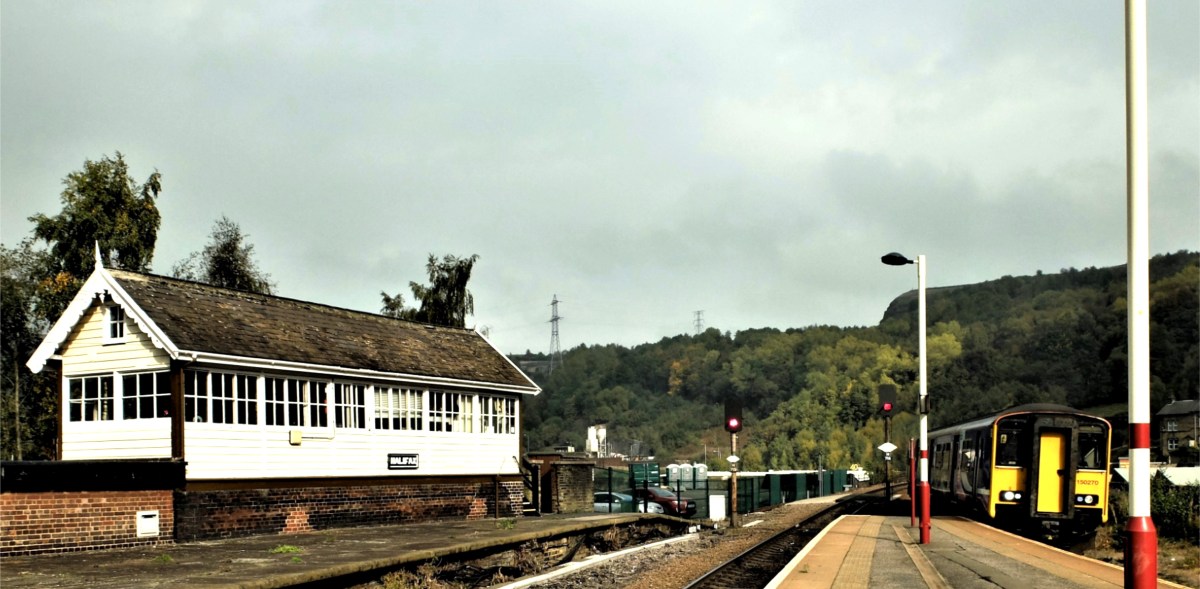
History in the making? The scene looking north-east(-ish) from Halifax station hints tantalisingly at the future. Observant Leeds-bound passengers know that if the signal at the end of the platform shows a yellow (never amber on the railway!), they’ll be crawling to a halt at a red just this side of Beacon Hill Tunnel. A preceding train has to pass the signal nearly 4 miles away at Wyke before the next can go. Network Rail’s resignalling scheme over the next 18 months aims to sort the problem, allowing trains at closer headways all the way from Manchester to Bradford, meaning higher frequencies as well as speeds and—hopefully—better punctuality. It will also make the historic signalbox standing on the former platform redundant as control of the signals is transferred to York. What new use will the old “box” find? The train on the left, a grim old Class 150 unit arriving at Platform 1 for Manchester Victoria, is also going to change and before 2020 will more likely be one of Northern’s brand-new trains now being built by CAF in Spain. The “150” itself, years of life remaining, is promised good-as-new refurbishment. Truly tantalising is the vacant track bed next to the Platform 2 line, with much interest locally in the idea of bringing Platform 3 back into use. Wider development promises to create a transformed gateway between station and town. A third platform would spread the crowds and allow more flexible operation, though we may still have a job on to persuade the railway of its necessity.
History could have been different. Back in the 1980s Halifax & District Rail Action Group started up against a background of shady proposals by British Rail to reduce the line from Sowerby Bridge to Bradford to single track. Ambitions in West Yorkshire put a stop to that idea so that after 30 years of improvement that relied on cut-back infrastructure, we now have a railway that’s not too hard to upgrade, hopefully overcoming current worries to transform services by three years from now.
So, settling in to 2017, we wish HADRAG members and friends, passengers actual and would-be,happy travelling in the future! – JSW
The new Northern franchise is indeed transformational. But we aren’t the only ones saying even more is needed to meet potential travel needs. West Yorkshire Combined Authority oversees the Metro brand in the county. At a recent transport committee meeting, a report from officials highlighted gaps and areas for improvement, some of them close to HADRAG’s heart. “Adjustments” and smaller changes for discussion with Northern include:
Moving to 2 trains/hr at Low Moor
Sunday trains Leeds-Dewsbury-Brighouse-Manchester (one of two routes in the city region without a Sunday service);
Earlier Sunday trains Hebden Bridge/Brighouse to Leeds.
Possibility of starting the Bradford-Manchester Airport service before 2019 (it is actually to start 2017 on Sundays)…
And classed as “enhancements”:
WYCA goal of 4 trains/hour between Bradford and Manchester…
…with restoration of link between local stations like Walsden and Bradford. We could support that!
A separate report sets out a rail narrative for West Yorkshire. Elland tops the list of new stations listing benefits of connectivity, modal shift, network access and park & ride.







 Halifax and District Rail Action Group