
TRU Works: Raw Deal for the Brighouse Line

On the Calder Valley line, Brighouse had fastest passenger growth, percentage-wise, for more than 10years before the pandemic. It’s a station with massive potential, but services are now being disrupted for work on the TransPennine Route Upgrade (TRU). The present timetable, June to December, has several dates when services change. When TRU work is happening at Huddersfield, Brighouse is used as a railhead and there are bus replacements for Northern Huddersfield-Halifax trains, plus shuttles Brighouse-Hud for TPE passengers. It is good to see lots of intercity passengers using Brighouse station, but they do not always have an easy time (more on that later).

When the direct line through Dewsbury to Leeds is being worked on, Northern’s Wigan-Manchester- Brighouse-Leeds trains are diverted via Halifax and Bradford, with a bus link Halifax, Brighouse and intermediate stations to Leeds. Leeds-Brighouse takes 65 to 75 minutes on the replacement bus, compared with 35 min on the train. Passengers from upper Calderdale and beyond to Brighouse, Mirfield, Dewsbury etc have to change at Halifax, again with significant journey time penalty. We thought it would be better to divert the Brighouse “valley bottom” service via Wakefield. This would maintain a service for Brighouse and Mirfield.

So we raised it with Northern and TPE contacts and received a prompt reply. The situation is “quite complex”, with both paths (fitting trains in) and platforms at Leeds. Capacity is reduced by freight paths as well as diversions of TPE trains. (We could interpret this as meaning TPE expresses have the advantage over Northern stoppers.) HADRAG may not be quite ready to give up on this. We support the work being done on the TP upgrade. But this work will go on for some time, and it seems wrong that Brighouse passengers are being penalised.

Our email also mentioned the confusing situation with replacement bus stops. The buses stop outside the Brighouse station car park. There are some small, not terribly prominent arrow signs supposedly directing people to the buses. Unfortunately the ones from the westbound platform send you up the steps (though the ramps could also be used) and the along to Huddersfield Rd where there is a bus stop but for service buses, not the rail replacements. People have missed the onward transport because of this. Staff posted on the station do a good job helping people. We gather whenever the bus is due staff go up to collect passengers from the wrong bus stop and bring them to the right one. Could you make this up?

There have been problems with vandalism of the arrow signs, which are fixed to lamp posts using that ultra- modern fixing, the cable tie. Northern/TPE are “considering more permanent signage”.

Finally we mentioned the West Yorkshire Combined Authority rail strategy and the need for progress to deliver a better service for Brighouse – and indeed Elland. How does this fit in with plans post-TRU? What about capacity of the 2-track Dewsbury route, with potential of a fast (limited stop) journey of 20 minutes Brighouse-Leeds? The answer was that Northern and TPE are working with “partners in WYCA, the TRU programme and wider industry to understand what can be delivered in terms of future service patterns”, with a reference to “lots of moving parts”.

Trans Pennine on the up, we hope

TransPennine Express brought in temporary service cuts in the 2023-4 timetable in an effort to improve performance. Early signs are that the tactic is working. Crew training issues have been eased with withdrawal of loco-hauled push-pull sets. Four trains/day run Manchester-Huddersfield-Wakefield-York, hopefully to become hourly in December. But for now the off-peak Leeds-Huddersfield service is just three trains per hour. Makes our line look good! TransPennine Route Upgade work affects our line of course. Swings and roundabouts. Brighouse is disrupted, but does see calls by diverted TPE services that avoid Huddersfield.

Diversions

Fine sunshine. Let’s have a Sunday out by train! But, first Sunday in June engineering work meant your train from Halifax was probably a bus. Halifax to Leeds took an hour to an hour and a half. Brighouse-Leeds was actually better than usual with Blackpool and Chester trains stopping – though some sources showed these stops as “unadvertised”. This gave a journey time of a little over 20 minutes. (Brighouse-Leeds by replacement bus via Halifax would take you nearly 2 hours.)

It is not clear why the whole Bradford-Huddersfield service had to replaced by buses. Could not trains have run from Halifax via Brighouse to Leeds? One did first thing in the morning. It took 29 minutes to Leeds including a stop (bizarrely shown on Real Time Trains as “unadvertised”) at Brighouse. Not bad!

We realise things may not that easy, but with lots more diversions ahead as work on the Transpennine Upgrade proceeds the companies need to make sure our line gets a fair deal.


Header Image: “The Lord’s Arrival” flickr photo by JohnTurner1955 https://flickr.com/photos/johngreyturner/49060701926 shared under a Creative Commons (BY-NC-ND) license

Valley Loop: Don’t get your hopes up!

WORK on the TransPennine Route Upgrade (TRU), whenever it starts, is going to affect services on the Calder Valley Line. To ease matters, Network Rail plans a loop, westbound, between Mytholmroyd and Hebden Bridge. The expectation is this will be a static loop, meaning trains will stop in the loop so TransPennine Express trains can overtake. We understand the CV services affected will be the hourly Leeds-Brighouse-Wigan stopper, but the procedure should allow diversion of 3/hr York-Leeds-Manchester fasts via Brighouse and Rochdale. Brighouse  It is not clear when this will start or how lengthy or  regular the diversions will be.

The loop will be east of and separate from the existing Hebden Bridge siding, which will be shortened. We understand the plan is for the new loop to be long enough to accommodate a train of length 163m, which is enough for 2×3-car “158” or “195” units. So let’s not raise our hopes that this will provide extra long-term capacity for lengthy freights to be overtaken by CV trains.

Our info is from the Branch Line Society’s newsletter (BLN1385) last September, so may need updating. “Calls [by the diverted TPEs] at Brighouse or Elland would probably adversely affect performance but this has yet to be determined.” We can only add for now that major remodelling of platforms and new tracks through Huddersfield station seems likely to mean, let’s just say, considerable periods of diversions. Brighouse or better still the new station at Elland could be a good alternative for Huddersfield passengers.

Loop for TransPennine Route Upgrade Work

Assuming it’s going ahead, TransPennine route (aka Huddersfield line) upgrade will mean services being diverted via the Calder Valley whilst various parts of the Huddersfield route are blocked. Apart from 4- tracking Huddersfield-Dewsbury there is major track and platform remodelling, and of course electrification (we hope). You may know more by the time this newsletter reaches you and we’ll update in our next issues.

We do know that a westbound loop is being planned between Mytholmroyd and Hebden Bridge allowing diverted fast TPE services to overtake Calder Valley “locals” during TRU works. So some of our trains will be slower whenever the diversions are taking place. No pain no gain. What we don’t know yet is whether the loop will be long enough to shift freights out of the way of our passenger trains. It would seem short sight-sighted for it not to be.

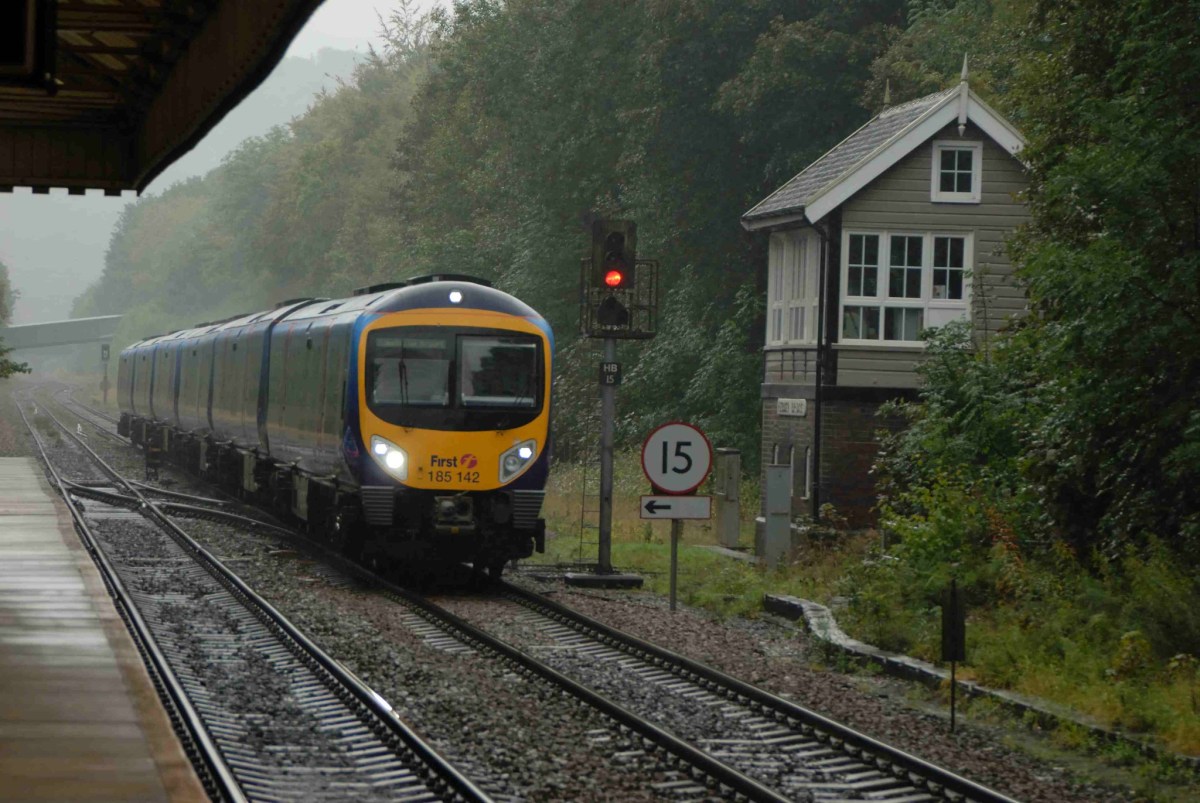
Header Image: “185142+120 Diverted TPE Liverpool Service At Hebden Bridge” flickr photo by RyanTaylor1986 https://flickr.com/photos/ryantaylorphotography/6084429293 shared under a Creative Commons (BY-NC-ND) license

No regrets and a quick win for TRU and Calder Valley?

Network Rail is about to submit a list of “no regret” schemes to accelerate electrification to the government, ahead of the DfT’s Transport Decarbonisation Plan (expected in March 2021).

Quoted in New Civil Engineer (17 Dec 2020) Andrew Haines, chief executive of Network Rail, said the no regret list aimed “to present a series of quick wins that can be worked on as soon as government gives the go ahead.” Haines said many schemes had good business cases “even after Covid”, and that “we have to bust a gut” to prove that to the Treasury. Haines adds that he will “fight anyone to the death” over a suggestion of doing nothing for the next two or three years. He described the Huddersfield line Transpennine Route Upgrade (TRU) as “waiting to go”.

What about the Calder Valley then? We wrote to Mr Haines and two of his regional managing directors just before Christmas. (An immediate acknowledgement promised a detailed reply early in January.) Picking items firstly for which planning might be somewhat advanced, we said:

May we therefore express the wish that your list of schemes about to go to the DfT will include:

– Completion of Midland Main Line electrification at least to Sheffield, plus full electrification in the TransPennine Route Upgrade (Manchester-Huddersfield-York). Within the latter, Church Fenton to Leeds (Neville Hill) would be a quick-win extension of already planned Colton Jn-Church Fenton.

– Top priorities of the March 2015 Northern Electrification Task Force report (Northern Sparks). The top-ranked (as we understand it on business, economic and environmental criteria) Northern Sparks recommendation was of course the Calder Valley line – Leeds via Brighouse and via Bradford to Rochdale and Manchester and to East Lancs and Preston. A start on this linked to TRU electrification would surely be logical.

This is a call, therefore, for you to press the government to make a start on schemes – such as the Calder Valley and Huddersfield lines -that seemed to be promised several years ago. We note that the recent National Infrastructure Commission report, though mainly about priorities for new high-speed lines and regional enhancements, also recommends a rolling programme of electrification.

We are not suggesting that Calder Valley electrification is ready to go in the same sense as the Transpennine upgrade (first announced as a full electrification scheme nearly a decade ago) or Midland Main Line (cancelled north of Bedford in 2017). But we would argue that planning needs to start for our line, almost six years since it was prioritised by the Northern Sparks report. Could early stages start alongside TRU, extending up the valley from Mirfield towards Hebden Bridge and beyond? And could North West wiring at Manchester Victoria be quickly extended not only to Stalybridge – where work actually started several years ago – but to Rochdale or Littleborough? Interim train operation might require bimodes – maybe batteries rather than diesels? Leeds-Bradford-Halifax will be challenging, but achievable with the latest engineering and the skills retention of a rolling programme. It is surely time we had a plan for full wiring.

TDNS, Calder Valley, and across North

The TDNS business plan sets out recommendations for just about all unelectrified lines. Some routes have “multiple options”. All of the Northern Sparks “full” Calder Valley route is recommended for electrification, via both Bradford and Brighouse through Rochdale to Manchester, and through East Lancs to Preston. There is a multiple option in East Lancs, but electrification is recommended: “Regional passenger service between Colne and Blackburn could operate as battery…” but “electrification would provide completed eastwest link towards Halifax and Leeds”. (We’d add: a reopened Colne-Skipton line would link with the electric Airedale route.) Electrification is recommended for Bolton-Hellifield and Skipton-Lancaster/Carlisle.

Freight is a strong factor favouring electric trains.

Harrogate-York could be battery, with electrification Leeds-Harrogate. Where’s the hydrogen then? Maybe on the Yorkshire coast through Bridlington (but could be battery with full wiring Hull-Beverley). Maybe Middlesbrough-Saltburn. But even in the Tees “hydrogen hub”, first choice long-term seems to be electric. Battery trains to Bishop Auckland and Whitby could charge under the wires Darlington-Middlesbrough. Technology should double battery storage capacity by 2035. Hydrogen could be just an interim solution on some lines.

Electrification pays for itself

So the argument for electrification is won. We think maybe the DfT gets it. But we have to convince the Treasury. A rolling programme potentially halves wiring costs. Long term, electric trains are cheaper to buy, less complex and cheaper to run. Electricity in overhead wires will be cheaper than any kind of hydrogen. A holistic economic view would show electrification paying for itself. Northern Sparks must be brought to life! – JSW

Sources include: Traction Decarbonisation Network Strategy – Interim Programme Business Case (networkrail.co.uk) and Traction Decarbonisation Network Strategy – Executive Summary (networkrail.co.uk) http://www.railengineer.co.uk

Network Rail draws up list of ‘no regret’ electrification schemes – New Civil Engineer

More at electriccharter.wordress.com


Featured Image: “Northern Electrics branding” flickr photo by hugh llewelyn https://flickr.com/photos/camperdown/20658157925 shared under a Creative Commons (BY-SA) license

Elland On Track – We Hope

As the pandemic goes from wave to wave, we can be certain of nothing. But we understand Elland station is still planned to open “on time” (debatable concept) before 2023. There is an obvious interface with “TRU”, that long-awaited (not as long as Elland) Trans-Pennine (Huddersfield) route upgrade. So when the Huddersfield line is “under possession” for track remodelling or electrification TP Expresses will be diverted, and at times this will mean using the Brighouse and Elland route. The worry was that with TRU works due to start, who knows quite when, this could mean Elland being delayed. So we added this to a list of concerns in a HADRAG letter to Grant Shapps in September. The reply from a Department for Transport official (two months later) said West Yorkshire Combined Authority intends to seek an approval in principle for production of an outline design (outline?) early in 2021, and that WYCA would be expected to work closely with Network Rail, DfT and train operators on coordination with other schemes including TRU, and develop a timescale. Opening “by December 2022” was still the expectation. “Elland first” is surely sensible. We pointed out that when Huddersfield station is out of use during works on the big project, Elland – right next to the A629 – could be an ideal alternative railhead for Huddersfield passengers. The DfT did not respond to that, but more local contacts suggest the idea is under consideration.

Elland station will not only serve commuters (however many of them there are in the post-Covid future), but with a package of active travel links will be ideal for the local community and visitors seeking leisure on foot or cycle in our beautiful valley. This, surely, is just what we need to rebuild and repurpose our railway.