Calder Valley and Halifax rail: time to plan upgrades!

1. Fully electric train operation is the most energy efficient means of operating railways

…a key objective in a world that must strive to eliminate greenhouse gas emissions, notably CO2. Compared with diesel or bi/tri-mode trains pure electric trains are

  • simple, cheaper to build; reliable, cheaper to maintain; by 66%
  • lightweight giving faster acceleration and ability to serve more stops and carry more passengers;
  • more capable of using regenerative braking returning energy to the supply system.

Electrification is capital investment. Future payback will come through a railway that is less costly to operate, attracting more passengers, stimulating employment – and zero-carbon.

We welcome the recent West Yorkshire Combined Authority rail strategy. It is pleasing to see WYCA sticking to its guns and advocating electrification including the full Calder Valley. This and the government-proposed Leeds- Bradford electrification must seen as one scheme. The Calder Valley routes do require full electrification. Hybrid trains with multiple traction systems are heavier, waste more energy, and are potentially less reliable. By full we mean the whole route through Bradford and Brighouse to upper Calderdale. Manchester, Preston and beyond.

The full Calder Valley line was of course the top-ranked scheme in the cross-party task force Northern Sparks report 9 years ago EFT Report FINAL web.odf (transportforthenorth.com). Since then we have seen numerous other reports calling for electrification of most routes. Following Northern Sparks, campaigning groups along the Calder Valley lines launched the Electric Railway Charter. We are pleased that Calderdale Council has now twice passed resolutions calling for rail electrification. A rolling programme of electrification will reduce costs, and make the investment pay, by building up and carrying forward engineering expertise. No more stop-start.

2. Calder Valley line services – York/Hull and Leeds to Halifax/Brighouse, upper Calderdale, Manchester, Chester and Lancashire, plus Bradford-Huddersfield are due an upgrade: capacity, service, and speed.

Service improvements can be made with existing infrastructure, but we welcome proposals in the WYCA strategy for additional tracks that would allow passenger trains to overtake slower freights. Upgrades need to be made before electrification work starts. Meantime, we look for:

  • improved pattern; trains better coordinated between different services on the line;
  • new services so Calderdale can, for example, get across Manchester to access jobs, leisure destinations and connections. A service to Manchester Airport originally, promised for 2018 now, seems to be some years from delivery. This would build on existing Chester service.
  • all trains to call Sowerby Bridge – station with second fastest percentage passenger growth in Calderdale pre-pandemic, based on Office of Road and Rail (ORR) figures over a decade;
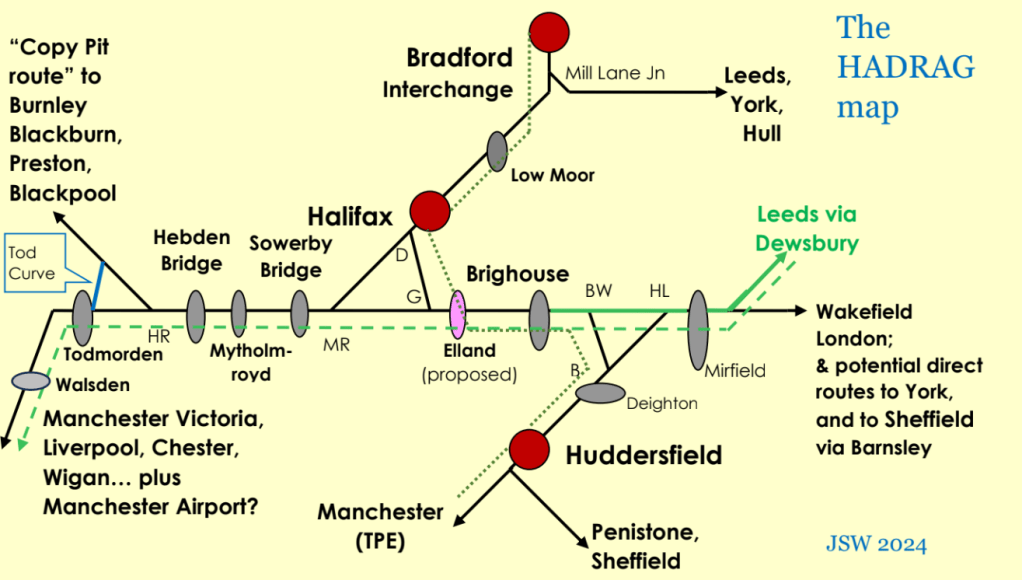
  • better service on Brighouse line – doubling frequency, faster trains direct to Leeds as suggested in WYCA rail strategy. Brighouse had fastest passenger percentage growth of… all Calder Valley line stations pre-pandemic. We also need better services N-S, Bradford-Huddersfield or Sheffield. HADRAG supports the list of possible reopening schemes mentioned on p68-9 of WYCA rail strategy – including the Crigglestone link for direct trains Bradford and Calderdale to Sheffield with attractive journey times.
  • Elland station – how can we get this started? Originally proposed 25 years ago!
  • new trains designed for passenger comfort – let’s think about access for disabled people, families, adequate toilets, view out of window, and of course provision for bikes.

3. Bradford issues

Many of us support the idea of a new through station in Bradford that would eliminate the need for trains to reverse. It would increase capacity, and cut journey times Calderdale-Leeds. For example Halifax- Leeds could come down from around 35 minutes now to 25 minutes or less. There is concern about the proposed new Bradford station site:

St James’ market has been suggested but is remote from the city centre. We ask whether:

  • other more convenient sites are being considered; and whether
  • account has been taken of effect on journey times for Calderdale-Bradford passengers.

We hope mass transit (see below) will provide a good, frequent link across the city centre reaching Forster Square at least, and open at same time as the new heavy-rail station.

4. Bradford and “Network North”.

The 30 minute Bradford-Manchester journey time suggested for a route swinging round via Huddersfield seems optimistic, dependent on capacity west of Huddersfield, and potentially locally disruptive to build, with no visible local benefit for Calderdale communities. We can see people in Bailiff Bridge and Brighouse objecting to one suggested route. So: ⦁ Would it not be better to upgrade the Calder Valley, line? With modest linespeed and capacity improvements, and electrification, Bradford-Manchester journey time would be reduced to little more than 40 minutes, perhaps less, including two stops (Halifax and Rochdale). Semi-fast services would operate between the fasts serving all stations Bradford to Todmorden. Benefits in our lifetime for Bradford and Calderdale. ⦁ A later phase might include a new high speed route, in tunnel Halifax-Littleborough, reducing the timing to about 30 minutes again with 2 stops. This is more fanciful but not impossible.

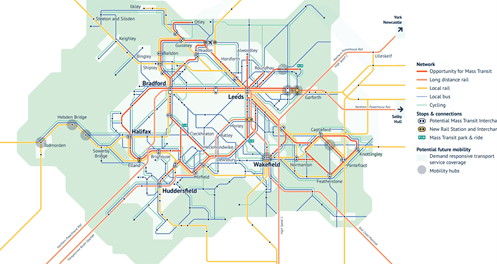
5. On mass transit we look forward to proposals about to emerge, and the upcoming consultation on initial routes. But it may be a decade before mass transit reaches Calderdale.

So: Mass transit must not be seen as a substitute for improving the heavy-rail Calder Valley line service including its branches through Elland and Brighouse, and the York-Blackpool trains. Mass transit does not mean fast transit.

Achievable heavy rail improvements can be delivered much more quickly, benefitting existing and would- be passengers. In our lifetime!

6. A major question is how any of the above is to be funded.

Rail development must be seen as investment in the interests of a green economy. It must be seen as affordable.

As concerned local campaigners HADRAG members would be happy to meet elected representatives or officers of the combined/local authorities either in public and/or in a small-group meeting. After the election, of course. Massive thanks to you for reading this. Map overleaf may be helpful. Looking forward to any response you are able to give or any questions you may have, with best wishes, Stephen

What’s in it for us?

WYCA agrees rail strategy

In line with our Electric Railway Charter!

It is good to record that West Yorkshire Combined Authority (WYCA) is sticking to its guns on electrification. The Metro rail strategy was formally agreed at WYCA’s full meeting in March, and includes as top-ranked (Tier 1) schemes:

  • The Calder Valley line extending the government’s Leeds-Bradford proposal to Calderdale, Preston and Manchester. The routes through Elland and Brighouse linking with Huddersfield routes are also included. York-Blackpool, Leeds-Manchester (and maybe on to Chester) could be electric all the way, as could trains via Brighouse. The Calder Valley network is noted as one of the busiest routes in the region. Full electrification would release a lot of diesel vehicles, and maximise the benefits of the Leeds-Bradford scheme – make sense of it in fact. We say track upgrades could be carried out along with – or preferably before – electrification.
  • The Harrogate line, already linked with electrified Airedale and Wharfedale routes, enabling large numbers of diesel trains to be removed. Electrification through to York would also link up with the electrified East Coast Main Line.
  • The Dearne Valley line linking Wakefield Westgate with soon to be electrified Sheffield-London, enabling service improvements on potentially fastest Leeds-Sheffield route.

Tier 2 includes the lines through Castleford and Wakefield to Knottingley (onwards to Goole), and Sheffield via Barnsley – where Northern currently routes its twice hourly fast (or fastish) trains from Leeds to Sheffield. Tier 3 would fill in gaps such as the Penistone line and Ravensthorpe-Wakefield.

The assumption is that the TransPennine Route Upgrade will electrify from Stalybridge through Huddersfield and Leeds to Church Fenton1, effectively completing wiring from Manchester Airport and Liverpool to York. Also assumed is that already announced schemes not only for Leeds-Bradford (the New Pudsey route) but also for Leeds-Hull will be there. Leeds-Hull is a government Network North proposal, as is Leeds-Sheffield (which latter we assume means the Dearne Valley route).

Rolling programme. But one project for our line!

The document gives equal ranking to Harrogate, Calder Valley and Dearne Valley routes. But Harrogate is always mentioned first, maybe just because it is less complex. Some of us would like to see our line at the top, as it was in Northern Sparks, the task force report that will celebrate its tenth anniversary next year. Then again, the Harrogate line is much simpler; could it even start before the Huddersfield main line is finished? Either way, the plan for full electrification is in line with our Electric Railway Charter, launched six years ago in Halifax (Electric Railway Charter). The Charter website lists several other reports that advocate, in one form or another, rolling electrification. The Calder Valley is always there.

It is vitally important the Calder Valley is seen as one project with Leeds-Bradford. Almost all trains from Leeds to Bradford Interchange continue to Calderdale and beyond. It would seem ludicrous to have to change traction from electric to batteries (or hydrogen) at Bradford. Bi-mode, even tri-mode trains might seem sexy to some engineers, but with two or more traction systems on board there is a lot of extra mass, more things to go wrong, less reliability and lower energy efficiency than pure electric. The Calder Valley also carries heavy freight trains for which the only sensible decarbonisation plan is full electrification. The strategy says batteries or hydrogen could be valuable as interim solutions on some lines including use of hybrid trains. But “the limited range and performance of such trains is likely to suit only low density, low traffic, low speed and shorter distance passenger routes,” says the strategy. As electric car drivers know, batteries are heavy2. And hydrogen, though the lightest gas, takes up a large volume.

Service frequencies need improving

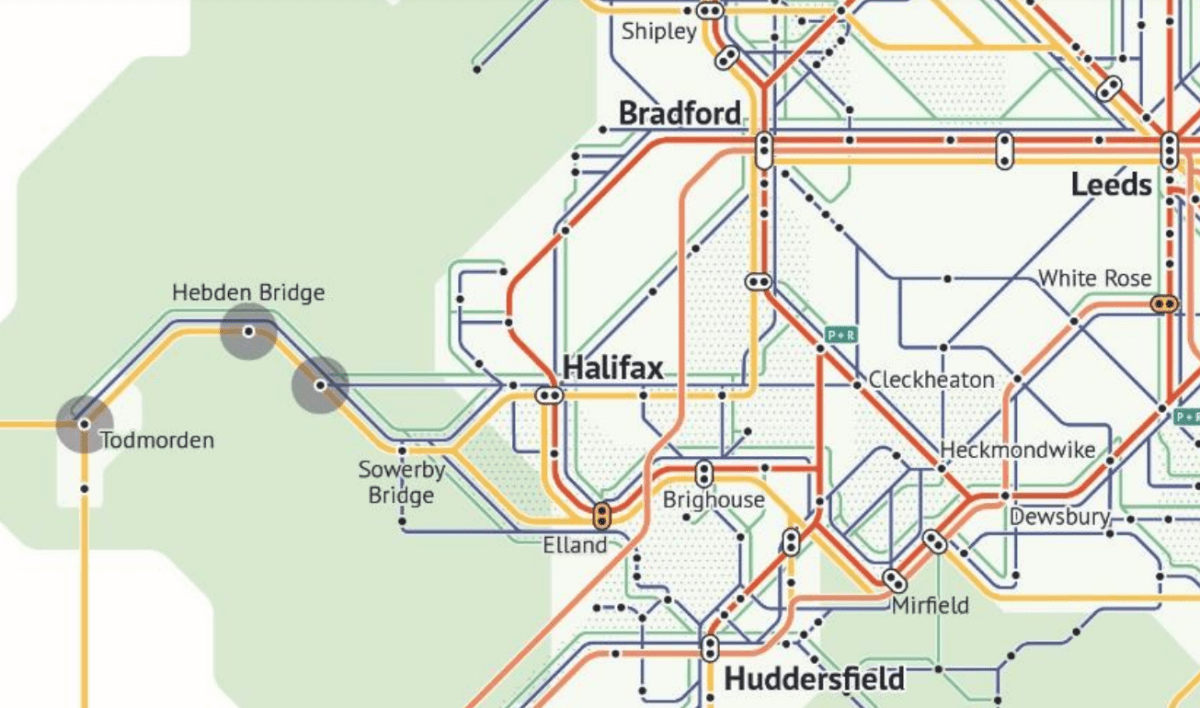
Our line – including the route from Brighouse to Leeds via Batley – is shown by one of the maps in the strategy as having nine stations where service frequency needs improving. HADRAG agrees. We shall keep on pressing for all trains passing through Sowerby Bridge stop there (at present just 2/hr compared with Hebden Bridge’s 4/hr). Halifax and Bradford Interchange (currently 5/hr) are both shown as needing improvement. Walsden’s present 1 train/hr is marked “not acceptable”.

Brighouse’s twice hourly pattern is also shown needing an upgrade. We have pointed out that the nominal 2 trains/hr at Brighouse is effectively only a single train on each of the two routes E-W (Wigan-Leeds) and N-S (Bradford-Hud). Two an hour – at least! – is needed on all arms. And we say they should connect, to give reliable upper Calderdale-

Huddersfield connectivity (if not through trains). Brighouse-Leeds is proposed to be semi-fast, just one or two stops. We say target journey time should be 20 minutes. Elland-Leeds would be about 23 minutes. At half-hourly that would be a very attractive service.

There is little if any more on suggested new routes including the “Crigglestone curve” one linking the Calder Valley line south of Dewsbury with Barnsley and Sheffield. We think a Bradford-Halifax-Sheffield service could offer some attractive journey times, our headline being Brighouse-Sheffield in 55 minutes, maybe less. Spen Valley reopening through Cleckheaton could be a later phase, cutting off the corner to give a direct inter-city link.

Bradford-Huddersfield is described as part of strategic evidence for CV line enhancements. “Network North” (last autumn’s government statement) is invoked here with its suggested (optimistic?) 12 minute journey time, non-stop, presumably via a new route. But this would not improve the service for Halifax, and not, we guess, for Brighouse either. Clearly any Network North new line is some years away. We need our lines improving now.

A further complication is service disruption for the TransPennine Route upgrade.

Network North proposed a 30 minute timing Bradford-Manchester. And yes, it does seem optimistic. Business case must be dubious if it’s a new line for only 2 trains an hour. Better surely to upgrade the Calder Valley line and aim initially for a half-hourly fast service. This might take as little as 42 minutes Bradford-Manchester and would also serve Halifax and Rochdale. Complementary services in between would serve intermediate stations. Track -and capacity – interventions are pencilled by the WYCA strategy over the Sowerby Bridge to Rochdale section.

This could mean passing loops, for example between Mytholmroyd and Hebden Bridge or further up the route. Longer trains are suggested through Halifax and Brighouse.

Tunnel to high speed?

Away from the WYCA spotlight, Colin Elliff, experienced railway civil engineer, has suggested a new route across the Pennines involving a 15 kilometre tunnel from Halifax to Littleborough. A 30 minute journey time is proposed from Bradford to Manchester.

Elliff’s proposal is part of a portfolio of schemes that also go under the banner “Network North Ltd”, not to be confused with the government’s more recent adoption of a similar brand! It scores higher for us than Transport for the North’s publicly unspecified high speed plans, because it actually serves the big towns on our line. Could it be a later phase? It is certainly a generation way. We need to develop the lines we already have – now!

Back in the WYCA strategy, talk continues of a new Bradford station. This could be outside the present city centre – maybe 10 minutes’ walk. It would be a through station eliminating the age-old need for trains to reverse in Interchange. This would ease “pathing” of trains in and out of the station and increase capacity.

Could other, more convenient, sites be possible?

We must add that Bradford’s vision is for the city centre to expand and include the new station site.

An alternative cross-city route stretches the definition of feasibility: the new(ish) Broadway shopping centre blocks the way. Bradford to Leeds via Shipley is 13 miles, compared with 10 miles via New Pudsey. And junction conflicts at both Interchange and Shipley would constrain timetabling. Colin Elliff’s diagram suggests Bradford-Leeds via Shipley would take 15 minutes, compared with 12 minutes currently predicted via New Pudsey (we assume both of these are non-stop). It all adds up. With the new station, Halifax-Leeds could come down to 25 minutes or less. – JSW

WYCA Rail Strategy

As mentioned inside, West Yorkshire Combined Authority continues to give electrification high priority – including our line. HADRAG also welcomes an aspiration to increase the direct service Brighouse to Leeds to twice hourly. WYCA’s rail strategy is about developing and improving services on existing routes. Improvements we might reasonably hope to see as early priorities! The question of course is where the finance is going to come from. But these kinds of aspirations should be deliverable in a relatively short time and at reasonable cost – unlike either new high speed lines or mass transit. We also welcome suggested enhancements to increase route capacity, for example in upper Calderdale.

Supporting ideas to transform services in the Five Towns around Pontefract we look for a similar approach in our area – not least development of Brighouse (and Elland!) line services. Wakefield and on to York, and Sheffield via a reopened curve at Crigglestone would be destinations to transform connectivity from Bradford and Calderdale. Not everybody wants to go to Leeds!

The Sheffield proposal is listed among other longer term more tentative proposals, including a more direct Sheffield route via the Spen Valley (not Calderdale!). Others such include commuter services from the Worth Valley heritage line; Otley; and the direct line from Penistone to Sheffield
in South Yorkshire, potentially restoring direct Huddersfield- Sheffield trains.

Strategic Transport Plan

Transport for the North, soon to become the first statutory subnational transport body, has published its draft Strategic Transport Plan. Rail North, the body of local/combined authorities that in partnership with the Department for Transport oversees the Northern and TransPennine Express train franchises, will become part of TfN. TfN looks to the long term, well beyond the nine-year horizon of the present Northern train franchise. The strategic plan can be found as a hefty collection of on-line material on the Transport for the North website and includes an update of the Long Term Rail Strategy.

All of which will take us some time to digest – but  not take too long as the whole thing is out for consultation and responses must be in by 17th April. You are encouraged to attend consultation events, in various venues, including one looming in Halifax as we write this.  See panel.

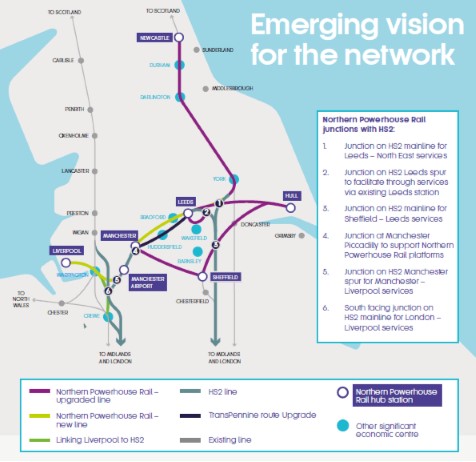
The emphasis seems to be on strategic links between cities as a means of driving economic growth. All transport modes are covered — road and rail, passenger and freight. It’s no surprise that a central proposal is high speed rail linking Liverpool with Hull and Newcastle with a new cross-Pennine line aiming to get the journey between Manchester and Leeds city centres down to 30 minutes. This is Northern Powerhouse Rail (NPR — aka HS3, Crossrail of the North etc). The favoured route for the new line would include a station in the city of Bradford, probably in the centre. We can speculate about the precise route, but much tunnelling is inevitable, on a truly alpine scale. The timescale is unclear but may go some way beyond the projected 2033 completion date for HS2, the high speed line from London to Leeds and Manchester.

For campaigners on the Calder Valley Line it is perhaps difficult to see how the benefits will trickle down to our line. Whatever is built in 15, 20, 25 years time we are surely right to be primarily concerned with shorter term but nonetheless strategic developments that can yield benefits for regular train passengers in a timescale we can see the end of. We want to get people off congested, polluted roads onto free flowing, clean and sustainable railways. With our environmental perspective it is not just about getting into the city centre, or getting between them, as quickly as possible but about making rail the natural mode for more and more people for more and more purposes — social and leisure, personal development, education—not just business and work. Surely its about the quality of everyone’s lives.

But if HS3, sorry NPR, comes through Bradford the intriguing possibility is whether, and how, it might be linked with the “classic” Calder Valley Line. Trains on NPR could get from Bradford to Leeds in maybe 6 or 7 minutes. What if a junction were built in Bradford linking the new line with our line and also Airedale/Wharfedale? Calder Valley trains could run fast Bradford-Leeds cutting the journey time from Halifax to Leeds from 35 minutes or more today to maybe less than 20. And trains from Ilkley or Keighley could run on the high speed line to Manchester. Are we dreaming? Or is this something for which we can realistically campaign? —JSW

Consultation Events

Consultation events on the STP are drop-in events open to everyone but if possible you are asked to register your details on the TfN website . Events have already been held in Halifax and Bradford. The Halifax one was led by TfN’s strategy director Jonathan Spruce and started with a presentation lasting about half an hour, followed by a good hour’s open and informal discussion. Several HADRAG members were present and raised issues including the need for a stronger environmental focus combatting climate change, linking NPR (HS3) with the Calder Valley Line, and the importance of smaller local stations.

The session format includes a repeat of the opening presentation at the end. So you don’t need to be there for the full three hours. Next event is:

  • Leeds – Monday, 5 March at The Tetley, Hunslet Rd, LS10 1JQ, 1600-1900.