When Rt Hon Patrick McLoughlin MP, Secretary of State for Transport announced that the Huddersfield Line and Midland Main Line electrification projects were in a state of pause, HADRAG’s committee had already agreed to write both to the Secretary of State and to bosses of Network Rail. At the end of September, when Mr McLoughlin made his surprise announcement that the two big schemes were to be immediately “unpaused” – but significantly delayed – we wrote again.
Sir Peter Hendy, freshly moved from his old job as Transport for London commissioner to shake up Network Rail as its new chair, is actually still reviewing the whole programme of “CP5” projects originally planned for the 2014-19 “Control Period”. For HADRAG this is not just about electrification of our line which was recommended by the task force earlier this year for CP6 (2019-24), but also about more urgent enhancements between Manchester and Bradford that should be in CP5.
Our latest letter to Patrick McLoughlin and Sir Peter Hendy expounds three wishes:
a) linespeed and capacity upgrades Manchester-Bradford to be delivered as promised to enable more trains and quicker journeys on the CVL before 2020;
b) replanning of Huddersfield Line electrification to include significant capacity increases as well as electrification. We want restoration of four tracks, Huddersfield-Mirfield, to allow CVL services via the Brighouse Line to be increased and speeded up;
c) electrification of the Calder Valley route Leeds-Manchester/Preston via both Bradford and Brighouse to follow straight on after Huddersfield Line wiring is finished in 2022, aiming to keep the 2024 promise of the Northern Electrification Task Force.
Back in June, if you knew anything about current UK rail development, you had known for months that Network Rail was struggling to deliver its ambitious 2014-19 plan that had been sold to a government eager for pre-election good news. It was clear that North-west electrification was running late – it still is. And, we heard, planning work had ground to a halt on Trans-Pennine electrification scheme to extend the wires from Stalybridge via the Standedge Tunnel route to Huddersfield, Leeds and York. We were worried delays to Huddersfield Line electrification could have a knock-on effect on projected improvements including electrification on the Calder Valley Line.
Before HADRAG’s 30th anniversary annual general meeting in May this newsletter reported optimistically on the outcome of the Northern Electrification Task Force. The task force was a cross-party group of MPs, councillors representing Rail North, and officers from Rail North, the Department for Transport (DfT) and Network Rail. Professional work for the task force yielded in spring this year a list of lines recommended to the Secretary of State for electrification in the rail industry’s CP6 – the 2019-24 control period. Just to remind ourselves: in terms of points scored on economic, business and operational criteria Calder Valley Line (CVL) was ranked top of this list.
We say the CVL should follow on immediately after electrification of the Huddersfield Line. Economic and business modelling apart, it is simply common sense. The two routes are closely linked in terms of railway geography and operation. We are a diversionary route for TransPennine Express. Already our Blackpool-York trains run on lines (Blackpool-Preston, Leeds-York) that will be electrified in a few years. Planned services from Bradford should run to Manchester Airport by the end of 2019, probably with regional express branding, again over already electrified lines in south Manchester. In short it makes no sense not to electrify the CVL straight after the Huddersfield line with the teams that erect the masts and string up the overhead wires simply moving round the curve to get started on our line.
Maybe Huddersfield Line and Calder Valley Line electrification should be seen as a single project to be completed by the end of CP6. Whether Network Rail will see it that way is another matter.
Early essentials for Calder Valley as prelude to electrification
But there are other essential and more immediate enhancements required if the new Northern franchise (taking over next spring) is to deliver promised timetable improvements. The specification demands: extension of a Calder Valley service every hour to Chester via Warrington (from December 2017), and from 2019 an extra fast train hourly Bradford-Manchester with (as mentioned) through running to Manchester Airport. (The Airport service also requires the Ordsall Chord to be built in, a matter only very recently resolved in the courts) To facilitate the Calder Valley improvements as part of the wider Northern Hub development, we understand plans are already drawn up with funding both from Network Rail’s resources and (via West Yorkshire Combined Authority) from the West Yorkshire Plus Transport Fund for the following:
- line-speed improvements, Manchester-Bradford. Current limits of 70mph west of Hebden Bridge, 60 as far as Halifax, then 55 to Bradford could, we understand, be raised to 75 or 85mph.
- capacity improvements Hebden Bridge to Bradford with new signals so trains can run at closer headways.
- remodelling Milner Royd Junction, where Bradford and Brighouse routes diverge east of Sowerby Bridge, allowing existing 40mph speed restrictions to be raised.
These enhancements are considered urgent for another reason. When Huddersfield Line electrification does go ahead there will be a need to use the line via Brighouse and Hebden Bridge for diversions. So capacity and speed improvements round our way really should precede a start of serious engineering work on the Huddersfield TransPennine route.
Our first letter went to Patrick McLoughlin and also both to Network Rail chief executive Mark Carne and Sir Peter Hendy. We pressed the case for the Manchester-Bradford CP5 enhancements to go ahead, and, in CP6, for electrification of our line to follow the Huddersfield Line. We received fairly prompt replies during July, from a DfT official in response to our letter to the Secretary of State, and from Network Rail boss Mark Carne himself. Both were brief but reasonably positive in tone. Not surprisingly Mr Carne could not give direct assurances but was good enough to put us in touch with a regional strategy director who has promised to brief a delegation from HADRAG on the outcomes of the Hendy review later in the autumn. The offer will be taken up.
The reply from the DfT reasserted commitment to £13bn of transport investment in the North. (We take it this refers to Network Rail’s budget for enhancements, not to be confused with a higher figure sometimes quoted of about £39bn which includes like-for-like renewals.) “The budget for rail enhancements remains intact and the… pause on some projects will not impact on the delivery of the new rail franchises for TransPennine Express and Northern… .” That sounded encouraging in terms of the work required to deliver timetable improvements.
The DfT reply went on to say that consideration of schemes for delivery during CP6 (2019-24) had started, but it was “not possible yet to say whether or how the Electrification Task Force’s recommendations for the Huddersfield and Calder Valley lines might be accommodated in CP6”. A little worrying, perhaps? (And spot the error: Huddersfield electrification had already been approved and so was not on the task force list!)
Then three months after the great pausing of 25th June came the great unpausing of 30th September, in the middle of the party conference season. The full Hendy Review is not expected to report until November, and so is pre-empted by the surprise announcement (did Sir Peter have his arm twisted to agree to this?). Network Rail now seems to be saying it thinks it can probably electrify Stalybridge-Huddersfield-Leeds-York by 2022 – four years later than originally planned. For two years starting now there will be a “a full planning exercise” involving Network Rail, the DfT and Transport for the North resulting by the end of 2017 in a project that “increases benefits to passengers compared to the previous paused scheme” (letter from Sir Peter Hendy to Patrick McLoughlin, 29 Sep’15).
Make Huddersfield line improvements work for Brighouse and the Calder Valley – and then electrify our line!
Everyone concerned with campaigning for rail in the North certainly hopes that the replanned Huddersfield Line electrification will be a better scheme, building in significant capacity increases as well as just electrifying existing tracks. From a mid-to-lower Calder Valley perspective there is obvious scope to restore the mainly 2-track route between Dewsbury and Huddersfield to the 4-track railway that it used to be. This is important for HADRAG because it could help with the need for improved services on the Brighouse line, benefitting the whole of Calderdale. We are saying sensible capacity enhancements on the premier trans-Pennine route could also work for our line, as a prelude to full electrification as recommended by the task force.
But comments by Mr McLoughlin dampened optimism that schemes in the task force’s list would follow during CP6. Since questions remained about Calder Valley projects up to and including electrification, rather than simply wait for the outcome of the Hendy Review, HADRAG wrote again. We welcomed the restart of Huddersfield Line electrification, but set out our 3-point wish-list, expressing concern “to see progress with work that will enhance infrastructure and hence services on the Calder Valley Line which is linked geographically and operationally with the Huddersfield route. These Calder Valley enhancements are vital. They are both the short term (CP5) projects associated with the Northern Hub on the Bradford-Manchester route, and also medium term (CP6) aspirations including the extension of electrification to our line.”
Our Calder Valley route has been waiting decades for serious infrastructure enhancement. Services have been improved despite long-standing capacity and speed limitations which affect performance as well as limiting development. If the promised transformation is to be delivered by the new franchise, faster tracks and more signals will be needed before the end of the current decade. We say Sir Peter Hendy’s review of Network Rail projects must keep the promise to Calder Valley line passengers, actual and would-be, of speed and capacity improvements in the current “control period”, laying foundations for electrification in less than ten years. We are not giving up on this.
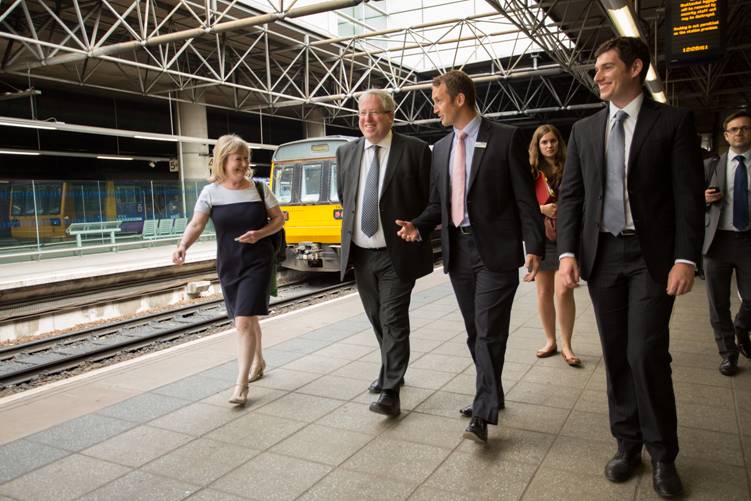
Header image attribution: flickr photo by Department for Transport (DfT) https://flickr.com/photos/transportgovuk/9305649181 shared under a Creative Commons (BY-NC-ND) license




 Halifax and District Rail Action Group