Brighouse 25, Hadrag 40, Northern Sparks 10 – forget “Rail 200”, we have anniversaries of our own.

40 years since we founded Hadrag. 25 years since we got Brighouse station opened. And 10 years since the Northern Sparks task force report by regional politicians and officials gave top priority to full Calder Valley line electrification – part of a programme that was to span the North. Transformation would be complete – just about all lines to be decarbonised by what is still the most energy efficient, and long-run cost-effective way of running a zero-carbon railway. Government ignored the recommendations. We founded the Electric Railway Charter to press for action. Calder Valley electrification is a clear objective of West Yorkshire Combined Authority and Calderdale Council, and we’ve had a good response from the new local MPs. Recently Calder Valley electrification got a mention in Lord Blunkett’s Yorkshire rail report – with a wait measured in decades. We are not holding our breath for the imminent spending review. Batteries are not good enough in the long run but will be part of the transition. Meanwhile dirty diesels continue to trundle noisily along our tracks.

We are delighted that our friend David Hoggarth, strategic rail director at Transport for the North has accepted our invitation to be guest speaker at our 2025 annual meeting.

All train users – actual and would be – will be welcome on the morning of Saturday 28 June in the conference suite at St John’s (community hall), Rastrick, HD6 1HN, 5 minutes’ walk from Brighouse station. Doors open just after 09.30 for 09.50 start. All done before 12.30, so time to enjoy Brighouse gala afterwards! More on back page. We hope to provide refreshments – and maybe a cake to cut!

Electric Progress?

We published our pre-election letters to election candidates in the summer issue of this newsletter. After the election Hadrag wasted no time and wrote to both Kate Dearden and Josh Fenton-Glynn as newly elected MPs for Halifax and Calder Valley constituencies. Two separate letters were sent:

  • firstly on the need for improvements to the Calder Valley line service – in terms both of timetable quality and of service delivery;
  • followed up by one specifically the need for decarbonisation by electrification and our Electric Railway Charter.

To say our new parliamentary representatives have a lot on their plates may be something of an understatement. We have provisionally set a date in diaries for a meeting mainly about electrification, early in the new year. We are thinking about three Hadrag members would be involved.

There are, of course, strong pressures to backtrack on electrification, but we intend to keep up the pressure for full wiring of the Calder Valley line – or rather lines. Leeds to Bradford Interchange must be the start. But remember that the 2015 Northern Electrification Task Force – yes, 10 years ago! – gave top ranking in its report Northern Sparks not just to the line to Manchester via Rochdale but also through East Lancs to Preston (already wired on to Blackpool). In West Yorkshire the line through Bradford and Halifax is essential and also the Brighouse route. That is what Northern Sparks meant by the full Calder Valley line. It has been largely supported by subsequent reports. Calderdale Council has twice agreed resolutions supporting electrification, and West Yorkshire Combined Authority (WYCA) continues to state as a need “electrification of our railway lines with the Calder Valley line identified as a priority” – WYCA Rail Strategy: Our Requirements (published 2024).

We are less sure about the sub-national body Transport for the North.

The Calder Valley Line is a natural follow-on to electrification of the Huddersfield line now approved under the Transpennine Route Upgrade.

There is pressure to cut capital cost of electrification by doing partial schemes and using trains with batteries. The Railway Industry Association published a report earlier this year calling for a decarbonisation by thirds approach. Broadly speaking this means a third already wired, a third planned schemes, and the rest alternative traction – batteries. But batteries waste energy, complicate traction systems and increase operating costs.

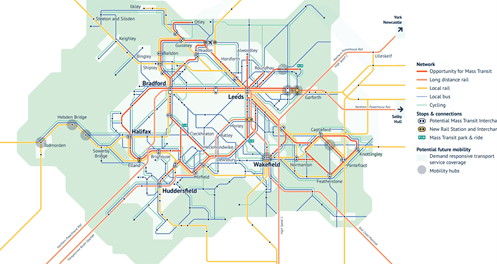
The RIA has published a map. It shows our line electrified – result! – but only as far west as upper Calderdale. Lines to Manchester and Preston would be left to unwired. This we say is not good enough. Our letter to the RIA and Rail Engineer magazine are shown below. We are awaiting a reply.


HADRAG: The Halifax & District Rail Action Group on the Calder Valley Line and Electric Railway Charter

David Shirres, Editor, Rail Engineer magazine and David Clarke, Technical Director, Railway Industry Association 1 November 2024

“Dear friends,

This is about RIA’s paper Delivering a lower cost, higher performing, net zero railway by 2050 (April 2024), featured in Rail Engineer magazine May-June 2024 (see links).

The paper is very welcome. We understand the principle of making essential decarbonisation affordable by limiting the number of further lines to be electrified.

We are worried however that our Calder Valley line, a major cross-Pennine route, is only shown for partial electrification. The Calder Valley line links West Yorkshire with Greater Manchester and Lancashire. Between Leeds and Manchester frequency of passenger trains is typically 4 trains/hr (6/hr Rochdale- Manchester). Two passenger trains/hr use the route into East Lancashire and there is an additional stopping service serving Colne. The trains through East Lancs include the highly successful York-Blackpool expresses, with obvious scope for increased frequency.

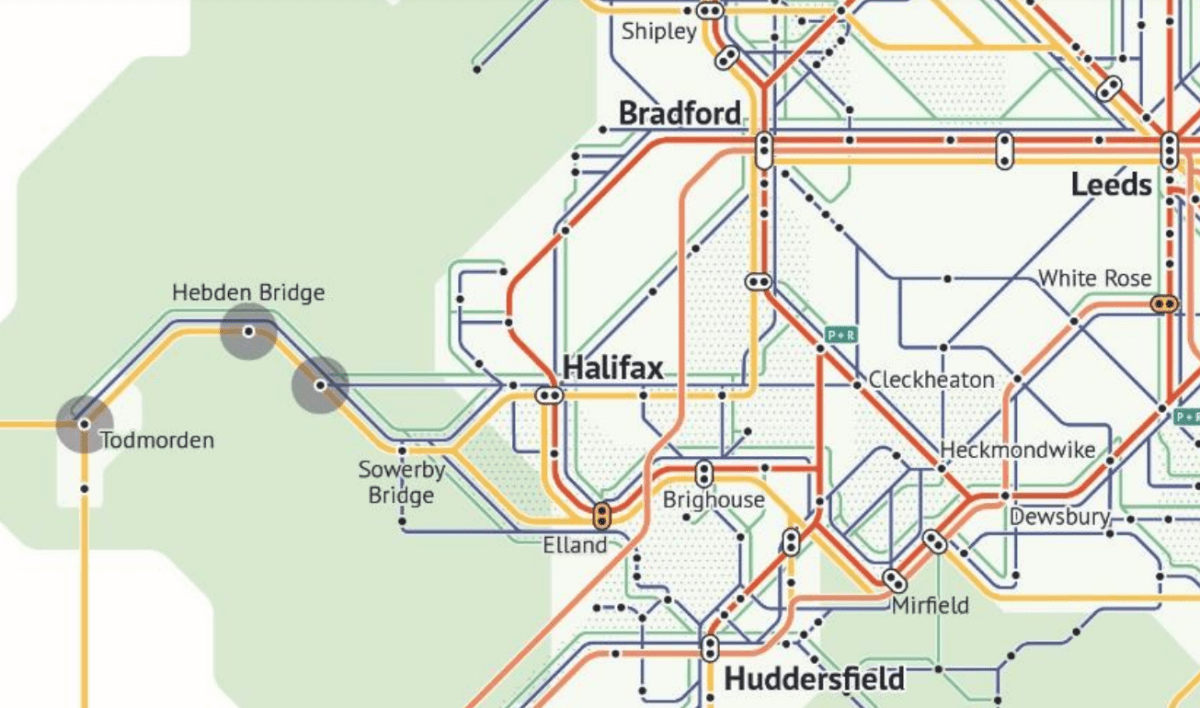
Both branches of the Calder Valley line also carry heavy freight trains, around two dozen paths per day (though not all used every day). We seriously question therefore whether wiring only from Leeds and Bradford to Todmorden is sufficient.

The Northern Electrification Task Force, an all-party body drawing on professional expertise, proposed full electrification of most lines across the North. Their report Northern Sparks[1] in 2015 ranked schemes on operational, business and economic criteria. The full Calder Valley line earned top ranking[2]. “Full” meant the complete route from Leeds to Preston and Manchester via both Bradford and Brighouse, linking with TransPennine route electrification.

Since then we have had other reports with similar conclusions. A rolling programme of electrification has been identified as a cost-saving, skill-developing procedure. Such a programme is under way in Scotland.

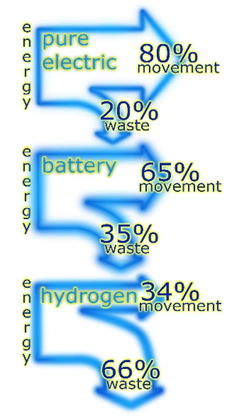
Our three simple Sankey diagrams illustrate the energy efficiencies of pure electric, battery and hydrogen powered trains. They reflect the figures on in Table 1 on p13 of the RIA paper. We have been a little generous with the value for hydrogen trains. The 65% efficiency for battery trains seems right for normal charging systems, but fast chargers as developed by Vivarail and advocated in your report for remote routes involve trickle charging of a static battery which is then used for rapid charging of train batteries – two charge-discharge stages. A first-order estimate of efficiency for fast-charged battery trains is thus maybe just over 50%. Half the energy is wasted. (And yes, we know this is better than diesel.)

Batteries also have a significant mass. More mass to accelerate even when running on electricity from the overhead wire. This again reduces efficiency – wastes more energy. Complexity alone means the cost of building, operating and maintaining battery trains is significantly greater than for pure and simple electric.

Then there is battery lifetime, and dependence on lithium supplies (with their own environmental impact) to consider. Demand for lithium seems set to increase, with cost consequences.

The RIA flier Rail Electrification: The Facts – Campaigns RIA (2023) sums up the arguments for electrification on one sheet.

Can we afford the complexity, inefficiency and future cost of continuing to not electrify strategic routes like the Calder Valley?

We issue a reminder at this point of the question of heavy freight and its volume on the Calder Valley line. Surely these massive trains cannot be left to run on diesel?

We are not opposed to batteries. We understand that batteries will be part of the transition to zero-carbon. Some lightly used lines will never be electrified. Some may use hydrogen. But the Calder Valley routes are busy with passenger and freight trains. Full electrification will be worthwhile. It will pay back in a reasonable time.

We expect the Calder Valley line to be in the first phase a coming programme of full electrification, as envisaged a decade ago in Northern Sparks, and supported by local and combined authorities and businesses along the route.

Looking forward to receiving any comments you are able to make.”

With thanks in anticipation and best wishes, Stephen,

Chair HADRAG (and joint coordinator of the Electric Railway Charter)


[1] EFT Report FINAL web.pdf (https://transportforthenorth.com/wp-content/uploads/EFT Report FINAL web.pdf )

[2] It was assumed that other schemes already planned such as the route through Huddersfield would be finished first.


What’s in it for us?

WYCA agrees rail strategy

In line with our Electric Railway Charter!

It is good to record that West Yorkshire Combined Authority (WYCA) is sticking to its guns on electrification. The Metro rail strategy was formally agreed at WYCA’s full meeting in March, and includes as top-ranked (Tier 1) schemes:

  • The Calder Valley line extending the government’s Leeds-Bradford proposal to Calderdale, Preston and Manchester. The routes through Elland and Brighouse linking with Huddersfield routes are also included. York-Blackpool, Leeds-Manchester (and maybe on to Chester) could be electric all the way, as could trains via Brighouse. The Calder Valley network is noted as one of the busiest routes in the region. Full electrification would release a lot of diesel vehicles, and maximise the benefits of the Leeds-Bradford scheme – make sense of it in fact. We say track upgrades could be carried out along with – or preferably before – electrification.
  • The Harrogate line, already linked with electrified Airedale and Wharfedale routes, enabling large numbers of diesel trains to be removed. Electrification through to York would also link up with the electrified East Coast Main Line.
  • The Dearne Valley line linking Wakefield Westgate with soon to be electrified Sheffield-London, enabling service improvements on potentially fastest Leeds-Sheffield route.

Tier 2 includes the lines through Castleford and Wakefield to Knottingley (onwards to Goole), and Sheffield via Barnsley – where Northern currently routes its twice hourly fast (or fastish) trains from Leeds to Sheffield. Tier 3 would fill in gaps such as the Penistone line and Ravensthorpe-Wakefield.

The assumption is that the TransPennine Route Upgrade will electrify from Stalybridge through Huddersfield and Leeds to Church Fenton1, effectively completing wiring from Manchester Airport and Liverpool to York. Also assumed is that already announced schemes not only for Leeds-Bradford (the New Pudsey route) but also for Leeds-Hull will be there. Leeds-Hull is a government Network North proposal, as is Leeds-Sheffield (which latter we assume means the Dearne Valley route).

Rolling programme. But one project for our line!

The document gives equal ranking to Harrogate, Calder Valley and Dearne Valley routes. But Harrogate is always mentioned first, maybe just because it is less complex. Some of us would like to see our line at the top, as it was in Northern Sparks, the task force report that will celebrate its tenth anniversary next year. Then again, the Harrogate line is much simpler; could it even start before the Huddersfield main line is finished? Either way, the plan for full electrification is in line with our Electric Railway Charter, launched six years ago in Halifax (Electric Railway Charter). The Charter website lists several other reports that advocate, in one form or another, rolling electrification. The Calder Valley is always there.

It is vitally important the Calder Valley is seen as one project with Leeds-Bradford. Almost all trains from Leeds to Bradford Interchange continue to Calderdale and beyond. It would seem ludicrous to have to change traction from electric to batteries (or hydrogen) at Bradford. Bi-mode, even tri-mode trains might seem sexy to some engineers, but with two or more traction systems on board there is a lot of extra mass, more things to go wrong, less reliability and lower energy efficiency than pure electric. The Calder Valley also carries heavy freight trains for which the only sensible decarbonisation plan is full electrification. The strategy says batteries or hydrogen could be valuable as interim solutions on some lines including use of hybrid trains. But “the limited range and performance of such trains is likely to suit only low density, low traffic, low speed and shorter distance passenger routes,” says the strategy. As electric car drivers know, batteries are heavy2. And hydrogen, though the lightest gas, takes up a large volume.

Service frequencies need improving

Our line – including the route from Brighouse to Leeds via Batley – is shown by one of the maps in the strategy as having nine stations where service frequency needs improving. HADRAG agrees. We shall keep on pressing for all trains passing through Sowerby Bridge stop there (at present just 2/hr compared with Hebden Bridge’s 4/hr). Halifax and Bradford Interchange (currently 5/hr) are both shown as needing improvement. Walsden’s present 1 train/hr is marked “not acceptable”.

Brighouse’s twice hourly pattern is also shown needing an upgrade. We have pointed out that the nominal 2 trains/hr at Brighouse is effectively only a single train on each of the two routes E-W (Wigan-Leeds) and N-S (Bradford-Hud). Two an hour – at least! – is needed on all arms. And we say they should connect, to give reliable upper Calderdale-

Huddersfield connectivity (if not through trains). Brighouse-Leeds is proposed to be semi-fast, just one or two stops. We say target journey time should be 20 minutes. Elland-Leeds would be about 23 minutes. At half-hourly that would be a very attractive service.

There is little if any more on suggested new routes including the “Crigglestone curve” one linking the Calder Valley line south of Dewsbury with Barnsley and Sheffield. We think a Bradford-Halifax-Sheffield service could offer some attractive journey times, our headline being Brighouse-Sheffield in 55 minutes, maybe less. Spen Valley reopening through Cleckheaton could be a later phase, cutting off the corner to give a direct inter-city link.

Bradford-Huddersfield is described as part of strategic evidence for CV line enhancements. “Network North” (last autumn’s government statement) is invoked here with its suggested (optimistic?) 12 minute journey time, non-stop, presumably via a new route. But this would not improve the service for Halifax, and not, we guess, for Brighouse either. Clearly any Network North new line is some years away. We need our lines improving now.

A further complication is service disruption for the TransPennine Route upgrade.

Network North proposed a 30 minute timing Bradford-Manchester. And yes, it does seem optimistic. Business case must be dubious if it’s a new line for only 2 trains an hour. Better surely to upgrade the Calder Valley line and aim initially for a half-hourly fast service. This might take as little as 42 minutes Bradford-Manchester and would also serve Halifax and Rochdale. Complementary services in between would serve intermediate stations. Track -and capacity – interventions are pencilled by the WYCA strategy over the Sowerby Bridge to Rochdale section.

This could mean passing loops, for example between Mytholmroyd and Hebden Bridge or further up the route. Longer trains are suggested through Halifax and Brighouse.

Tunnel to high speed?

Away from the WYCA spotlight, Colin Elliff, experienced railway civil engineer, has suggested a new route across the Pennines involving a 15 kilometre tunnel from Halifax to Littleborough. A 30 minute journey time is proposed from Bradford to Manchester.

Elliff’s proposal is part of a portfolio of schemes that also go under the banner “Network North Ltd”, not to be confused with the government’s more recent adoption of a similar brand! It scores higher for us than Transport for the North’s publicly unspecified high speed plans, because it actually serves the big towns on our line. Could it be a later phase? It is certainly a generation way. We need to develop the lines we already have – now!

Back in the WYCA strategy, talk continues of a new Bradford station. This could be outside the present city centre – maybe 10 minutes’ walk. It would be a through station eliminating the age-old need for trains to reverse in Interchange. This would ease “pathing” of trains in and out of the station and increase capacity.

Could other, more convenient, sites be possible?

We must add that Bradford’s vision is for the city centre to expand and include the new station site.

An alternative cross-city route stretches the definition of feasibility: the new(ish) Broadway shopping centre blocks the way. Bradford to Leeds via Shipley is 13 miles, compared with 10 miles via New Pudsey. And junction conflicts at both Interchange and Shipley would constrain timetabling. Colin Elliff’s diagram suggests Bradford-Leeds via Shipley would take 15 minutes, compared with 12 minutes currently predicted via New Pudsey (we assume both of these are non-stop). It all adds up. With the new station, Halifax-Leeds could come down to 25 minutes or less. – JSW

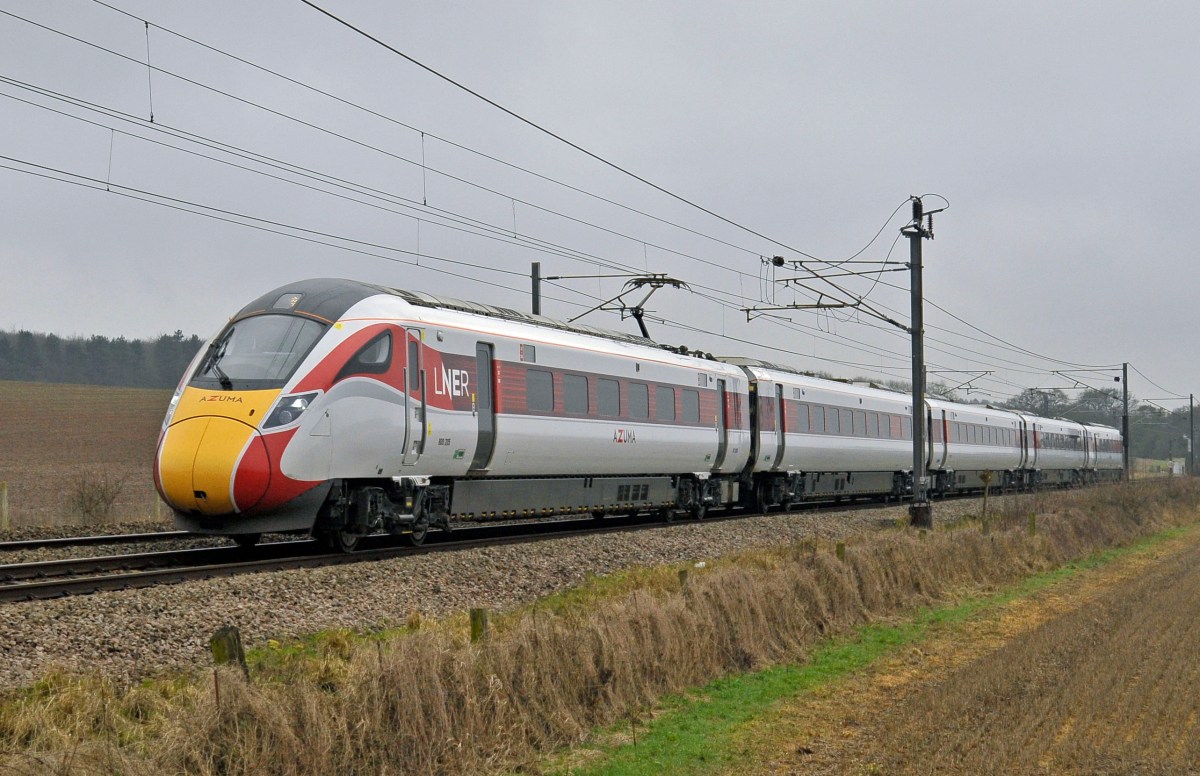
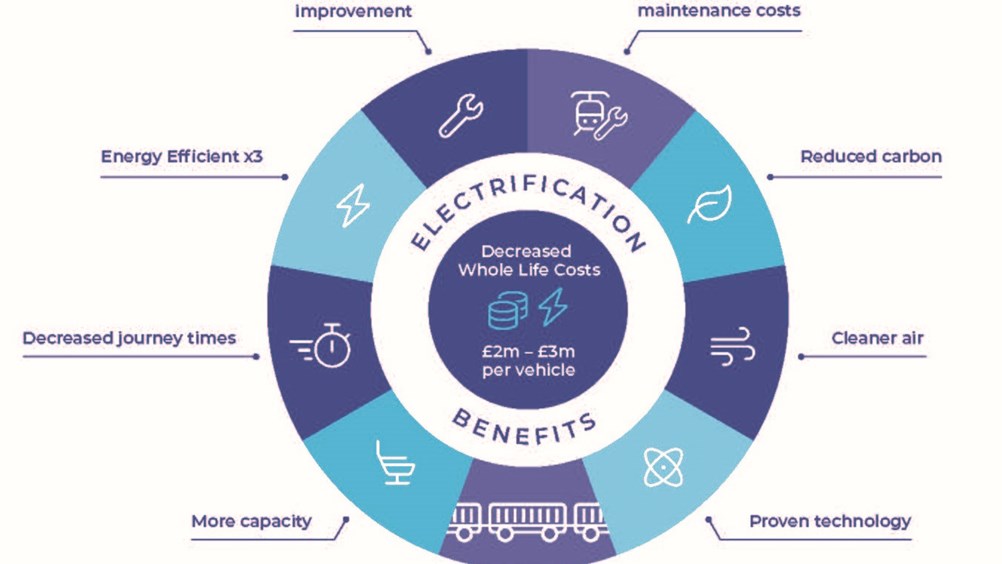
Electric trains are economical, energy efficient, potentially zero-carbon, proven technology, reliable to operate, and easy to maintain. 

The rolling programme is dead: long live the rolling programme! Somebody tell HM Treasury.

Full Midland Main Line electrification “could be shelved to pay for HS2” headlined Modern Railways magazine (Apr’2023, p9), reflecting goings on in Network Rail and the DfT. Let’s hope the they are being over- pessimistic. If not, what price electrification across the North? Two pages later the headline is the House of Commons transport committee saying government “must increase pace” of electrification in its report Fuelling the Future: motive power and connectivity. Committee chair lain Stewart MP (Con, Milton Keynes S.) strongly urged the government “to crack on with projects for electrifying train lines throughout the UK, or identify alternative lower carbon solutions where full electrification is not economically viable.” Electric trains are simple and efficient, capable of zero-carbon operation and suitable for dense passenger services and heavy freight – services with which batteries and hydrogen might never be able to cope. The hydrogen and batteries have to be manufactured and the energy has to be, converted meaning a lot more is wasted than by using renewably generated electricity directly. The report adds that hydrogen is not currently capable of producing the power needed by freight and high-speed trains. Batteries have similar limitations, have limited lifetimes in service and produce lots of greenhouse gas CO2 in manufacture. And, many of us still say, the hydrogen must be “green” not made from fossil fuels with CO2 as by-product. (Let’s not get into the argument about whether the CO2 can be buried forever.)

The government is slow to recognise the need for a rolling programme of electrification – and the benefits in terms of learning on the job and cost reductions. HM Treasury, it seems, is happy to ignore the work done by Network Rail on TDNS (traction decarbonisation network strategy), in favour of short-term financial thinking. Payback will be long term, based on lower costs of electric trains and the “sparks effect” of more people wanting to use them. TDNS of course proposed electrification of the great majority of present diesel-powered routes. In Scotland there is at least a statement of desirable outcomes. But across the UK the rolling programme seems to be “dead”. Thankfully that does not stop forward-thinking, scientifically literate bodies like the R|A (Rail Industry Association) keeping up the argument. In our Winter 2022-3 issue we reported on RIA North’s vision for a wired railway from Carlisle to Corby, Sunderland to Warrington with the Calder Valley line listed among top priorities. Now the RIA has launched RailDecarb23 calling for – yes, you guessed it – a rolling programme of cost- effective wiring, fleet orders for low-carbon rolling stock and incentives for suppliers to get on board. There is 2-side information sheet summarising the arguments (link: Rail Electrification:p The Facts – Campaigns (riagb.org.uk)).

Meanwhile a practically brand-new line is being built between Oxford and Milton Keynes without electrification. They will end up wiring it later. It’s a cliche, but you couldn’t make it up. – JSW


Header Image: Public Domain

Electric Railway Charter Update

RIA (Rail Industry Association) North has published a plan for electrification across the North spanning Carlisle, Teesside and the East Midlands. Most lines are designated priority 1 (yellow on map below). Priority 2 lines (green) would later transform bi-mode operation to pure electric. Priority 3 (blue) is longer term battery/hydrogen proposals around the edges of the map. RIA North marks 36 freight terminals that would be decarbonised one way or another.

Needless to say, all cross-Pennine routes are priority 1 from Merseyside to Humberside and Scarborough, including of course the full Calder Valley line that was top-ranked by the 2015 task force. Manchester-Bradford-Leeds is second among the top 10 priority 1 schemes, after Sheffield-Doncaster/Wakefield. Completion of Huddersfield and London-Sheffield is assumed. Our thumbnail of RIA North’s map below may be small print but you can find the whole report at Roadmap for a green railway in the North unveiled (riagb.org.uk).

The trick now of course is to convince HM Treasury that not only is electrification affordable. We cannot afford not to electrify, given environmental and resources uncertainties about hydrogen (the RIA barely mentions it) and about batteries (where’s all the lithium coming from?) and less-than ideal efficiency – wastefulness – of multi-mode trains. Electrification will pay for itself by cutting running costs, benefitting customers and combatting climate change.

White paper step forward on electrification?

Strongest hint yet of a rolling programme. But must we really wait for “feet under table” at Great British Railways?

The government’s Great British Railways white paper says “Transport generates over a quarter of the UK’s greenhouse gas emissions, … the largest emitting sector of the economy. But rail produces around 1% of Great Britain’s transport emissions, despite carrying almost 10% of all passenger miles and nearly 9% of freight moved before the pandemic.” (p88 of the Report)

We say absolutely right. Rail already has the capability to move passenger and goods with net-zero carbon dioxide emissions. “ There are huge opportunities for rail to contribute … through further electrification.” That, at last, is getting close to what we should be hearing. The document continues:

Electrification is likely to be the main way of decarbonising the majority of the network. Electrification does not merely decarbonise existing rail journeys: it has a clear record of attracting new passengers and freight customers to rail, the so called ‘sparks effect’, thereby decarbonising journeys that would otherwise have been by road. The government has announced almost £600 million to start work on electrifying the Trans-Pennine route between Leeds and Manchester, design work to extend electrification to Market Harborough is underway, and the government will announce further electrification projects in England … shortly.

Great British Railways, the Williams-Shapps Plan for Rail

That may not be quite a commitment to a rolling programme, but is the nearest we’ve had yet. It’s not absolutely clear if this is a commitment to full electrification of the route through Huddersfield and Stalybridge but it feels like a strong hint. Market Harborough is on the Midland Main Line where, the next step must surely be through to Nottingham Sheffield and on to Leeds. We want to see these commitments firmed up, beyond vague ministerial (indeed prime ministerial) promises to a national programme that includes the March 2015 Northern Sparks task force recommendations headed by our full Calder Valley Line.

Note: “the main way” of decarbonising the majority of the network. We make no apology here for repeating figures showing what the split between electrification, battery power and hydrogen should be – based on Network Rail’s traction decarbonisation network strategy published last autumn. We think the DfT and ministers get this.

The worry is the word “shortly”. Here’s the next bit. You can spot our slight concern here:

Great British Railways will bring forward costed options to decarbonise the whole network to meet the government’s commitment to a net-zero society as part of the 30-year strategy. These plans will help to kickstart innovation and change across the sector, support long-term funding commitments and build on the forthcoming Transport Decarbonisation Plan and Great British Railways will bring forward costed options to decarbonise the whole network to meet the government’s commitment to a net-zero society as part of the 30-year strategy. These plans will help to kickstart innovation and change across the sector, support long-term funding commitments and build on the forthcoming Transport Decarbonisation Plan and Network Rail’s recent Traction Decarbonisation Network Strategy.

Great British Railways, the Williams-Shapps Plan for Rail

So the new “guiding mind” of our national rail network will offer options with price tags to the government. Meanwhile the DfT’s transport decarbonisation plan is coming soon. And at least the ground-breaking TDNS is acknowledged. But does this mean we have to wait until the still-to-be-appointed chief executive of GBR has established their feet under the table? Surely, Network Rail has schemes that it can be getting on with, and needs to be drawing up a rolling programme now? Yes, we have said it before, but let’s start getting electrification done.

Over and over again rail industry bodies call for ongoing electrification where teams stay together, developing and improving techniques as they move from scheme to scheme. This is network electrification, it reduces the overall costs, and multiplies the benefits as it cuts the number of non-electric trains operating “under the wires”. In Scotland all four routes between Edinburgh and Glasgow are electrified and there’s a plan to electrify all but the most remote outposts of the rail network. That’s a local example of good practice for the COP26 climate summit in Glasgow later this year. Even better would be a plan for the rest of the UK to catch up with Scotland.

Neighbouring schemes have mutual benefits – like the Calder Valley line naturally following on or even getting started in tandem with TransPennine Route Upgrade.

We do not disagree that some routes will have battery or hydrogen powered trains. Batteries and hydrogen are important ways of storing energy – but not the only ones. Storage is essential because the wind does not blow all the time even out at sea where the turbines spin. But hydrogen and battery powered trains may – in terms of track miles needing to be decarbonised – be no more than 15% of the total. The white paper says:

Battery and hydrogen-powered trains will be trialled for passenger routes where conventional electrification is an uneconomic solution, in order to support the government’s ambition to remove diesel-only trains from the network by 2040. Advances in technology, deployment and more appropriate regulation will be instrumental to achieving this in an affordable way, while also minimising disruption to passengers and freight customers.

“Trialled” – is someone admitting here that battery and hydrogen trains have still to be proven? And “diesel-only trains” removed from the network by 2040 – does that mean there will still be diesel bi-modes running, still wasting energy carrying around dead weight, still increasing maintenance costs, still burning carbon? Of course there are schemes under development to take the diesel engines out of electro-diesel bimodes and replace them with batteries – a form of electrification “without wires”, albeit limited. 

And “where conventional electrification is an uneconomic solution” – who decides on the economics? We know that a rolling programme will cut costs of wiring, maybe by a third, maybe even by half.

We also know that electric trains:

  • use less energy to run because overhead wires are the most efficient way of delivering traction energy. So they are cheaper to buy and cheaper to run.
  • are much less complicated than diesels, bi-modes or hydrogen-power meaning they are more reliable and cheaper to maintain.

And electrics deliver business benefits:

  • Lower mass, carrying  more passengers for the same amount of power;
  • Better acceleration reducing journey times even with more stops serving more stations on lines such as the Calder Valley;
  • Attractive to would-be passengers as clean, quiet, more spacious and more modern – and green. That’s the sparks effect mentioned in the white paper.

Now add in the economic benefit of having clean air, safety, roads freed of congestion by having more people using public transport, and saving future generations from climate catastrophe. Surely, then you have the economic case. With a stake in both tracks and trains Great British Railways should put the case effectively.  Grant Shapps must get the message to the Treasury. And readers, please tell your MPs!

Header Image: “Electrification work at Cardiff Central” flickr photo by Dai Lygad https://flickr.com/photos/126337928@N05/48892795197 shared under a Creative Commons (BY) license

Spring update – HADRAG responds to Williams review. Plus timetable issues and Electric Charter campaign


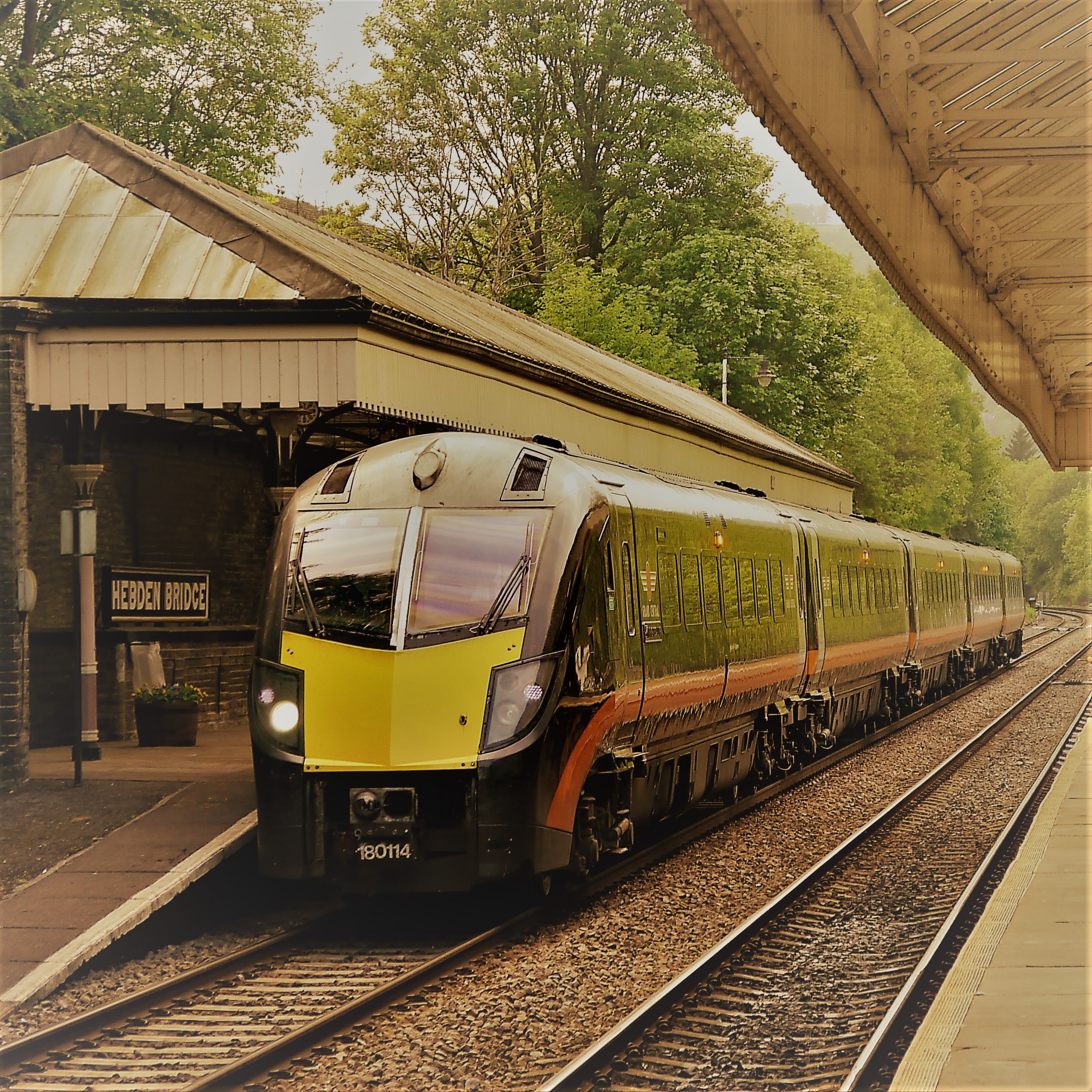
180HBG Zeke

HOW SHOULD our railways be run in the future? As a campaigning rail users’ group embracing a range of views, HADRAG does not take a view on whether our national rail system should continue with largely privatised, private enterprise train operation, or whether there should be some form of social ownership or renationalisation. What many of us do think is that the present system is crazy, not necessarily because of who owns it, but because of fragmentation. We desperately need one railway that works for passengers and to provide an attractive, modern, reliable alternative to congested roads, supporting good growth and protecting the environment, locally and globally.


Last May we had a timetable change that was a complete mess. That must never happen again. In the North of England we have two main train operators, Northern and TransPennine Express. They run across a system operated by Network Rail, the government-owned track operator. Network Rail decides the final timetable, from a remote train planning office in Milton Keynes. Northern and TPE both have their own train planners and must bid, to some degree in mutual competition, for slots in the Network Rail plan. So that is three separate bodies of train planning expertise planning what rail users are surely entitled to see as one train service. Who cares who runs the trains (or owns it – a wholly separate matter in the fragmented railway)? We just want a timetable that is strategically planned by a regional guiding mind to meet the needs of commuters and more occasional travellers, and delivers enhancements that will make train travel more attractive, more usable.

The Williams Review is looking at the whole organisation of our railways with a view to feeding in to a government white paper this autumn. It’s a tight deadline. HADRAG responded to the “initial listening phase earlier this year, but anyone can put forward views – on franchising, the public-private debate or other issues by the end of May. See the summary of our initial response below, and our full paper here.

Meanwhile, HADRAG’s latest newsletter Halifax and Calder Valley Rail Views sets out our latest thoughts on timetable issues, and we have an update on the Electric Railway Charter with the argument swinging back from “gapped” electrification towards the need for strategic routes like the Calder Valley (as well as the Huddersfield Line “TransPennine” route) to be fully electric. – JSW

Here’s HADRAG’s summary from our response to Williams:

“There should not be a conflict between the interest of passengers and taxpayers. Taxpayers benefit from the existence of a modern and effective rail network through its ability to reduce congestion, taking people to work and delivery goods. Railways directly reduce the number of vehicles on the roads. Government financial support for rail should be seen not as subsidy but as social payment for a public service with wide social, economic and environmental benefits. Because of that, the possibilities of rail travel should be made attractive to as great a percentage of the population as possible.

Priorities should be:

  • To re-integrate a railway that is fragmented in its structure. Removal of fragmentation to put functions under one roof can reduce costs and promote effective, agile decision making. Train-operation and system operation (including timetable planning) need to be unified. For example, in the North of England a single company should be responsible for internal services, planning service patterns, devising the timetable and delivery of the service. The present system for example of separate train-planning establishments within Northern and TransPennine Express TOCs and centrally within Network Rail does not make sense.
  • Devolved structures to promote effective and prompt decisions as close as possible to the point of service delivery, responsive to passengers’ needs. Regional “track+train” operating companies may be in the private sector or may be socially or cooperatively owned. (HADRAG maintains a neutral position on the political question of private versus public ownership.)
  • Expansion of the rail network with a fares system that encourages increasing use for an increasing range of purposes – culture, leisure and community as well as work and business.”

Electrification: Harrogate leads the way…with buses!

The Electric Railway Charter calls for smart electrification to save time, costs and disruption. Rail needs to catch up as cars and buses go green. Could pioneering bus development set the example? Andrew Whitworth reports from Harrogate.

It’s exasperating that railway electrification in England is going backwards.

Latest news on the delayed Manchester-Leeds-York plans came as an apparent (deliberate?) leak in September. The emphasis was on how difficult it would all be, despite actual proposed electrification seeming to be limited to Leeds-Huddersfield. It’s a different story in Scotland, where the fourth electrified route linking Edinburgh and Glasgow went live in July – and work progresses on the fifth route. The enterprising Scots are also wiring the Stirling to Alloa branch line. Meanwhile,

Wales has approved some innovative electric plans for the Cardiff Valleys lines using battery power to reduce the costs, timescales and disruption of electrification.

In contrast to their lamentable rail electrification policy for England, on the roads our government have set ambitious targets to switch everyone to electric cars (or at least hybrids) by 2040.

The government is also spending money now to promote low emission buses in towns and cities.

Of 13 such schemes approved in 2016, most are hybrid or electric, including a unique plan for Harrogate due to go live imminently.

Harrogate has had two battery buses since 2014, but they can only run for about 7 hours, then need an 8 hour slow charge at the depot.

Now, The Harrogate Bus Company owner Transdev is buying 8 new-generation electric single-deckers. The new battery buses are able to run for a full day, by using fast ‘opportunity charging’ whenever they’re at the bus station, which takes only 6 minutes. This is topped up by an overnight slow charge. Compared to conventional battery buses this system requires fewer vehicles, with smaller batteries -which also saves a lot of weight.

It’s an innovative idea which – together with the flexible approach in Wales, and the stability of the rolling programme that has succeeded in Scotland – must have potential to help get northern railway electrification plans back on track.

The Electric Railway Charter — watch out for our launch!

Quick recap: big station, fully electrified since 1960. But five out of six trains in our picture are still diesel. Seems a waste? It’s blindingly obvious more could be electrics, helping to keep the air in the station safe to breathe, helping to combat global warming, if only more lines had the “wires” up. Britain lags other advanced European countries in terms of electric rail-km. Yet the Department for Transport seems to be saying that buying fleets of trains laden with both electric pick-up and diesel-generator equipment is a sensible substitute. As explained in our Autumn issue, we don’t agree. “Bimodes” are inefficient, underpowered on diesel, overweight on electric, more complex and costlier to maintain, bad for business and bad for the environment. If diesel or bimode traction were to be the norm for another generation those polluting trains would still be running when fossil fuel power is coming to an end on the roads. Of course electrification means major investment, and, like any improvement scheme, some disruption. But as has been shown the cost is recouped by operational savings (such less fuel, less maintenance) and the “sparks effect” of trains that more people want to use.

Network Rail is the national agency that has the multifarious tasks of managing day to day operation of the system, maintaining tracks and signalling and organising upgrades. Having let engineering expertise go it has, with its contractors, been learning the hard way how to electrify railways in the North West, in Scotland and on the Great Western. An effectively managed rolling programme would capitalise on the skills gained. Nearly three years ago a politically balanced task force backed by professional research recommended a dozen northern routes for electrification by the mid-2020s. You won’t need reminding that the Calder Valley Line, from Leeds to both Manchester and Preston via both Bradford and Brighouse was the top-scoring scheme.

Campaigning train user groups along the length of the line are not giving up. In the coming weeks, HADRAG, STORM (Rochdale), Bradford Rail Users and our colleagues in the Upper Calder Valley Renaissance Sustainable Transport Group are to jointly launch the Electric Railway Charter. The charter will be a declaration calling for implementation of the task force recommendations with our line at the top. It will promise to keep up the campaign for an economically and environmentally sustainable railway. And it will call on a wide range of other groups—business, environmental, political, workplace, community—to support us. We are already supported by the Yorkshire branch of Railfuture, the national independent group campaigning for a better rail network for both passenger and freight. Spread the word.


Electrification: Don’t take our word for it!

Look at the recent panorama of one of our big northern stations, complete with overhead electric wires. Of six trains in shot, five are diesels. If only more lines in the North were electrified all could be electrics, quieter, more efficient, better for air quality, for the climate and for passengers. Don’t take our word for it; here’s what Network Rail said on its website:

Electrification of the railway allows for faster, greener, more reliable train journeys, improves passenger services and supports economic growth in Britain.

Benefits of electric trains:

  • More capacity for passengers; more seats than diesel trains of the same length
  • Faster than diesel trains: superior braking and acceleration make journey times shorter.
  • Quieter than diesel trains: good news for our lineside neighbours.
  • Better for the environment:… carbon emissions 20 to 35% lower than from diesel trains, and there are no emissions at point of use improving air quality in pollution hotspots such as city centres
  • Lighter. Less maintenance is needed because electric trains cause less wear on the track so the railway is more reliable for passengers.
  • Good for the economy. Faster trains with more seats and better connections with previously hard-to-reach areas improve access to jobs and services, and open up new business opportunities.

Electric trains are better business than diesels because they use simpler technology—cheaper to buy, operate and maintain, offering a self-evidently better passenger experience.