Northern Meeting: Rolling Stock

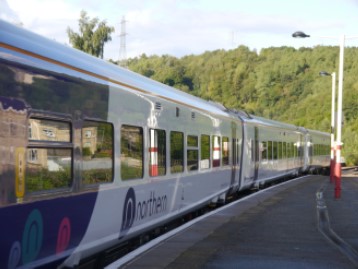
Copley viaduct, on the line from Sowerby Bridge to Halifax and Bradford. Lower bridge over the Calder is route of Leeds-Brighouse-Manchester trains that come through Elland and Greetland. By chance both trains in this shot are 30-year old  “Class 150” Sprinter types — the ones with cramped 2+3 seating. 150s should be banished from this line, though not from Northern, in less than two years’ time. Northern Connect services crossing the viaduct en route to Blackpool, Chester, Manchester Airport, Leeds and York will be brand new trains now being built in Spain, whilst the “valley bottom service” (soon to be extended to Southport) is expected, in less than a year, to get refurbished millennium-vintage “Turbostars” arriving from Scotland; these will be a lot better than 150s or Pacers or even the “express” 158s — trust us! We hear Northern hope to replace of more of the older units. So maybe things really can get better.


Northern Meeting: Stations and Information

Halifax station should get three new ticket vending machines in the near future as Northern installs more and more of its shiny “smartwalls” across the network. Let’s support our staffed booking offices, expanded maybe to offer a wider range of services.  More local and tourist information would be a start. Northern seem to be saying they want to develop the role of the booking office. Stations like Sowerby Bridge — at present unstaffed — could get modular buildings for staff to serve the public.

People still want printed timetables. HADRAG has criticised the current Northern style  where you need three separate booklets to find the whole Calder Valley Line service. We understand the plan is for a smaller number of area-based timetables. That could be a step forward.

Image: Sowerby Bridge Station (flickr photo by calflier001 https://flickr.com/photos/calflier001/4605598267 shared under a Creative Commons (BY-SA) license)

Northern Meeting: Capacity, Service patterns

HADRAG takes up issues with Northern. No quick fix for overcrowding but a glimmer of hope the first lot of new trains could be followed by more. We keep up pressure on serious timetable issues for Halifax and Calder Valley Line stations whilst train planners wrestle with the May 2018 timetable.

Last Autumn HADRAG wrote to the new managing director of Northern (Arriva Rail North) with a familiar catalogue of issues. Commuting capacity—can anything be done short term to relieve some of the outrageous overcrowding? Service patterns—our concerns about the May 2018 plan and what happens in 2019, particularly for Sowerby Bridge and Mytholmroyd. Hopes for a better deal on the Brighouse line (and Elland station). And issues about retailing and information—stations and booking offices, and the poor quality timetable booklets. In January a group from HADRAG met Northern at their office. It was a good meeting with mutual respect. We were listened to as equals.

We started with the bad news. Bolton line electrification is (further) delayed because of the sort of problems you only find when you start digging. So there’s a delay to the “cascade” of diesel trains to other services. Northern’s train planners are working to figure our how much of the May 2018 timetable plan can actually be delivered on 20/05/18 and which enhancements will have to be postponed, perhaps till December. (Remember May’18 was originally supposed to be December 2017!) For our line the May 2018 plan includes extension services to Southport (the Brighouse “valley bottom” service), Chester and Manchester Airport with earlier morning and later night trains at least for some stations. They expect to tell us in early March what they can actually deliver in May, and what will be postponed until maybe Autumn.

Questioning the Wisdom

On capacity and overcrowding we had questioned the wisdom of the refurbishment programme when the shortage of carriages is so obvious. But refurbishment is part of the franchise agreement and committed. (We can all draw our own conclusions about unwanted consequences of franchising.) It seems we can shout as loud as we like that current sardine-can conditions are unacceptable but there does not seem to be any sign of a quick fix to relieve conditions before new trains start arriving or our line. The new trains are now being built in Spain.  The glimmer of hope is that further orders could follow and more reasonably modern trains from other operators could be cascaded to Northern. Meanwhile, expect an improvement on the Leeds-Brighouse-Manchester-Southport service which should get refurbished “Turbostars” (Class 170) in less than a year’s time. Northern will receive about 16 of these trains from Scotland starting in a few weeks. The first of them are expected to be deployed on Harrogate services, perhaps in May.

There does seem to be an acceptance that the franchise capacity promise, a 37% increase by 2020, may not be enough. Many Calder Valley Line commuters would argue their train is already 100% overcrowded, with some trains leaving passengers behind at stations such as New Pudsey and Castleton that are near the end of the route. And we’ve seen it happen at Halifax.

For the train companies and the DfT, capacity includes standing room. But let’s be reasonable. You might not mind standing from New Pudsey to Leeds if there is a bearable amount of space. But if you are travelling from Halifax to Leeds or Manchester it’s reasonable to expect a seat and a fair share of elbow room. If you can’t be sure whether you’ll be able to get on the train, and when you do everyone is crammed nose-to-nose, that surely, ought to be unacceptable.

Serious Concerns

Earlier in February we saw details on Open Train Times and Real Time Trains websites of provisional May 2018 timings. We knew this was subject to change, as explained, because of the Bolton line issue. But what we saw gave us continuing serious concerns about aspects of the proposed Calder Valley timetable pattern. Along with other groups, we first raised these in response to a consultation last summer.

We strongly welcome the positives. If all goes to plan we get, if not in May by the end of the year, hourly services to Manchester Airport and Chester. Sowerby Bridge and Mytholmroyd will be served by the York-Blackpool trains all day, seven days a week. Brighouse-Manchester gets better timings with fast running  Rochdale-Manchester. There are new early morning and late night services, with an earlier first train from Brighouse at 0632 direct to Leeds. (But this also means users of the present 0702 will have to get up earlier!) All good news but…

Northern timings from 20th May have now disappeared from view online. We understand the timetable will now appear around 8th March.1  We hope issues we have pressed on Northern again since we met them will be addressed:

  • Sowerby Bridge and Mytholmroyd Manchester service.
  • “Missing trains” that were in the draft timetable that did not appear in the recent online version—hopefully accidental omissions that will be restored. Our concern is for Low Moor and Halifax-Manchester commuters.
  • Whether the 0728 Halifax-Leeds “extra”, the 5-car Grand Central train, will continue. Its omission would leave a serious gap in the proposed peak Halifax-Leeds service.
  • Clockface patterns, not least from Halifax towards Leeds. If we have 4 trains/hour it’s reasonable to expect reasonably even spacing, though we accept that precise quarter-hourly is impossible.

We have asked Northern to address all of these points. We believe the red line should be no loss of connectivity or worsening of service for any station. For example in the evenings and on Sundays end-to-end journey time is surely less important than ensuring that all intermediate stations retain a decent service, whilst maintaining frequency of commuter trains should be sacrosanct.

Other concerns include:

  • Connections upper Calderdale stations-Huddersfield at Brighouse/Halifax.
  • Leeds-Brighouse service pattern if the train via Bradford is overtaken by the train via Dewsbury.
  • Need for Sunday service Leeds-Brighouse-upper Calderdale-Manchester.
  • Extended journey times Bradford-Brighouse-Huddersfield due to difficult “pathing” with extended dwell times. Surely, we have said to Northern, some better solution is available?
  • Calder Valley-Manchester Airport trains planned not to call at Deansgate station in Manchester, even though the present trains to Oxford Road do so.

We understand Northern’s train planners face a massive challenge. But the price of welcome new destinations such as Manchester Piccadilly/Airport and Chester should not be loss of decent local connectivity at sensible timetable intervals. If some of the May changes are to be delayed by circumstances outside Northern’s control maybe there is a chance to come up with something better later in the year.  —JSW


The Electric Railway Charter — watch out for our launch!

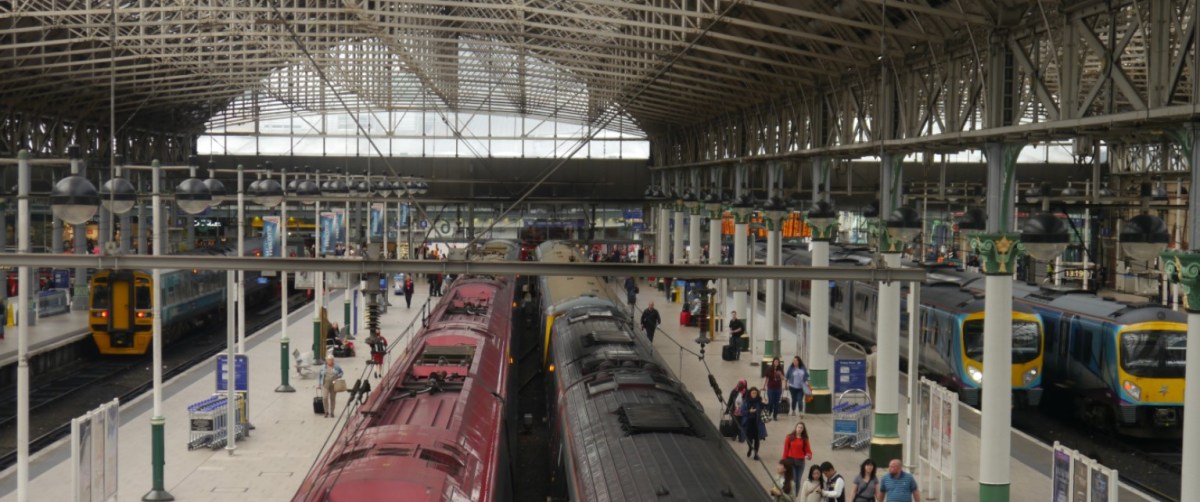
Quick recap: big station, fully electrified since 1960. But five out of six trains in our picture are still diesel. Seems a waste? It’s blindingly obvious more could be electrics, helping to keep the air in the station safe to breathe, helping to combat global warming, if only more lines had the “wires” up. Britain lags other advanced European countries in terms of electric rail-km. Yet the Department for Transport seems to be saying that buying fleets of trains laden with both electric pick-up and diesel-generator equipment is a sensible substitute. As explained in our Autumn issue, we don’t agree. “Bimodes” are inefficient, underpowered on diesel, overweight on electric, more complex and costlier to maintain, bad for business and bad for the environment. If diesel or bimode traction were to be the norm for another generation those polluting trains would still be running when fossil fuel power is coming to an end on the roads. Of course electrification means major investment, and, like any improvement scheme, some disruption. But as has been shown the cost is recouped by operational savings (such less fuel, less maintenance) and the “sparks effect” of trains that more people want to use.

Network Rail is the national agency that has the multifarious tasks of managing day to day operation of the system, maintaining tracks and signalling and organising upgrades. Having let engineering expertise go it has, with its contractors, been learning the hard way how to electrify railways in the North West, in Scotland and on the Great Western. An effectively managed rolling programme would capitalise on the skills gained. Nearly three years ago a politically balanced task force backed by professional research recommended a dozen northern routes for electrification by the mid-2020s. You won’t need reminding that the Calder Valley Line, from Leeds to both Manchester and Preston via both Bradford and Brighouse was the top-scoring scheme.

Campaigning train user groups along the length of the line are not giving up. In the coming weeks, HADRAG, STORM (Rochdale), Bradford Rail Users and our colleagues in the Upper Calder Valley Renaissance Sustainable Transport Group are to jointly launch the Electric Railway Charter. The charter will be a declaration calling for implementation of the task force recommendations with our line at the top. It will promise to keep up the campaign for an economically and environmentally sustainable railway. And it will call on a wide range of other groups—business, environmental, political, workplace, community—to support us. We are already supported by the Yorkshire branch of Railfuture, the national independent group campaigning for a better rail network for both passenger and freight. Spread the word.


Divided we Stop

Disturbing incident, early February, when a 30 year-old “sprinter” train entering Leeds station on a Calder Valley service, became uncoupled, its two coaches separating as they came to a halt. Thankfully such incidents are rare. And on a railway designed to be fail-safe, when the compressed-air pipe running along the train is broken, the brakes come on automatically to stop in the shortest distance possible. So passengers waiting at the station were delayed whilst several lines were closed allowing passengers on the broken unit to be helped out and walked to safety. There will doubtless be an inquiry about why the coupling on this train failed, and we must await the results patiently. But, meanwhile, we can’t help thinking: is pressure on depot time a factor in this kind of failure, given the shortage of trains? Isn’t this another argument for keeping guards on all trains? And what if, instead of mid-afternoon, this train that split in two exposing gaping gangways had been a crush-loaded commuter service?

Header Image: “Leeds station name sign (3 Mar 17)” flickr photo by Daniel H Wright https://flickr.com/photos/danielhwright/32482341114 shared under a Creative Commons (BY-NC-ND) license

Strategic Transport Plan

Transport for the North, soon to become the first statutory subnational transport body, has published its draft Strategic Transport Plan. Rail North, the body of local/combined authorities that in partnership with the Department for Transport oversees the Northern and TransPennine Express train franchises, will become part of TfN. TfN looks to the long term, well beyond the nine-year horizon of the present Northern train franchise. The strategic plan can be found as a hefty collection of on-line material on the Transport for the North website and includes an update of the Long Term Rail Strategy.

All of which will take us some time to digest – but  not take too long as the whole thing is out for consultation and responses must be in by 17th April. You are encouraged to attend consultation events, in various venues, including one looming in Halifax as we write this.  See panel.

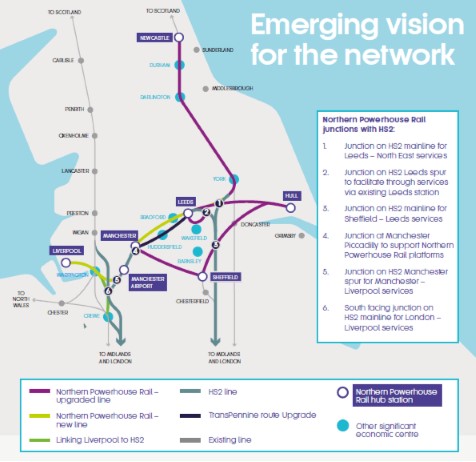
The emphasis seems to be on strategic links between cities as a means of driving economic growth. All transport modes are covered — road and rail, passenger and freight. It’s no surprise that a central proposal is high speed rail linking Liverpool with Hull and Newcastle with a new cross-Pennine line aiming to get the journey between Manchester and Leeds city centres down to 30 minutes. This is Northern Powerhouse Rail (NPR — aka HS3, Crossrail of the North etc). The favoured route for the new line would include a station in the city of Bradford, probably in the centre. We can speculate about the precise route, but much tunnelling is inevitable, on a truly alpine scale. The timescale is unclear but may go some way beyond the projected 2033 completion date for HS2, the high speed line from London to Leeds and Manchester.

For campaigners on the Calder Valley Line it is perhaps difficult to see how the benefits will trickle down to our line. Whatever is built in 15, 20, 25 years time we are surely right to be primarily concerned with shorter term but nonetheless strategic developments that can yield benefits for regular train passengers in a timescale we can see the end of. We want to get people off congested, polluted roads onto free flowing, clean and sustainable railways. With our environmental perspective it is not just about getting into the city centre, or getting between them, as quickly as possible but about making rail the natural mode for more and more people for more and more purposes — social and leisure, personal development, education—not just business and work. Surely its about the quality of everyone’s lives.

But if HS3, sorry NPR, comes through Bradford the intriguing possibility is whether, and how, it might be linked with the “classic” Calder Valley Line. Trains on NPR could get from Bradford to Leeds in maybe 6 or 7 minutes. What if a junction were built in Bradford linking the new line with our line and also Airedale/Wharfedale? Calder Valley trains could run fast Bradford-Leeds cutting the journey time from Halifax to Leeds from 35 minutes or more today to maybe less than 20. And trains from Ilkley or Keighley could run on the high speed line to Manchester. Are we dreaming? Or is this something for which we can realistically campaign? —JSW

Consultation Events

Consultation events on the STP are drop-in events open to everyone but if possible you are asked to register your details on the TfN website . Events have already been held in Halifax and Bradford. The Halifax one was led by TfN’s strategy director Jonathan Spruce and started with a presentation lasting about half an hour, followed by a good hour’s open and informal discussion. Several HADRAG members were present and raised issues including the need for a stronger environmental focus combatting climate change, linking NPR (HS3) with the Calder Valley Line, and the importance of smaller local stations.

The session format includes a repeat of the opening presentation at the end. So you don’t need to be there for the full three hours. Next event is:

  • Leeds – Monday, 5 March at The Tetley, Hunslet Rd, LS10 1JQ, 1600-1900.


Good Old Trains Move On: Can We Have Some?

Congratulations to “our” intercity operator Grand Central on its tenth anniversary at the end of last year. As if to mark the occasion, GC has withdrawn its three InterCity 125 “high speed train” (HST) units, receiving four more of the “Class 180” trains familiar both to Halifax/Brighouse-London passengers and to those  who depend on the 0728 Halifax-Leeds. The extra 180s are from Great Western, another company taking HSTs out of service as new  “Intercity Express Project” trains arrive. The GC HSTs, which received new engines  in 2010, have gone to East Midlands Trains. What a pity they could not have moved sideways from Arriva-owned GC to sister company Northern to help relieve overcrowding whilst we desperately await new trains.

Header Image: “43 480” flickr photo by hugh llewelyn https://flickr.com/photos/camperdown/13914425522 shared under a Creative Commons (BY-SA) license


Good use for good trains?!

It may be a cast-off from down south but this “319” was given a quality refurbishment and and glossy branding by the previous Northern franchise. 86 of these 4-car trains used to work the Bedford-London-Brighton “Thameslink” route that now has a completely new fleet. 32 are now Northern’s, plus eight more that will have diesels added so they can work on both electric and non-electric routes. Good idea? Maybe. But an electro-diesel “bimode” train working, say, the Windermere branch will also have to run to Manchester Airport using power from the 25kV overhead supply, carrying its diesel engines there and back as energy-wasting dead weight.

Sister company Arriva Trains Wales is also, we hear, to acquire bimodes converted from the same fleet. That still leaves about half of the 319 fleet, looking for good work to do. More electro-diesel conversions in prospect?

Is that what we want in a world where we should be saving energy and combatting climate change?

Meanwhile, TransPennine Express has ordered brand new electric trains to use on Liverpool/Manchester-Scotland services, making redundant a small fleet of modern “Class 350” units, pure electrics built just four years ago. The 350s were going to go to the Midlands, but the new operator of the West Midland train operation has ordered new trains instead. So that’s another 10 good, modern pure electric trains that could be put to good use in the North of England, if only more routes were electrified.

Header Image: “Liverpool & Manchester (101)” flickr photo by Rept0n1x https://flickr.com/photos/121958154@N04/16766158856 shared under a Creative Commons (BY-SA) license


Happy Commuting

“Today,” writes one of our commuters, “The 0807 was late, and therefore extra full. By Bradford it was heaving.” The 0749 Halifax-York should be 3-car but sometimes we get: “Only two carriages. Only just got on at Halifax. Several gave up trying. Delayed as last few tried to squeeze on. Will be standing all way to Leeds…” And more: “Only a handful could get on at New Pudsey – must have left more than 50 on the platform. A bit of swearing too.” No wonder people get angry. A phone picture conveys something of the nightmare. Arriva (Northern) promise 37% more peak capacity with new trains by 2020. But why is a train planned for three carriages at present so often only two? We fear worse before it gets better. Halifax-Leeds passengers at present have the 5-car 0728 using an intercity train hired from Grand Central. This highly successful service was not shown in the draft timetable circulated earlier this year for May 2018, leaving a peak-hour 23 minute gap in Halifax-Leeds departures from 0718 to 0741. In other words a reduction in service.

We made our views known in HADRAG’s response to the draft timetable and specifically asked for the GC train to be kept until all the new stock arrives.

Let’s hope.

Station parking debate

Brighouse station “park & ride”. Most of the cars are there all day — no chance if you set off late. Does every car belong to a rail user?

Hebden Bridge station will soon get 50 per cent more car parking, going up to 127 standard + 4 blue badge bays. Mytholmroyd, currently with no official park & ride, shouldn’t be far behind with an ambitious build, still subject to Network Rail approval, to create 195 + 8 spaces. Mytholmroyd will take £3M from £32.5M of WY+ Transport Fund money allocated to West Yorkshire Combined Authority’s initial programme of a dozen stations across the county due to be complete by 2019.

Sowerby Bridge had its car park doubled in size about five years ago, but now on weekdays its 105 or so spaces are nearly all taken by 07.30. Brighouse has a bigger problem with just 64 spaces. Calderdale Council’s transport working group (on which HADRAG’s Chair is a coopted member) discusses station parking and there’s local pressure on West Yorkshire Combined Authority to include more of our stations in future plans. Land could be available at Sowerby Bridge. Brighouse is more difficult. The former dairy site next to the station was sold off commercially by its private owners and is now an office development: in effect WYCA (Metro) was outbid. Future station car parks could be two or more storeys. That would reduce land-take but could be disruptive to build over the existing facility. At Brighouse another issue has been non-passengers parking in the station car park to walk into town, not noticing “rail users only” signs. Station car parks are run by the train companies or their contractors. We have heard of genuine rail users being fined for parking outside the marked bays (perhaps in frustration), but it would seem non-passengers abusing the facility are a more difficult nut to crack.

So what do you do if you want to park at the station and use the train, say mid-morning, but find the car-park full? Many would-be rail users will simply not bother and complete the journey by car. A lot of us have done just that. And it does seem unfair that station parking is effectively unavailable for work, business and leisure travellers setting off later in the day. Most Northern Rail car parks in West Yorkshire and Greater Manchester are free, whilst in other parts of the country – though not all! – charging is the norm. Should West Yorkshire drop its policy of having free train station parking? That would surely cause resentment. Would it not lead some commuters, already jaded by overcrowded trains, to drive to work?

HADRAG’s friend Steven Leigh of Mid-Yorkshire Chamber of Commerce is also a coopted member of Calderdale’s transport working group. Steven has suggested stations might have more than one category of parking, maybe with some restricted-time (but free) spaces and maybe some at premium rate for people who want to travel later in the day. Steven emphasises it’s just an idea. But what if a train ticket plus premium parking ticket is more than you are prepared to spend? And if travelling on business you might be just as prepared to pay for a taxi to the station. It’s a real conundrum and no doubt the debate will continue. What do our readers think?

At Halifax, 30-odd spaces, regularly filled before 07.00, are to be moved off the station bridge to ground level as part of town centre Eastern Gateway plans. The plans also include a public car park on two levels. So whilst there may not, at least initially, be a lot more free parking for rail users, there will at least be pay-to-park spaces, well connected to a transformed station and providing those “premium” spaces for train users setting off later.

Final point. Taking Sowerby Bridge as an example, the station has an annual footfall (passenger entries & exits) of 392000 (ORR, 2015-16). So that’s roundly 1100 per day or the equivalent of 550 return trips, more than five times the station car park capacity. Applying a similar calculation elsewhere you see that most local station users don’t actually park at the station. They may walk, take the bus, cycle or be dropped off by friends/relatives/partners. Shouldn’t we encourage more of this? How many who park at the station before 0700 live walkably close? Maybe a few — and maybe they have good reasons, like getting up at 0530 to get the train when every minute seems to count in busy lives. Park & ride is a significant part of the mix and we need to keep pressing for more.