Have you submitted your objection to proposals to close hundreds of station ticket offices? Included in the list are Halifax, Hebden and Tod. The deadline is tomorrow. In other words they went to close all ticket offices in Calderdale. HADRAG has submitted a 7-page objection (see https://hadrag.com/wp-content/uploads/2023/07/to-consultn-hadragweb-2.pdf ). For most train companies the deadline is tomorrow, Wed 26 July but see below. You can send in your objection to the official watchdog Transport Focus. And for Northern you have until on Friday 28 July at 23.59: Email: ticketoffice.Northern@transportfocus.org.uk
If your response relates to a certain station please include the station name in your response.
Transport Focus is the independent transport user watchdog. If you would like to know more about the consultation process and what happens next please go to transportfocus.org.uk
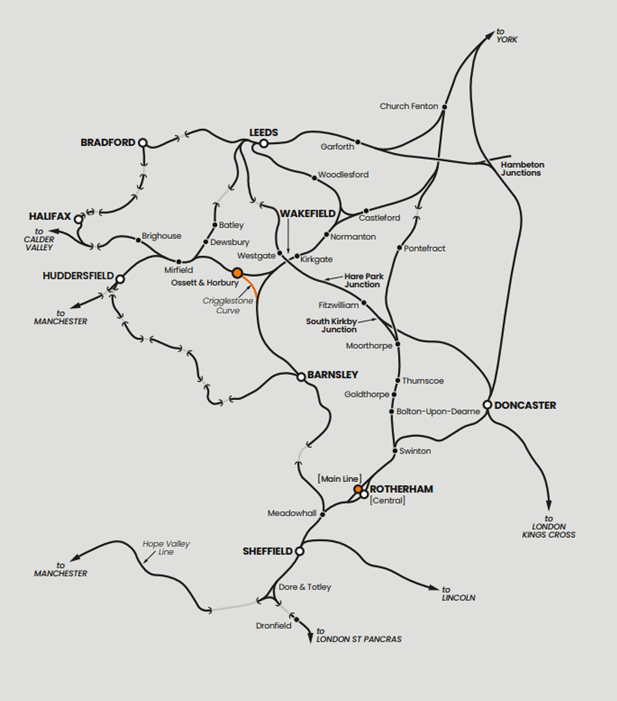
Could a route in the lower Calder Valley be reopened to transform connectivity between Bradford, Calderdale, Barnsley and Sheffield? The Crigglestone curve was one of the five curves that carried just a few trains on summer Saturdays until closed in the mid-1980s. Three of the curves formed the Halifax-Huddersfield railway that reopened with Brighouse station in May 2000. The Crigglestone curve, which carried weekly Bradford-Weymouth train, branched off the Calder Valley line at Horbury Station Junction where Horbury and Ossett station used to be and linked to the Wakefield Barnsley-Line.
The curve has not been used since, but HADRAG members have held on to the idea that this would be a very useful link indeed if reopened for an hourly service every day from Bradford to Sheffield. We reckon trains serving Low Moor, Halifax, Elland (we hope!) Brighouse, Mirfield, and a reopened Horbury and Ossett, could then run fast to Barnsley, Meadowhall and and Sheffield. We reckon Bradford Interchange to Sheffield would take no more than 75 minutes; Brighouse to Meadowhall about 50 minutes.
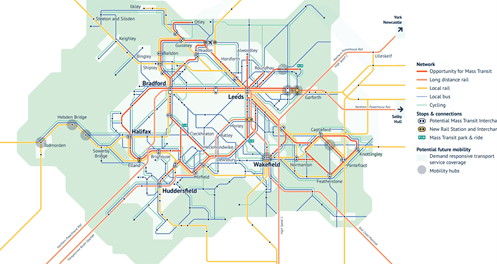
And it would be much more attractive for Halifax and lower Calderdale passengers than the big trail round via Leeds. The map below shows the wider Leeds-Sheffield discussed in a recent report by Greengauge 21 (http://www.greengauge21.net/ )
Map shows the Leeds-Sheffield corridor as envisioned by research group Greengauge 21, Sheffield-Leeds: What’s Next, December 2022.Reproduced with thanks.
Greengage 21’s new paper (http://www.greengauge21.net/wp-content/uploads/Sheffield-Leeds-Whats-Next-A4-FINAL-1.pdf ) advocates immediate action to provide a second fast service every hour Leeds-Sheffield via Wakefield Westgate. A new main line station at Rotherham could be served. On the Barnsley route, East Midlands trains from St Pancras could be extended through to Wakefield Kirkgate and maybe on to York via Castleford.
Greengauge 21 says Bradford-Sheffield would be in a second phase headed initiate planning. The proposed new station at Horbury would serve Ossett, described as the largest town in Yorkshire without a trains. The proposal not only delivers new connectivity for Bradford, Halifax and the Horbury-Barnsley corridor, but also avoids the inconvenience of indirect travel via Leeds for people heading for South Yorkshire, Midlands and beyond. The new service could be extended to the East Midlands, maybe Leicester.
These are feasible ideas that the would allow the railway to make progress, and passengers to feel the benefit, years, maybe decades before plans, still being considered, for new high speed routes come to fruition.
Reinstating tracks along the Crigglestone curve would be a relatively minor piece of engineering. Not as sexy as a new high speed line, but almost as useful!
So we could, just maybe, see Bradford-Sheffield trains coming through Halifax in about 10 years time. HADRAG will certainly be campaigning for that. We have already suggested the possibility of the service through Brighouse is increased one train an hour could go to Wakefield and on to York. Maybe trains to Barnsley and Sheffield could complement that. See our updated policy paper below.
HADRAG members had a great meeting with Cllr Colin Hutchinson at the end of November. Massive thanks to Colin for a great contribution, listening to members ideas and joining the discussion. We look forward to WYCA’s draft rail strategy in 2023.
We have updated our own paper calling for better services at more of our stations including Sowerby Bridge, Brighouse and future Elland. Any one of these three stations potentially serves a population equal to that of upper Calderdale stations combined, but they have a much poorer service. Train frequencies need to be doubled, and decent connections provided – for example so that people from the upper valley can get more easily to Huddersfield. We also think the idea of a new service from Calderdale to Wakefield and York should be explored. Not everyone wants to go to Leeds!
Stations are also a concern. Real fears remain that the government wants to close all booking offices. Yet down at Halifax whenever we visit there is a queue at the window. We also need a return to printed timetables, well distributed so would-be passengers can browse and discover the possibilities of rail travel. These are difficult times with the dispute over not just pay but also conditions – what the railway is going to look like in the future. The only way forward is to expand. See our paper below. JSW:
LATEST report by HADRAG, the Halifax & District Rail Action Group, calls for an action plan to develop the route with better services, decent frequencies at Sowerby Bridge and Brighouse and an equally good deal for the new station now planned to open at Elland in 2025.
The meeting is on Saturday afternoon 26 November, and is open to all local rail users and others who want to see a better rail deal for Halifax and the Calder Valley line.
Busy Brighouse! Station has about half the number of trains it needs.
Venue is the Oddfellows room, ground floor at 3 Coleridge St, Halifax HX1 2JF, starting at 2.30 pm (tea, coffee etc from 2pm). Directions to venue below.
Speaker will be Councillor Colin Hutchinson, who is a Calderdale council representative on West Yorkshire’s Combined Authority’s Transport Committee. Councillor Hutchinson will talk about WYCA’s rail strategy and join the Q&A discussion.
HADRAG’s has produced its own paper setting out ambitions for the Calder Valley line. No. 1 is a more reliable service. Then easy things like gaps in service at Sowerby Bridge and Mytholmroyd need to be sorted out – Mytholmroyd has no trains to Manchester on Sundays. HADRAG quotes figures showing Sowerby Bridge serves a population equal to that of Hebden Bridge and Todmorden combined – but has about half the number of trains. All trains that stop at the main upper valley stations should also stop at Sowerby Bridge, say the campaigners. The same is true of Brighouse and the planned station at Elland.
Elland is now due to open in 2025.
Brighouse and future Elland have just one train an hour on two routes. HADRAG calls for a business case based on population served and housing development, to double that frequency, to have better connections between upper Calderdale and Huddersfield, and maybe open up a new route from Calderdale through Wakefield and Castleford to York. Not everybody wants to go to Leeds! And a lower-valley service would also benefit Wakefield which has poor rail links towards and across the Pennines.
Bradford and Calderdale were let down by the broken promise of regular trains to Manchester Airport serving workplaces, hospitals, universities and leisure attractions on the south side of the city. HADRAG says better services via the Brighouse route could link up to Manchester Piccadilly station.
And come to our meeting on Saturday. Doors open 2pm for 2.30 start. The Oddfellows room is on corner of Coleridge St, just off Prescott Street below Skircoat Road (A629 towards Huddersfield) in Halifax – 5 minutes’ walk from Halifax town centre. All welcome: see you there!
LINKS above will take you to HADRAG responses to recent consultations[1]. It was a busy winter. The Integrated Rail Plan proposed a high speed line from Warrington to Marsden, after which “Northern Powerhouse Rail” would be conventional 3-track, 4-track and a final 8 miles of just 2 tracks Dewsbury-Leeds. We say we will support NPR if it benefits our area. So how about extending the line from Marsden in a tunnel to Bradford? A station at Elland could serve Calderdale, linking with local trains, buses and mass transit. We say more important and more urgent than high speed rail is improving our existing Calder Valley line service, getting trains across Manchester, and getting the line electrified
Other consultations have included the December 2022 and May’23 timetables, following the Manchester Recovery Task Force reports. We have repeated our concern that the idea of a service from Bradford, Calderdale and Rochdale to Manchester seems to be indefinitely shelved. Yet this was a central promise when Manchester’s “Northern Hub” was first put forward. The Ordsall chord line, opened to a limited Calder Valley service in 2017 now has just one TransPennineExpress (TPE) train every hour. Which looks like a fixed pattern until “Castlefield corridor” capacity through Oxford Road on the way to Piccadilly is improved.
It’s not just that we all want to get to the Airport, a dodgy objective in world that must, to secure a civilised future, transition to zero-carbon. But Calder Valley passengers need better access to the south side of Manchester city for work, higher education, health services, history and culture, the arts, and sports attractions, as well as onward regional and inter-city connections.
As an interim measure we have suggested extension of the Manchester Piccadilly-Huddersfield stopping service to Bradford via Brighouse, benefiting lower rather than upper Calderdale, but providing useful regional links. It would also provide a useful service from stations such as Greenfield, Marsden and Slaithwaite to Calderdale and Bradford for commuting and outdoor leisure.
We have repeated our concerns about the Calder Valley service pattern, not least trains that miss out places like Sowerby Bridge and as well as the need for a better service via Brighouse and Elland.
Halifax station gateway plans should now move towards local planning approval. We have written a generally supportive response to the second consultation. The new building and foot (& cycle?) bridge will transform of the whole area. We have expressed concern at a decision to put the ticket office on the ground floor, OK for people arriving by car but useless for those accessing on foot via the new bridge. We say ticket offices will still be needed in the future and putting them out of the way of half the passengers is unhelpful. Just an idea, but how about combining ticket issuing with general retailing? This has been done stations such as Southport and Liverpool Central for years. Train operator Northern told us they want the ticket office downstairs so that staff can keep an eye on people going into the toilets. Understandable. But you couldn’t make it up, could you?
[1] Postal members of HADRAG will be sent paper copies.
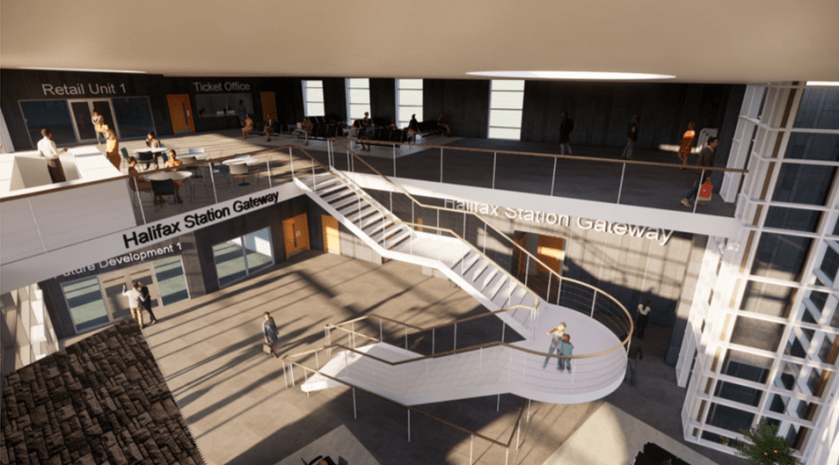
Exciting plans! Latest version of Halifax station gateway proposals are on-line, including iconic new pedestrian bridge linking with town and bus stops, car park at ground level and brand-new 2-storey containing shops and café. Slightly worryingly the ticket office is now shown on the ground floor, though pedestrians arriving over the new bridge will access the station at first floor level.
Ground floor. Booking office is at this level. Are we sure that is right?
Continuing concerns include location of booking office. We accept that with online bookings and tickets on phones, ticket offices are being less well used. But staff need to be available, both to help people use the ticket vending machines, and to provide information and advance booking that even the internet can’t provide.
One idea might be to combine the ticket office with the station shop, so ticket sales could be combined with more general retailing. Please tell us what you think, and more important send in your own response to the consultation by 16 January. More thoughts below.
1 Ticket office location. The circulated materials say little about this, which is slightly worrying. The office appears to have moved from the first floor to ground floor and looks to be out-of-the-way for many potential users. OK for people arriving by car, but a long way and on a different floor from the main pedestrian entrance via the town bridge. We can see how this might work in term of having all staff accommodation together. Northern Trains say the use ticket offices had declined during the pandemic. Out response is that ticket offices need to be reinvented to encourage a greater range of functions and dissemination of material not just about rail travel but about local attractions etc with expanded retailing or even combination with other forms of retailing:
it must be agreed that a ticket and information desk is essential, must be centrally located, and must be staffed throughout most station opening hours;
there should also be staff on the concourse and platforms not least to help people use the ticket vending machines, which become no less complex for users, especially occasional users and people not familiar with the jargon of ticketing;
many station users will arrive from the new town bridge at first floor level and if they then have to drop down to a ground-level ticket office then come back up again to access the footbridge that will be inconvenient, annoying, and increase effective journey time;
alternative solutions for the booking office might be considered:
it could be located on the first floor as originally planned;
it could be incorporated into the first floor retail unit giving a combined rail ticket, information, news and wider retail unit; examples of this arrangement exist at Merseyside stations (Southport, Liverpool Central…).
there could be an island or peninsula staffed desk on the concourse, able to issue tickets and info, provided if necessary with protective glass screens. This could replace some of the seating on the upper concourse. (We expect most passengers to wait for trains on the platform.)
one reason for having a booking office is for people to arrange longer more complex journeys as well as obtain information in a comfortable environment. Whilst a lot of this type of booking is now done online there are also good reasons why people should not be discouraged from visiting the station to book or obtain info. In fact, they should be encouraged. Interaction with staff should be encouraged. Let’s make it a busy place!
Location of TVMs is not particularly clear.
2 Lift – We remain concerned that there is only one public lift between ground and first floor. Lifts are not 100% reliable.
3 Lots of good points including the community room though the access route to this is not all that clear, and access via the underpass to the Hebble Trail for walkers and cyclists. Video here .
4 Provision for future platform 3 is welcome. Needs to be direct ground-level access as well as “up and down”.
The above are our instant reaction. HADRAG’s formal response to follow, after the consultation briefing in January.
This will start with AGM business. We then have speakers (at 11.00) and Q&A session focussing on the Calder Valley line timetable, electrification and community rail. Speakers expected are:
Councillor Daniel Sutherland (Calderdale + WYCA transport committee)
Pete Myers (Northern Rail)
Mick Sasse (West Yorks Combined Authority)
John Lewer (Calderdale Council, transportation)
If you’d like to be at the meeting please use contact form to message us and we’ll send you a Zoom link. Have your say!
HADRAG responded to Transport for the North’s decarbonisation strategy at the end of August. We supported the submission made by Railfuture’s four north of England branches, adding weight to proposals benefiting the Calder Valley line:
Electrification as proposed by the 2015 task force report, which gave the full Calder Valley line top ranking
Development of poorly served routes centred on the Elland/Brighouse corridor, Bradford/Calderdale-Huddersfield, upper Calderdale-Leeds, Wakefield and York. Rail can succeed as low-carbon mode of transport whilst other modes are still planning their catch-up.
Here is HADRAG’s submission, with links to the longer Railfuture document:
HADRAG supports the ambitions of Transport for the North to decarbonise transport across the North.
We agree with the submission made by the northern branches of Railfuture which can also be found on the Railfuture website at www.railfuture.org.uk/display2779 (freeform response – also appended to this report) and www.railfuture.org.uk/display2780 (questionnaire response).
HADRAG is a founding group of the Electric Railway Charter (www.electriccharter.wordpress.com). We support a rolling programme of electrification across the North of England as envisaged by the Northern Sparks task force (NETF) report (spring 2015). Northern Sparks gave top ranking on the basis of business, economic and environmental criteria to electrification of the full Calder Valley line from Leeds via both Bradford and Brighouse to Manchester, East Lancashire and Preston. Thus described, the CV Line was placed first in list of a dozen schemes for an initial 5-year programme (the five years being 2019-2024). We still await a government go-ahead for any kind of rolling programme. Indeed we still await a definite go ahead for electrification of the Huddersfield line under the TransPennine Route Upgrade, and for the Midland main line from Market Harborough to Sheffield. These two schemes were baseline assumptions of NETF.
The recent Traction Decarbonisation Network Strategy (TDNS – summer/autumn 2020) by Network Rail generally reinforces the Northern Sparks recommendations. TDNS recommends that about 85% of unelectrified railways across Great Britain should be overhead electrified. Overhead electrification offers at least about 80% energy efficiency (source to wheel) compared with about 70% for battery-electric trains and 34% or less for hydrogen. 34% efficiency means 66% of original energy wasted. All energy transfers involve wastage. Overhead line electrification wastes least because fewer intermediate transfers or conversions are involved. Given the low energy storage density of batteries and hydrogen it is no surprise that TDNS recommends batteries for only 5% and batteries only 9% of unelectrified routes. (For references see Railfuture submission below.)
Northern Sparks and TDNS surely provide the basis of a rolling programme in the North.
Modal shift and the Calder Valley Line
Rail is already low-carbon compared with other modes, and overhead electrification will increase this advantage. Whilst the road, air and marine transport are still working on solutions to decarbonisation at least a modest start can be made by encouraging modal transfer to rail. Whilst our Calder Valley Line is waiting for electrification there are opportunities for decarbonisation by services particularly by increasing frequency over at present underused route through Brighouse (with a new station expected at Elland in the next two years).
The Railfuture submission (appended) lists some possibilities for the CV Line focussed on the Brighouse and Elland route. Calderdale, Kirklees, Wakefield network:
From Preston/East Lancs/Calderdale via Brighouse, and from Manchester via Stalybridge to Huddersfield, Wakefield, Castleford and York; including links via routes crossing at Elland/Brighouse between Bradford, Calderdale, Huddersfield and Leeds, where greater frequency is required;
New/increased services could include some of the following –
New service Preston-Wakefield-Castleford-York (additional to existing Blackpool-Bradford-York)
Huddersfield-Castleford service extended to Pontefract/Knottingley
Manchester-Stalybridge-Hud service extended to Wakefield and York
Increased frequency upper Calderdale-Brighouse-Leeds/Wakefield connecting into increased frequency Bradford-Huddersfield at Elland/Brighouse
New service upper Calderdale-Huddersfield.
The sub-paragraph in bold suggests a “taktfahrplan” approach with half-hourly west-east services connecting into half-hourly north-south services at Elland/Brighouse. Other solutions are possible. We would also like to see services developed along the Preston-Wakefield-York corridor opening new opportunities for rail for to offer low-carbon alternatives, for example for a direct from Calderdale to Wakefield, Castleford and York avoiding Leeds. We refer to the Railfuture submission attached for further points.
Is it stopping? Most of the day only half of trains through Sowerby Bridge stop. We think they all should. And we want a better deal for the Brighouse line. (So what’s new?)
Northern, along with other train companies across the region has published draft timetables for May next year. But their draft for next year shows limited changes for Calder Valley line – where the present timetable is set to carry on, pretty much, warts and all. But big changes are expected in December 2022 resulting from the task force consultation earlier this. It seems “Option B+” is to be adopted. We expect to keep our hourly service to Chester, are still going to be kept waiting for trains to south the of Manchester and the airport.
We have taken the opportunity to a call for a Swiss-style “taktfahrplan” or fixed, even-interval with connections between different routes giving predictable regular connections between. For example a half-hourly upper Calder Valley-Brighouse-Leeds/York service could connect at Brighouse (or Elland) Bradford-Huddersfield trains, something that’s never quite worked in the past. Let’s make it work in the future!
HADRAG has responded to three consultations so far this year.
Halifax station gateway is moving toward the final stage of plans (see Halifax Railway Station | Calderdale Next Chapter) We have welcomed the latest iteration of this transformational scheme for a new concourse building, parking and drop-off area, and pedestrian bridge linking to town. And we are pleased to note that the scheme is now designed to allow from possible reinstatement of a third operational platform in the future. Platform 3 is not going to be used in the present scheme but it will be left undamaged for a possible use as the train service is increased. Our response the consultation held in February this year is here .
A DfT and rail industry task force on Manchester Rail Recovery (MRRTF) reported early this year (see Manchester Recovery Task Force: Public Consultation (publishing.service.gov.uk)). Whilst the wait continues for major infrastructure enhancement, the idea was to come up with a timetacle that could work reliably over the complex routes in Manchester, notably the Castlefield corridor shown on HADRAG’s map below:
Three options were put out to consultation. We were disappointed, but not surprised, that there was no proposal to provide the service from Bradford, Calderdale and Rochdale via the “Ordsall chord” to stations on the south side of Manchester city and the airport. Connectivity to Deansgate, Oxford Road and Piccadilly stations would open up a wide range of travel opportunities for work, education, heritage and the arts as well as onward connections. And it would better connect our area for visitors coming in. We ask for the link promised by the now defunct Northern franchise, and for other improvements to the service on the Calder Valley line. Our response is here.
Finally, we have responded to the West Yorkshire connectivity strategy and Rail Vision . Alongside a bold vision for a network of mass transit routes across the county there are plans to continue upgrading a rail lines. We are pleased that WYCA continues to support electrification as recommended by the Northern Sparks task force six years ago, putting the Calder Valley Line as number one scheme. Our response supports the mass transit proposals, where we comment on suggestions for Bradford-Halifax routes serving Queensbury, Ovenden and Calderdale hospital, with rail, interchanges and Halifax, Elland and Low Moor. On the rail vision we welcome plans for capacity upgrades and possibe new services over existing lines. We want a better timetable for the Calder Valley line, a fair deal for Sowerby Bridge, Elland and Brighouse, and new services, for example to York via Brighouse, Wakefield and Castleford.
Comments on the governments “Great British Railways” white paper to follow.








 Halifax and District Rail Action Group