


We published our pre-election letters to election candidates in the summer issue of this newsletter. After the election Hadrag wasted no time and wrote to both Kate Dearden and Josh Fenton-Glynn as newly elected MPs for Halifax and Calder Valley constituencies. Two separate letters were sent:
- firstly on the need for improvements to the Calder Valley line service – in terms both of timetable quality and of service delivery;
- followed up by one specifically the need for decarbonisation by electrification and our Electric Railway Charter.
To say our new parliamentary representatives have a lot on their plates may be something of an understatement. We have provisionally set a date in diaries for a meeting mainly about electrification, early in the new year. We are thinking about three Hadrag members would be involved.
There are, of course, strong pressures to backtrack on electrification, but we intend to keep up the pressure for full wiring of the Calder Valley line – or rather lines. Leeds to Bradford Interchange must be the start. But remember that the 2015 Northern Electrification Task Force – yes, 10 years ago! – gave top ranking in its report Northern Sparks not just to the line to Manchester via Rochdale but also through East Lancs to Preston (already wired on to Blackpool). In West Yorkshire the line through Bradford and Halifax is essential and also the Brighouse route. That is what Northern Sparks meant by the full Calder Valley line. It has been largely supported by subsequent reports. Calderdale Council has twice agreed resolutions supporting electrification, and West Yorkshire Combined Authority (WYCA) continues to state as a need “electrification of our railway lines with the Calder Valley line identified as a priority” – WYCA Rail Strategy: Our Requirements (published 2024).
We are less sure about the sub-national body Transport for the North.
The Calder Valley Line is a natural follow-on to electrification of the Huddersfield line now approved under the Transpennine Route Upgrade.
There is pressure to cut capital cost of electrification by doing partial schemes and using trains with batteries. The Railway Industry Association published a report earlier this year calling for a decarbonisation by thirds approach. Broadly speaking this means a third already wired, a third planned schemes, and the rest alternative traction – batteries. But batteries waste energy, complicate traction systems and increase operating costs.
The RIA has published a map. It shows our line electrified – result! – but only as far west as upper Calderdale. Lines to Manchester and Preston would be left to unwired. This we say is not good enough. Our letter to the RIA and Rail Engineer magazine are shown below. We are awaiting a reply.
HADRAG: The Halifax & District Rail Action Group on the Calder Valley Line and Electric Railway Charter
David Shirres, Editor, Rail Engineer magazine and David Clarke, Technical Director, Railway Industry Association 1 November 2024
“Dear friends,
This is about RIA’s paper Delivering a lower cost, higher performing, net zero railway by 2050 (April 2024), featured in Rail Engineer magazine May-June 2024 (see links).
The paper is very welcome. We understand the principle of making essential decarbonisation affordable by limiting the number of further lines to be electrified.
We are worried however that our Calder Valley line, a major cross-Pennine route, is only shown for partial electrification. The Calder Valley line links West Yorkshire with Greater Manchester and Lancashire. Between Leeds and Manchester frequency of passenger trains is typically 4 trains/hr (6/hr Rochdale- Manchester). Two passenger trains/hr use the route into East Lancashire and there is an additional stopping service serving Colne. The trains through East Lancs include the highly successful York-Blackpool expresses, with obvious scope for increased frequency.
Both branches of the Calder Valley line also carry heavy freight trains, around two dozen paths per day (though not all used every day). We seriously question therefore whether wiring only from Leeds and Bradford to Todmorden is sufficient.
The Northern Electrification Task Force, an all-party body drawing on professional expertise, proposed full electrification of most lines across the North. Their report Northern Sparks[1] in 2015 ranked schemes on operational, business and economic criteria. The full Calder Valley line earned top ranking[2]. “Full” meant the complete route from Leeds to Preston and Manchester via both Bradford and Brighouse, linking with TransPennine route electrification.
Since then we have had other reports with similar conclusions. A rolling programme of electrification has been identified as a cost-saving, skill-developing procedure. Such a programme is under way in Scotland.
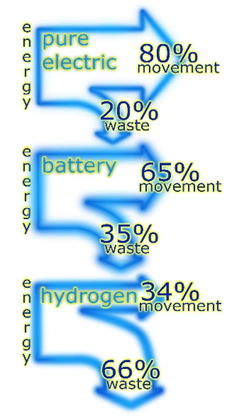
Our three simple Sankey diagrams illustrate the energy efficiencies of pure electric, battery and hydrogen powered trains. They reflect the figures on in Table 1 on p13 of the RIA paper. We have been a little generous with the value for hydrogen trains. The 65% efficiency for battery trains seems right for normal charging systems, but fast chargers as developed by Vivarail and advocated in your report for remote routes involve trickle charging of a static battery which is then used for rapid charging of train batteries – two charge-discharge stages. A first-order estimate of efficiency for fast-charged battery trains is thus maybe just over 50%. Half the energy is wasted. (And yes, we know this is better than diesel.)
Batteries also have a significant mass. More mass to accelerate even when running on electricity from the overhead wire. This again reduces efficiency – wastes more energy. Complexity alone means the cost of building, operating and maintaining battery trains is significantly greater than for pure and simple electric.
Then there is battery lifetime, and dependence on lithium supplies (with their own environmental impact) to consider. Demand for lithium seems set to increase, with cost consequences.
The RIA flier Rail Electrification: The Facts – Campaigns RIA (2023) sums up the arguments for electrification on one sheet.
Can we afford the complexity, inefficiency and future cost of continuing to not electrify strategic routes like the Calder Valley?
We issue a reminder at this point of the question of heavy freight and its volume on the Calder Valley line. Surely these massive trains cannot be left to run on diesel?
We are not opposed to batteries. We understand that batteries will be part of the transition to zero-carbon. Some lightly used lines will never be electrified. Some may use hydrogen. But the Calder Valley routes are busy with passenger and freight trains. Full electrification will be worthwhile. It will pay back in a reasonable time.
We expect the Calder Valley line to be in the first phase a coming programme of full electrification, as envisaged a decade ago in Northern Sparks, and supported by local and combined authorities and businesses along the route.
Looking forward to receiving any comments you are able to make.”
With thanks in anticipation and best wishes, Stephen,
Chair HADRAG (and joint coordinator of the Electric Railway Charter)
[1] EFT Report FINAL web.pdf (https://transportforthenorth.com/wp-content/uploads/EFT Report FINAL web.pdf )
[2] It was assumed that other schemes already planned such as the route through Huddersfield would be finished first.
“Northern Electrics branding” flickr photo by hugh llewelyn https://flickr.com/photos/camperdown/20658157925 shared under a Creative Commons (BY-SA) license
 Halifax and District Rail Action Group