Down at the Station

Big crowds at Halifax station when we were there one Saturday. Issues Hadrag had raised decades ago were still issues. People crowding on the narrowest parts of the island platform particularly the Leeds-bound platform by the waiting room where the curve reduces how far you can see. Having to say “excuse me” to pass folks close to the edge just feels unsafe. How about what we suggested all those years ago: signs, PA announcements, and screen messages inviting people to move along to where there is more space. More seats would also be good.

Latest footfall statistics from the Office of Road and Rail came out as we were putting this Rail Views to bed. Halifax recorded 1,620,920 passenger entries and exits (Apr’23 to Mar’24). This compares with a peak of 1,992,662 – so near 2 million! – in 2016-17. The pandemic yielded a low of 368,000 (2020-21), since when we’ve seen a healthy increase. We can see the increase in leisure travel with our own eyes – crowded trains on Sunday! Commuting is also back on the increase – but many workers are going in for fewer days. We’ll do a full report for our first issue in 2025. For now we’ll just add that Sowerby Bg is on 372,672 (91% of peak value 409,938 in 2019). Sowerby Bg now has slightly higher footfall then Brighouse. Let’s hope Northern can build on this. (More on this in next issue of Rail Views.)

Back at Halifax, at time of writing the single lift – essential for people unable to use the stairs – had been out of service for some days. Thanks to Northern for keeping us informed: work was completed as predicted. Years ago we suggested installation of a ramp. It would have to be a substantial structure to provide for disabled access.

Toilet at back of waiting room is still unpleasant to use. Plans to replace fittings – we have asked about timescale – look to be pretty much like-for-like. How about a new modular unit at the station entrance? Would plumbing be a problem? (In the early days of Hadrag, toilets were always mentioned at our AGMs!) With the station gateway proposals “pipelined” – waiting for funding from somewhere – there is a fear nothing will be done. Halifax deserves better than this. Could car parking could be moved off the forecourt to ground level? New access would have to be made, but space would be created at the station entrance to facilitate safe drop-off, pick­up, taxis, and of course good access for people with disabilities.

Electric Progress?

We published our pre-election letters to election candidates in the summer issue of this newsletter. After the election Hadrag wasted no time and wrote to both Kate Dearden and Josh Fenton-Glynn as newly elected MPs for Halifax and Calder Valley constituencies. Two separate letters were sent:

  • firstly on the need for improvements to the Calder Valley line service – in terms both of timetable quality and of service delivery;
  • followed up by one specifically the need for decarbonisation by electrification and our Electric Railway Charter.

To say our new parliamentary representatives have a lot on their plates may be something of an understatement. We have provisionally set a date in diaries for a meeting mainly about electrification, early in the new year. We are thinking about three Hadrag members would be involved.

There are, of course, strong pressures to backtrack on electrification, but we intend to keep up the pressure for full wiring of the Calder Valley line – or rather lines. Leeds to Bradford Interchange must be the start. But remember that the 2015 Northern Electrification Task Force – yes, 10 years ago! – gave top ranking in its report Northern Sparks not just to the line to Manchester via Rochdale but also through East Lancs to Preston (already wired on to Blackpool). In West Yorkshire the line through Bradford and Halifax is essential and also the Brighouse route. That is what Northern Sparks meant by the full Calder Valley line. It has been largely supported by subsequent reports. Calderdale Council has twice agreed resolutions supporting electrification, and West Yorkshire Combined Authority (WYCA) continues to state as a need “electrification of our railway lines with the Calder Valley line identified as a priority” – WYCA Rail Strategy: Our Requirements (published 2024).

We are less sure about the sub-national body Transport for the North.

The Calder Valley Line is a natural follow-on to electrification of the Huddersfield line now approved under the Transpennine Route Upgrade.

There is pressure to cut capital cost of electrification by doing partial schemes and using trains with batteries. The Railway Industry Association published a report earlier this year calling for a decarbonisation by thirds approach. Broadly speaking this means a third already wired, a third planned schemes, and the rest alternative traction – batteries. But batteries waste energy, complicate traction systems and increase operating costs.

The RIA has published a map. It shows our line electrified – result! – but only as far west as upper Calderdale. Lines to Manchester and Preston would be left to unwired. This we say is not good enough. Our letter to the RIA and Rail Engineer magazine are shown below. We are awaiting a reply.


HADRAG: The Halifax & District Rail Action Group on the Calder Valley Line and Electric Railway Charter

David Shirres, Editor, Rail Engineer magazine and David Clarke, Technical Director, Railway Industry Association 1 November 2024

“Dear friends,

This is about RIA’s paper Delivering a lower cost, higher performing, net zero railway by 2050 (April 2024), featured in Rail Engineer magazine May-June 2024 (see links).

The paper is very welcome. We understand the principle of making essential decarbonisation affordable by limiting the number of further lines to be electrified.

We are worried however that our Calder Valley line, a major cross-Pennine route, is only shown for partial electrification. The Calder Valley line links West Yorkshire with Greater Manchester and Lancashire. Between Leeds and Manchester frequency of passenger trains is typically 4 trains/hr (6/hr Rochdale- Manchester). Two passenger trains/hr use the route into East Lancashire and there is an additional stopping service serving Colne. The trains through East Lancs include the highly successful York-Blackpool expresses, with obvious scope for increased frequency.

Both branches of the Calder Valley line also carry heavy freight trains, around two dozen paths per day (though not all used every day). We seriously question therefore whether wiring only from Leeds and Bradford to Todmorden is sufficient.

The Northern Electrification Task Force, an all-party body drawing on professional expertise, proposed full electrification of most lines across the North. Their report Northern Sparks[1] in 2015 ranked schemes on operational, business and economic criteria. The full Calder Valley line earned top ranking[2]. “Full” meant the complete route from Leeds to Preston and Manchester via both Bradford and Brighouse, linking with TransPennine route electrification.

Since then we have had other reports with similar conclusions. A rolling programme of electrification has been identified as a cost-saving, skill-developing procedure. Such a programme is under way in Scotland.

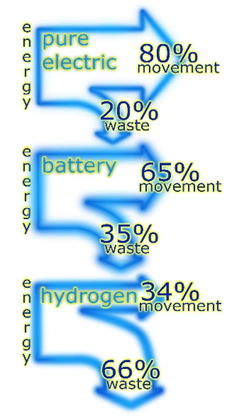
Our three simple Sankey diagrams illustrate the energy efficiencies of pure electric, battery and hydrogen powered trains. They reflect the figures on in Table 1 on p13 of the RIA paper. We have been a little generous with the value for hydrogen trains. The 65% efficiency for battery trains seems right for normal charging systems, but fast chargers as developed by Vivarail and advocated in your report for remote routes involve trickle charging of a static battery which is then used for rapid charging of train batteries – two charge-discharge stages. A first-order estimate of efficiency for fast-charged battery trains is thus maybe just over 50%. Half the energy is wasted. (And yes, we know this is better than diesel.)

Batteries also have a significant mass. More mass to accelerate even when running on electricity from the overhead wire. This again reduces efficiency – wastes more energy. Complexity alone means the cost of building, operating and maintaining battery trains is significantly greater than for pure and simple electric.

Then there is battery lifetime, and dependence on lithium supplies (with their own environmental impact) to consider. Demand for lithium seems set to increase, with cost consequences.

The RIA flier Rail Electrification: The Facts – Campaigns RIA (2023) sums up the arguments for electrification on one sheet.

Can we afford the complexity, inefficiency and future cost of continuing to not electrify strategic routes like the Calder Valley?

We issue a reminder at this point of the question of heavy freight and its volume on the Calder Valley line. Surely these massive trains cannot be left to run on diesel?

We are not opposed to batteries. We understand that batteries will be part of the transition to zero-carbon. Some lightly used lines will never be electrified. Some may use hydrogen. But the Calder Valley routes are busy with passenger and freight trains. Full electrification will be worthwhile. It will pay back in a reasonable time.

We expect the Calder Valley line to be in the first phase a coming programme of full electrification, as envisaged a decade ago in Northern Sparks, and supported by local and combined authorities and businesses along the route.

Looking forward to receiving any comments you are able to make.”

With thanks in anticipation and best wishes, Stephen,

Chair HADRAG (and joint coordinator of the Electric Railway Charter)


[1] EFT Report FINAL web.pdf (https://transportforthenorth.com/wp-content/uploads/EFT Report FINAL web.pdf )

[2] It was assumed that other schemes already planned such as the route through Huddersfield would be finished first.


Bradford: new station needed for better train performance

One major effect on Calder Valley line performance is the track capacity and flexibility of layout at Bradford Interchange station. Bradford famously has two terminus stations. Interchange adjoins the junction of lines to Bradford and Leeds, and trains from the Halifax direction going towards Leeds will always conflict with ones coming the other way. Extra tracks have been put in in recent years. So, for example you might find your Leeds train running into the station alongside another one from Leeds. But to continue their journeys these trains will have to cross each other’s paths – as if the lines were single track. That works OK if everything is running precisely to time, but at the moment that is often not the case. How often do we get stopped at signals coming into Bradford Interchange? These signal stops propagate delays.

The obvious answer is a new “through” station eliminating the need to reverse, instead of a terminus. Journey times could be cut. With other track upgrades Leeds to Bradford could be 12 minutes, Leeds-Halifax maybe 25 minutes.

But where would you put the new through station. Colin Elliff who spoke at our AGM in July wants a cross­city link to the line into Forster Square. This would be a massive project possibly cutting through the top floor of the Broadway shopping centre. Is it realistic to suggest that? Forster Sq feeds an indirect route (2 miles further) to Leeds and potentially has its own junction conflicts such as at Shipley. Colin talks of four tracking as part of solution.

A site that has been proposed more officially is St James’s wholesale market. This would slightly reduce the distance to Leeds cutting out the present curve. But St James’s is outside the present city centre. Is there a more central site that could accommodate four platforms fit for trains 250m in length (10 coaches)?

Could West Yorkshire’s mass transit proposals help? Final proposals for the first phase should be out next year. Could trams provide the missing link from a new station replacing Interchange and serving an upgraded Calder Valley service, to key city-centre stops and Forster Square?

Meanwhile work continues to make Interchange fit for use in Bradford’s Year of Culture, 2025.

What do Hadrag members think? – jsw.


Performance and Comfort Concerns

Hadrag’s September committee meeting asked me to write to Northern about service performance. Both reliability – whether trains in the timetable actually run – and punctuality – how close the trains that do run are to scheduled time. As I write this I have still to write that specific letter, but there will be little in it that has not already been raised with Northern’s managers and mentioned to our new MPs in recent month.

A friend of a friend reported recently on commuting travails. Points failure one week, next week signal failure – both times an hour late to work. “Tree down on line, no trains. Travelled to Manchester and had to pay twice… revenue inspector would not accept ticket despite Northern website saying they would. Still not got money back. Generally all my trains are late especially in the morning.” One in ten were on time – sounds like 50% were around 5 or 10 minutes late and a substantial number more than 15 minutes late.

A frequent Halifax passenger who commutes on Wednesday evenings for a choir practice in Todmorden reports (OK, this one is me) that trains that are often now five minutes or so late – used to be closer to time. Last week the 2143 back to Halifax was cancelled – the second time in, I think, three weeks. On the first occasion I went for the bus – a slow and miserable journey – but this time waited on Tod station. Next train was 20 minutes late, so I got back to Hfx at 2253, 49 late on original schedule. Actually it turned out my usual 2143 train had eventually run but arrived in Hfx 58 minutes late. I count that as effectively cancelled. Next week the train ran, but was 21 min into Halifax, result of slippery rails, and a signal stop to allow the 2221 to Leeds to leave first. It should be noted that poor rail conditions mean drivers proceed with greater caution, a need highlighted by the recent fatal collision in mid-Wales.

No staff on stations late at night of course. Frequent electronic PA messages at Todmorden were as usual electronically broken up, defying comprehensibility. We did gather the disruption was result of a teatime incident when a person had been taken ill on a train. We can only sympathise with the passenger involved and with train staff on hand to help. We hope all is now well with them. Station screens at both Halifax and Todmorden continued to refer to the disruption throughout the evening as if it had just happened. Obviously, we realise that disruption after an incident may last several hours. We also totally appreciate that this disruption did not originate with Northern staff or management. The data below may be of interest for that day.

One day in November: departures from Halifax (information from “RTT” Realtime Trains (www.realtimetrainsco.uk) Formatted so higher figure means better performance. Northern trains only included. Includes trains normally via Bgh and Dew to Leeds diverted due to TP route upgrade work
Time periodNumber of trains in timetableNot cancelled (or late enough to be so considered)On time or up to 5min lateOn time (= 0 late)Other points
0545-11597069    =    98.6%62    =    88.6%44 = 32.3%Not bad for time of year!
1200-17596665    =    98.4%57    =    86.4%
1800-23596152    =    85.2%*38    =    62.3%12 = 19.7%* 9 cancellations include 1 train that ran but was more than an hour late (i.e. effectively cancelled). Evening affected by passenger taken ill on train.
All day197186 =    94.4%157 = 79.7%56 = 28.4% 

Note that in the first two thirds of the day less than a third of trains were precisely on time (= 0 minutes late). This is considerably worse than results we obtained in the days of The HADRAG Survey though autumn results always reflected poor rail conditions. However for up to 1800 hrs when the disruption started the “up to 5 min late” percentages are not too bad. The Survey always yearned for improvement!

We looked again at the data on RTT for the following Saturday. Brighouse-Leeds should have been running normal route from Wigan and Manchester, but lo and behold they were diverted via Halifax as they are at present whilst work is taking place on the Dewsbury route Mon-Fri). And no trains on the Bradford-Huddersfield line, nor freights on the Sowerby Bridge to Mirfield route. On the Monday we noticed a temporary speed restriction in place on the river bridge at Elland.

Bradford-Huddersfield has always felt like a soft target for cancellations. And of course the York-Blackpools, not least at weekends, and the Chester trains which change crews along on the way and have a complex route prone to other operators running late. We have seen York- Blackpools running empty all the way, presumably because there was no guard (conductor) available, though again these trains seem to change crews en route. There has been a lot of talk about industrial relations issues and people not working weekends. (Would you want to?) But weekend services are becoming more and more important. So there need to be agreements that mean train staff do work weekends – with an acceptable deal of course.

Are more staff are needed? New (interim) rest-day working agreements were put forward soon after October’s Rail North Committee. Northern was taken to task by Andy Burnham, GM metro mayor. A month later Northern revealed plans to get cancellations down to 2% (under 5% on Sundays) and get punctuality above 90% by 2027. Burnham said: “We cannot wait until 2027. That cannot happen. We do not understand why the answers are so vague regarding improvement and we need a better working relationship to bring that target down because 2027 is completely unacceptable.”

Back on the Calder Valley line in September the Warings came close to missing a concert in Blackburn when not one but two Saturday morning Blackpool trains were cancelled. Shouldn’t the York-Blackpools be four coaches not three? We got the train in between that actually ran. Was it crowded – you bet! If you needed the toilet, you’d better be standing next to it. Another was the time we were on our way back from Todmorden on that 2143. Normally 4 coaches – lots of space! – it was two coaches and absolutely rammed on this Saturday night. The one toilet was out of service.

Weekend trains are often very busy. People have to stand. Why should they have to grin and bear it? They paid enough for their tickets.

The toilet issue needs to be dealt with. The new(ish) 195 class trains have two or three coaches per unit but one toilet per unit. Not too bad if you can get to it, But if you are on a train that’s two pairs of 2-car units and one toilet is not working you may be stuck. Are toilet failures increasing? Not long ago we were on a train – toilet not working – that had to make a special stop of Hebden Bridge so people could use the facilities there.

Above all, access must be improved so that people with disabilities can board and alight easily. It may not work at every station platform yet, but if trains are designed for level boarding that is a start. It also means access to decent toilets. We also need:

  • space for cyclists so they are not competing with disabled people.
  • comfortable spaces for family groups.
  • and a view out of the window! (Next time you get on a “195” train notice which seats people avoid.)

Trains need to be fit for the growing cohort who want to use them, but just hope that one day they will be able to rely on the service, expecting a comfortable journey. We contribute through taxes to the cost of our transport system. That system must be available to all.


“Class195 Interior” by Superalbs is licensed under CC BY-SA 4.0.

Fares: Hull, Halifax and Chester

First the good news. You can now buy Northern cheap “Advance” tickets up to 15 min before travel from station ticket offices. Previously the company was refusing to let station staff, or ticket vending machines, sell these tickets on day of travel. (They were however allowed to sell other train companies Advance tickets “on the day”.) Common sense – good for staff and good for those of us who like talking to other human beings. Well done, Northern.

There are still issues about advance-purchase, though. The Calder Valley service to Chester is a big success. Halifax-Chester is about £27 for return journey using two Advance singles. (All fares quoted before any railcard discount. Looked up, Nov 2024: subject to change) But Advance fares are only valid on booked train. What if you want flexibility? Who wants to specify both outward and return journeys on a trip like Halifax-Chester? A short distance return valid on any Northern train is about £45 (any operator off-peak about £55 – ouch!) Cheaper options may be available by “split ticketing”. Hull-Halifax is another example. Two Hadrag members recently came back from Rotterdam by P&O North Sea Ferries. They didn’t want to specify train in advance of fear of missing it. An anytime flexible single would be £39.50 (each – another ouch!). An Advance ticket (booked train only) could be about £13/person. But you have to know which train you are travelling on before you book. In the end our pair went to the ticket office, but found they couldn’t book the cheap fare in person (it was before the rules were relaxed) so booked on phones.

Advance tickets are quoted-controlled: only so many available for any train. Now it is rumoured Advance tickets could go back to being sold no later than the day before. This must strengthen the argument for cheaper on- the-day fares. We can understand long-distance operators like LNER marketing Advance (fixed train) tickets. But why does a local and regional operator have to ape this practice?


Staying power – Hadrag hits 40 in 2025!

If memory serves, in the early 1980s we had a basic hourly train service Leeds-Halifax-Manchester. A threat to cut the line to single track Bradford to Sowerby Bridge would have killed development. We needed an organisation to welcome improvements and demand more. So in 1985 we called Hadrag’s inaugural meeting.

Now, Mondays to Saturdays, Halifax has two trains/hour to Manchester, four to Leeds. The “Roses Rail Link” had begun in 1984 (so another 40th!) and is now scheduled hourly every day York-Halifax-Blackpool. We need this service to call at Sowerby Bridge, hourly, 7 days a week. Trains also run via Brighouse, reopened in in 2000. The hourly stopper Manchester- Todmorden-Brighouse-Dewsbury-Leeds was transformative when added to the (Leeds-)Bradford-Huddersfield trains in 2008. We say this direct service should also run on Sundays; West Yorkshire Combined Authority wants that too. Brighouse needs more trains, faster journeys to Leeds, all week. Brighouse, along with Bradford, Low Moor and Halifax is also served by Grand Central trains to London King’s Cross. Brighouse station usage grew percentage-wise faster than any other local station over more than 10 years before Covid. Why does Brighouse have effectively only one train an hour on its two essentially separate routes? And why does this big town have to put up with substitute buses when the line through Dewsbury is blocked for upgrade work? Can they not divert the trains as TransPennine do?

Elland station? The hope now is 2027.

In 2015 an all-party task force launched “Electric Sparks”, a well-considered proposal for electrification across the North. The full Calder Valley line was given top ranking linking West Yorkshire not just with Manchester but through East Lancs to Preston. Electric trains should by now be running on our lines through Bradford, Halifax and Brighouse. The Huddersfield line upgrade is underway – originally planned to be finished in 2019 – with a commitment to full wiring, as our line also needs. Hadrag with other cross-Pennine groups launched the Electric Railway Charter in Halifax. Big name supporters of CV line wiring include Calderdale Council and West Yorkshire Combined Authority. What, we wonder, about Transport for the North? We have some way to go.

ORR station footfall figures just out show continuing post-pandemic recovery. Full report in next Rail Views.

Meanwhile, we are engaging with train operators about performance. We used to say on good days it’s an excellent service, but recently some days have been dire. All taxpayers support the railway. All – young, old, able-bodied, or less mobile – should feel confident to use our trains. We all deserve better.

JSW, 29 Nov’2024


Waiting for Elland!

When we founded HADRAG in 1985 one aim was to get the Halifax-Huddersfield links reopened with stations at Brighouse (previously closed 1970) and Elland (closed 1962). The initial service in 2000 was hourly Leeds via Halifax to Huddersfield, with a peak-hour extra between Hebden Bridge, Brighouse and Leeds (via Dewsbury). In 2008 the “extra” became hourly from Manchester (now Wigan) was added, a big boost, though Mon-Sat only. So Brighouse has two services an hour on two different routes. The station had largest local percentage increase in footfall over more than 10 years after that service boost. Brighouse needs more trains, starting with Sunday trains on Leeds and Manchester direct route. Hadrag will keep pressing for 2 trains/hr on this route during the week, one of them fast. Aim should be 20 minutes Brighouse-Leeds.

We are of course still waiting for Elland to open, latest estimate being Spring 2027 which looks realistic. So 27 years late and counting. Not long ago we – and a TV reporter – bumped into locals walking dogs near the Elland site. One of them had moved there 30 years ago in anticipation of commuting from the new station. Now, they are approaching retirement! Elland was postponed when Brighouse got under way, the money needed elsewhere.

More recently we have seen setbacks and forced design upgrades, as well as land issues hopefully now resolved. It’s a big project with a difficult site, partly why it did not happen in 2000. There is no better location. The new station will be on an embankment requiring steps, lifts and ramps for access – rather spectacular! A local access package will accompany the station with new active travel routes including canal and river bridges. West Yorkshire Combined Authority is overseeing the station, Calderdale the access package.

Research back in the 1990s suggested Elland station could be at least as successful as Brighouse. Which strengthens the case for more trains on the line through Dewsbury to Leeds. If Brighouse-Leeds could be 20 minutes, Elland-Leeds could be less than 25.

Waiting for news on New Stations

New White Rose station (Leeds) has been on hold since March, construction halted by increased costs. No date yet for restart, which must surely happen. Inflation has hit a number of projects. (Halifax station gateway is on a back burner, to put it politely. And there is still no starting date for Elland.

On paper completion should be late 2026, less than 2 years away, but White Rose raises a new worry. Outside the Elland site with a TV reporter, passers-by said they had bought new houses 20-odd years ago, when selling point was a train station.

Some of these local residents are now nearing retirement, having been driving cars to work for a quarter of a century. If only Elland, predicted to be at least as successful as Brighouse, had opened at the same time back in May 2000. Elland was always more complex to build, as we have seen with the recent saga of design upgrades. 2026 will be 26 years late and counting. But let’s keep the faith.

TRU Works: Raw Deal for the Brighouse Line

On the Calder Valley line, Brighouse had fastest passenger growth, percentage-wise, for more than 10years before the pandemic. It’s a station with massive potential, but services are now being disrupted for work on the TransPennine Route Upgrade (TRU). The present timetable, June to December, has several dates when services change. When TRU work is happening at Huddersfield, Brighouse is used as a railhead and there are bus replacements for Northern Huddersfield-Halifax trains, plus shuttles Brighouse-Hud for TPE passengers. It is good to see lots of intercity passengers using Brighouse station, but they do not always have an easy time (more on that later).

When the direct line through Dewsbury to Leeds is being worked on, Northern’s Wigan-Manchester- Brighouse-Leeds trains are diverted via Halifax and Bradford, with a bus link Halifax, Brighouse and intermediate stations to Leeds. Leeds-Brighouse takes 65 to 75 minutes on the replacement bus, compared with 35 min on the train. Passengers from upper Calderdale and beyond to Brighouse, Mirfield, Dewsbury etc have to change at Halifax, again with significant journey time penalty. We thought it would be better to divert the Brighouse “valley bottom” service via Wakefield. This would maintain a service for Brighouse and Mirfield.

So we raised it with Northern and TPE contacts and received a prompt reply. The situation is “quite complex”, with both paths (fitting trains in) and platforms at Leeds. Capacity is reduced by freight paths as well as diversions of TPE trains. (We could interpret this as meaning TPE expresses have the advantage over Northern stoppers.) HADRAG may not be quite ready to give up on this. We support the work being done on the TP upgrade. But this work will go on for some time, and it seems wrong that Brighouse passengers are being penalised.

Our email also mentioned the confusing situation with replacement bus stops. The buses stop outside the Brighouse station car park. There are some small, not terribly prominent arrow signs supposedly directing people to the buses. Unfortunately the ones from the westbound platform send you up the steps (though the ramps could also be used) and the along to Huddersfield Rd where there is a bus stop but for service buses, not the rail replacements. People have missed the onward transport because of this. Staff posted on the station do a good job helping people. We gather whenever the bus is due staff go up to collect passengers from the wrong bus stop and bring them to the right one. Could you make this up?

There have been problems with vandalism of the arrow signs, which are fixed to lamp posts using that ultra- modern fixing, the cable tie. Northern/TPE are “considering more permanent signage”.

Finally we mentioned the West Yorkshire Combined Authority rail strategy and the need for progress to deliver a better service for Brighouse – and indeed Elland. How does this fit in with plans post-TRU? What about capacity of the 2-track Dewsbury route, with potential of a fast (limited stop) journey of 20 minutes Brighouse-Leeds? The answer was that Northern and TPE are working with “partners in WYCA, the TRU programme and wider industry to understand what can be delivered in terms of future service patterns”, with a reference to “lots of moving parts”.

The Two Network Norths!

Colin Elliff, speaker at HADRAG’s AGM, leads Network North Ltd along with Quentin MacDonald. Both are graduate chartered engineers (BSc, CEng); Colin, based in North Yorkshire, is a civil engineer so he knows what is possible in terms of building new railways. Colin’s group has been using the name Network North since early 2019.

The government recently (October 2023) created another Network North, the billed cost-cutting substitute for Northern Powerhouse Rail. The October 2023 government proposal is described by Colin’s group as “a ragbag of road and rail schemes locates all across the country making a mockery of the name Network North”.

Colin and Quentin’s Network North Ltd has designed a rail network that “fully interlinks all of the principal cities and conurbations lying in the Northern Powerhouse – home to 16 million people”. Their flyer says: “Network North Ltd has been formed to promote the designs of Network 2020 Ltd which are the work of professional railway engineers. ”

For an overview see schematic map.

The map (this is the latest version) shows a new route from Halifax to Rochdale, both of which stations would be served, giving a journey time of about 30 minutes Bradford to Manchester. We think that includes stops at Halifax and Rochdale. It also shows a reopened the Woodhead Route linking Liverpool with both Sheffield and Leeds. Some of us have mixed feelings about that.

Benefits of whole plan

The new “Calder Valley Corridor” line would be in tunnel for maybe about 20km (12½ mile) from near Halifax to near Littleborough. Halifax to Manchester would take about 20 minutes, so the line through Rochdale would also need a substantial upgrade. Where would the tunnel start? Halifax station? Salterhebble? Would there need to be a new viaduct across the Calder Valley somewhere near Copley?

The flier list benefits of the whole scheme from Liverpool to Hull and Newcastle as linking all Northern Powerhouse cities using: 272km of new railway, 45 km of reopened routes, 350 km of existing railway upgraded.

Cost has been estimated by rail consultant Michael Byng at £40 billion. The package is described as:

  • meeting all Transport for the North targets for intercity journey times;
  • transforming connectivity and capacity – including “local capacity dividend”;
  • integrates with High Speed UK scheme for national high speed network;
  • delivers optimised national integrated rail plan, outperforming official proposals by an order of magnitude, with far greater connectivity locally, regionally and nationally, and far greater journey time reductions.

Worth noting that the Network North Ltd map shows the Calder Valley route between Halifax and Preston linked to Huddersfield and on to Sheffield. No journey times are indicated for this corridor. Would these services would run via the existing Penistone line? HADRAG would like to see services from Bradford to Sheffield via the Crigglestone curve and Barnsley. These would take significantly longer than the Network North proposed Bradford-Sheffield service, but would give a much needed semi-fast link south from Calderdale. Brighouse-Sheffield journey could be about 50 minutes with existing tracks. Network North Ltd shows a Bradford-Sheffield journey of 27 minutes via Dewsbury (“Interchange”). That must involve a route through the Spen Valley and a new high speed line, joining another one from Leeds, with a delta junction somewhere near Barnsley. The delta junction would link Leeds, Sheffield and Manchester (via Woodhead) routes. This ideas goes back decades and has its strengths but an also a big environmental impact.

One thing not on Colin’s map is the 2023 government-proposed Bradford-Huddersfield line, rumoured to be using the old formation through Bailiff Bridge. Part of the other Network North and probably a judicious omission.

Is this all fantasy? Certainly it is not on any political agenda right now (though the line through Bailiff Bridge might be). What becomes of NPR and either brand of Network North remains to be seen.

HADRAG has never been an advocate of long term mega-projects. We want improvements in the next few years on our existing routes, including the route through Hebden Bridge to Manchester serving all the intermediate stations. We need trains with more carriages, so people do not have to stand on Sunday mornings! More services on the Brighouse line, and Elland station. All this can benefit present passengers – actual and would be – in the foreseeable future.