


TransPennine Express brought in temporary service cuts in the 2023-4 timetable in an effort to improve performance. Early signs are that the tactic is working. Crew training issues have been eased with withdrawal of loco-hauled push-pull sets. Four trains/day run Manchester-Huddersfield-Wakefield-York, hopefully to become hourly in December. But for now the off-peak Leeds-Huddersfield service is just three trains per hour. Makes our line look good! TransPennine Route Upgade work affects our line of course. Swings and roundabouts. Brighouse is disrupted, but does see calls by diverted TPE services that avoid Huddersfield.
Author: jstephenwaring
What’s in it for us?
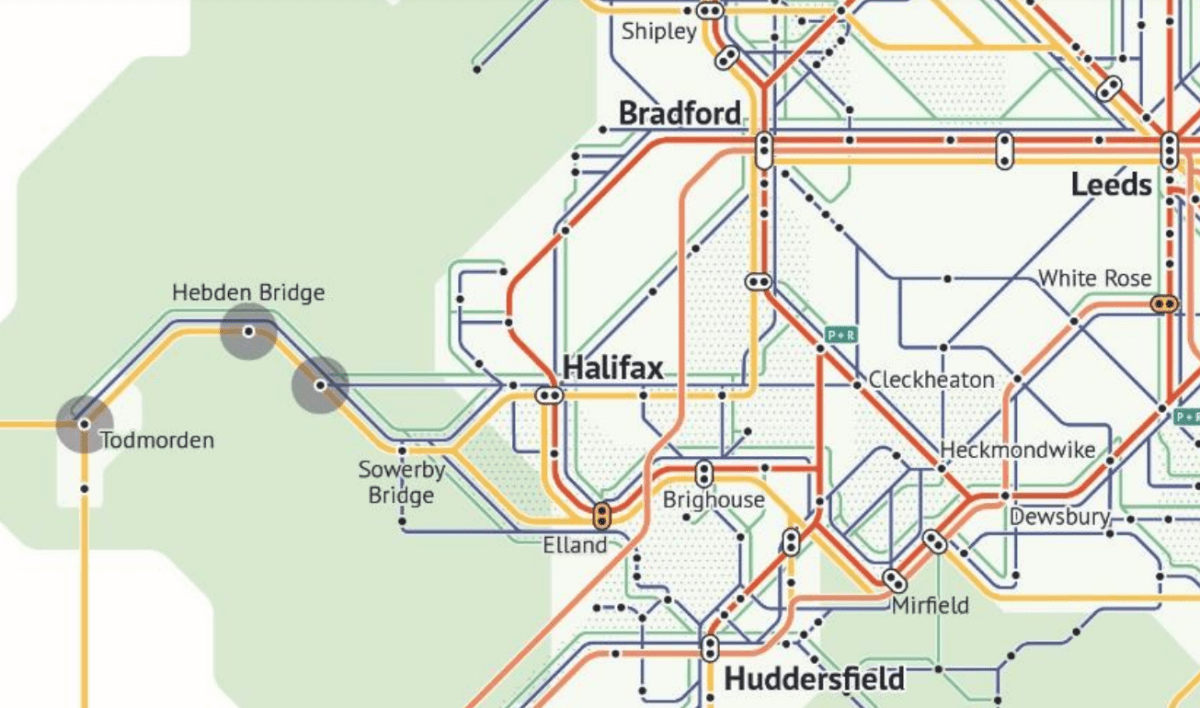
WYCA agrees rail strategy
In line with our Electric Railway Charter!
It is good to record that West Yorkshire Combined Authority (WYCA) is sticking to its guns on electrification. The Metro rail strategy was formally agreed at WYCA’s full meeting in March, and includes as top-ranked (Tier 1) schemes:
- The Calder Valley line extending the government’s Leeds-Bradford proposal to Calderdale, Preston and Manchester. The routes through Elland and Brighouse linking with Huddersfield routes are also included. York-Blackpool, Leeds-Manchester (and maybe on to Chester) could be electric all the way, as could trains via Brighouse. The Calder Valley network is noted as one of the busiest routes in the region. Full electrification would release a lot of diesel vehicles, and maximise the benefits of the Leeds-Bradford scheme – make sense of it in fact. We say track upgrades could be carried out along with – or preferably before – electrification.
- The Harrogate line, already linked with electrified Airedale and Wharfedale routes, enabling large numbers of diesel trains to be removed. Electrification through to York would also link up with the electrified East Coast Main Line.
- The Dearne Valley line linking Wakefield Westgate with soon to be electrified Sheffield-London, enabling service improvements on potentially fastest Leeds-Sheffield route.
Tier 2 includes the lines through Castleford and Wakefield to Knottingley (onwards to Goole), and Sheffield via Barnsley – where Northern currently routes its twice hourly fast (or fastish) trains from Leeds to Sheffield. Tier 3 would fill in gaps such as the Penistone line and Ravensthorpe-Wakefield.
The assumption is that the TransPennine Route Upgrade will electrify from Stalybridge through Huddersfield and Leeds to Church Fenton1, effectively completing wiring from Manchester Airport and Liverpool to York. Also assumed is that already announced schemes not only for Leeds-Bradford (the New Pudsey route) but also for Leeds-Hull will be there. Leeds-Hull is a government Network North proposal, as is Leeds-Sheffield (which latter we assume means the Dearne Valley route).
Rolling programme. But one project for our line!
The document gives equal ranking to Harrogate, Calder Valley and Dearne Valley routes. But Harrogate is always mentioned first, maybe just because it is less complex. Some of us would like to see our line at the top, as it was in Northern Sparks, the task force report that will celebrate its tenth anniversary next year. Then again, the Harrogate line is much simpler; could it even start before the Huddersfield main line is finished? Either way, the plan for full electrification is in line with our Electric Railway Charter, launched six years ago in Halifax (Electric Railway Charter). The Charter website lists several other reports that advocate, in one form or another, rolling electrification. The Calder Valley is always there.
It is vitally important the Calder Valley is seen as one project with Leeds-Bradford. Almost all trains from Leeds to Bradford Interchange continue to Calderdale and beyond. It would seem ludicrous to have to change traction from electric to batteries (or hydrogen) at Bradford. Bi-mode, even tri-mode trains might seem sexy to some engineers, but with two or more traction systems on board there is a lot of extra mass, more things to go wrong, less reliability and lower energy efficiency than pure electric. The Calder Valley also carries heavy freight trains for which the only sensible decarbonisation plan is full electrification. The strategy says batteries or hydrogen could be valuable as interim solutions on some lines including use of hybrid trains. But “the limited range and performance of such trains is likely to suit only low density, low traffic, low speed and shorter distance passenger routes,” says the strategy. As electric car drivers know, batteries are heavy2. And hydrogen, though the lightest gas, takes up a large volume.
Service frequencies need improving
Our line – including the route from Brighouse to Leeds via Batley – is shown by one of the maps in the strategy as having nine stations where service frequency needs improving. HADRAG agrees. We shall keep on pressing for all trains passing through Sowerby Bridge stop there (at present just 2/hr compared with Hebden Bridge’s 4/hr). Halifax and Bradford Interchange (currently 5/hr) are both shown as needing improvement. Walsden’s present 1 train/hr is marked “not acceptable”.
Brighouse’s twice hourly pattern is also shown needing an upgrade. We have pointed out that the nominal 2 trains/hr at Brighouse is effectively only a single train on each of the two routes E-W (Wigan-Leeds) and N-S (Bradford-Hud). Two an hour – at least! – is needed on all arms. And we say they should connect, to give reliable upper Calderdale-
Huddersfield connectivity (if not through trains). Brighouse-Leeds is proposed to be semi-fast, just one or two stops. We say target journey time should be 20 minutes. Elland-Leeds would be about 23 minutes. At half-hourly that would be a very attractive service.
There is little if any more on suggested new routes including the “Crigglestone curve” one linking the Calder Valley line south of Dewsbury with Barnsley and Sheffield. We think a Bradford-Halifax-Sheffield service could offer some attractive journey times, our headline being Brighouse-Sheffield in 55 minutes, maybe less. Spen Valley reopening through Cleckheaton could be a later phase, cutting off the corner to give a direct inter-city link.
Bradford-Huddersfield is described as part of strategic evidence for CV line enhancements. “Network North” (last autumn’s government statement) is invoked here with its suggested (optimistic?) 12 minute journey time, non-stop, presumably via a new route. But this would not improve the service for Halifax, and not, we guess, for Brighouse either. Clearly any Network North new line is some years away. We need our lines improving now.
A further complication is service disruption for the TransPennine Route upgrade.
Network North proposed a 30 minute timing Bradford-Manchester. And yes, it does seem optimistic. Business case must be dubious if it’s a new line for only 2 trains an hour. Better surely to upgrade the Calder Valley line and aim initially for a half-hourly fast service. This might take as little as 42 minutes Bradford-Manchester and would also serve Halifax and Rochdale. Complementary services in between would serve intermediate stations. Track -and capacity – interventions are pencilled by the WYCA strategy over the Sowerby Bridge to Rochdale section.
This could mean passing loops, for example between Mytholmroyd and Hebden Bridge or further up the route. Longer trains are suggested through Halifax and Brighouse.
Tunnel to high speed?
Away from the WYCA spotlight, Colin Elliff, experienced railway civil engineer, has suggested a new route across the Pennines involving a 15 kilometre tunnel from Halifax to Littleborough. A 30 minute journey time is proposed from Bradford to Manchester.
Elliff’s proposal is part of a portfolio of schemes that also go under the banner “Network North Ltd”, not to be confused with the government’s more recent adoption of a similar brand! It scores higher for us than Transport for the North’s publicly unspecified high speed plans, because it actually serves the big towns on our line. Could it be a later phase? It is certainly a generation way. We need to develop the lines we already have – now!
Back in the WYCA strategy, talk continues of a new Bradford station. This could be outside the present city centre – maybe 10 minutes’ walk. It would be a through station eliminating the age-old need for trains to reverse in Interchange. This would ease “pathing” of trains in and out of the station and increase capacity.
Could other, more convenient, sites be possible?
We must add that Bradford’s vision is for the city centre to expand and include the new station site.
An alternative cross-city route stretches the definition of feasibility: the new(ish) Broadway shopping centre blocks the way. Bradford to Leeds via Shipley is 13 miles, compared with 10 miles via New Pudsey. And junction conflicts at both Interchange and Shipley would constrain timetabling. Colin Elliff’s diagram suggests Bradford-Leeds via Shipley would take 15 minutes, compared with 12 minutes currently predicted via New Pudsey (we assume both of these are non-stop). It all adds up. With the new station, Halifax-Leeds could come down to 25 minutes or less. – JSW
Late night minor triumph. But we say no to Cinderella syndrome!
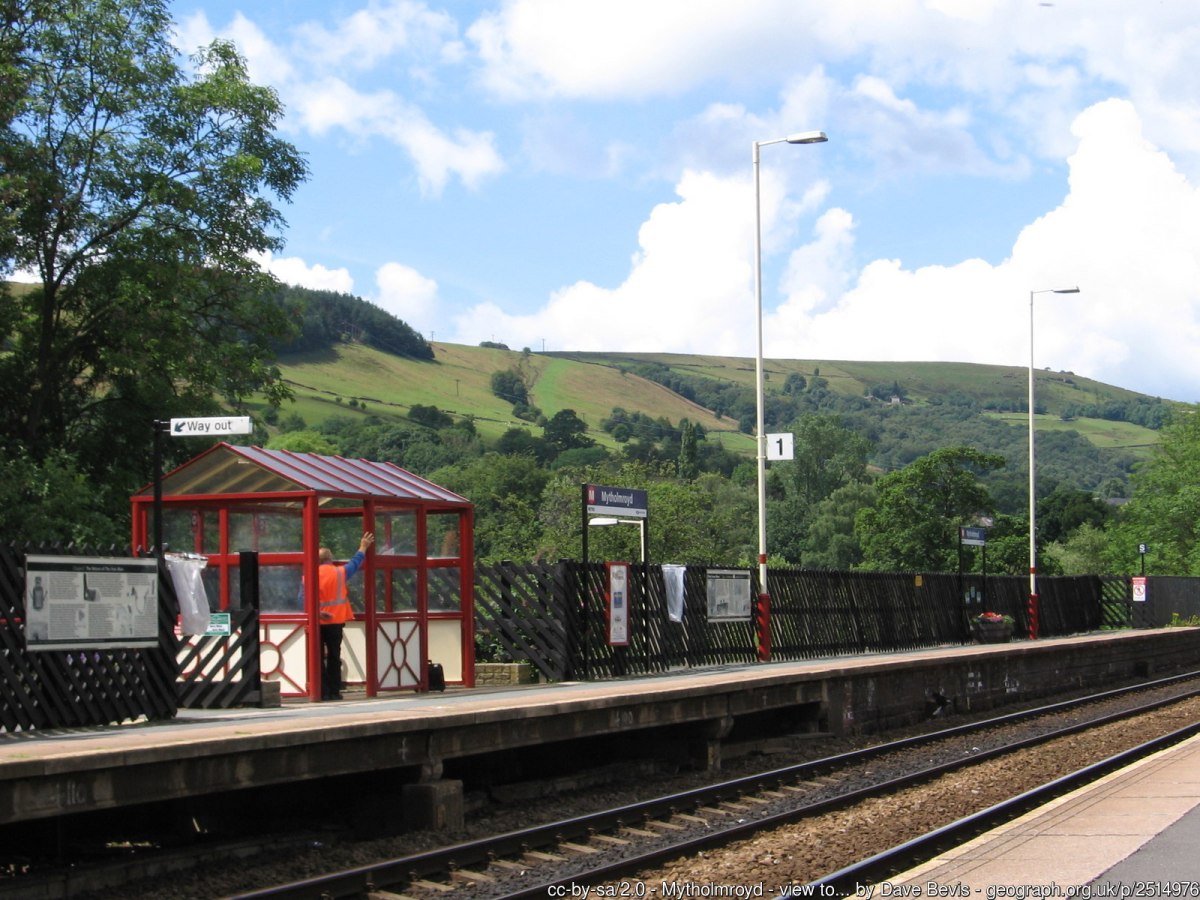
Hadrag first raised the issue of a late-evening 2-hour gap in services back from Manchester at Mytholmroyd and Sowerby Bridge back in 2018. (Is that right? We can’t believe it.) Thankfully this has at last been at least partially dealt with. We would also have liked to see stops by Blackpool trains -not only late night but all day. Improvements will appear in the summer (May) timetable. But we are someway off getting the increased service at Sowerby Bg called for in the WYCA rail strategy. Meanwhile we still moan (forgive us!) about lack of services from Bradford and Calderdale to the far side of Manchester, though we are thankful for the Chester trains. It’s not just the we want trains to the airport; we want services to give our line access to work, education, leisure attractions and connections south via Piccadilly and Oxford Rd stations. At a recent TravelWatch NW conference in Stockport we heard the December 2026 timetable change would could be strategic. But Calder Valley to Manchester Airport was one option under consideration for… well, around the end of the decade. Remember the first trains round Manchester’s Ordsall Chord in December 2017 were actually Calder Valley ones, supposedly a prelude to airport trains. That was reversed in May 2018, just before the famous timetable omnishambles. We shall continue to argue for an alternative routeing Bradford, Halifax to Manchester Piccadilly via Huddersfield, which would also link stations from Stalybridge with our nack of the woods, but suspect TransPennine upgrade works will be a ready made obstacle to that. Whatever rail businesses’ and government excuses we refuse to keep quiet as our line continues to be a northern Cinderalla.
26 Years Late and Counting: When Will Elland Station Open?

There is a growing sense of frustration about Elland station. For estimated opening date latest we can find in print is “late 2026” – 2½ years away. Do we feel that is realistic? As we write, the nearly finished new station at White Rose, by the well-known Leeds shopping centre, is at present on-hold because of cost increases. It is clear that White Rose will be finished, but not (as we write this) quite clear when.
Which does increase the worry about Elland.
On the Calderdale Next Chapter website West Yorkshire Combined Authority is quoted as saying (Jan’2024):
“We remain committed to the Elland Railway Station project and work is progressing on the ground to deliver these improvements. As we confirmed last November, the completion date for this scheme has been pushed back until late 2026 because of a variety of factors, including design changes and supply chain challenges. This project will improve accessibility and make it easier for people to travel around the region by boosting connectivity across Calderdale and beyond.” (Elland Rail Station and access package I Calderdale Next Chapter, to whom thanks also due for illustrations.)
We suspect there may also be issues to do with land ownership. Will compulsory purchase orders be needed?
We can understand why, when Brighouse station opened almost a quarter of a century ago, Elland was put on hold – and not just because something in Leeds was felt to be more important. Elland station is complex. On an embankment with steps, lifts and ramps all needed (see picture) – veritably a wonder of the world. (Alternative sites at Greetland or Exley Lane would not have done.) The scheme is not just the station but includes an access package with new canal and river bridges to link up the local area. It sounds like it will be worth waiting for. But even those of us who have kept faith with this are getting frustrated. This station should have opened in 2000. It is running 26 years late. And counting.
WYCA Rail Strategy
As mentioned inside, West Yorkshire Combined Authority continues to give electrification high priority – including our line. HADRAG also welcomes an aspiration to increase the direct service Brighouse to Leeds to twice hourly. WYCA’s rail strategy is about developing and improving services on existing routes. Improvements we might reasonably hope to see as early priorities! The question of course is where the finance is going to come from. But these kinds of aspirations should be deliverable in a relatively short time and at reasonable cost – unlike either new high speed lines or mass transit. We also welcome suggested enhancements to increase route capacity, for example in upper Calderdale.
Supporting ideas to transform services in the Five Towns around Pontefract we look for a similar approach in our area – not least development of Brighouse (and Elland!) line services. Wakefield and on to York, and Sheffield via a reopened curve at Crigglestone would be destinations to transform connectivity from Bradford and Calderdale. Not everybody wants to go to Leeds!
The Sheffield proposal is listed among other longer term more tentative proposals, including a more direct Sheffield route via the Spen Valley (not Calderdale!). Others such include commuter services from the Worth Valley heritage line; Otley; and the direct line from Penistone to Sheffield
in South Yorkshire, potentially restoring direct Huddersfield- Sheffield trains.
Pickle Bridge? We need Calder Valley Line electrifying!

ACCORDING to the December 2023 issue of that eminent magazine Modern Railways a proposed Network North line from Bradford via Huddersfield to Manchester could be routed via the old short-cut from Pickle Bridge at Wyke.
The line goes through Bailiff Bridge where it passes close to houses built since the line closed in 1952 – might residents have something to say? Bailiff Bridge station closed in 1917. The line also served Clifton Road (east of Brighouse centre), and then turned south to cross a site that is now a densely developed industrial estate, to join the Calder Valley line on the wrong side of Brighouse.
Further on, the M62 would complicate possible alternatives, heading for the Bradley curve line (we assume) towards Huddersfield.
If this really is the route planned it just skirts the eastern fringe of Calderdale. We are not aware of any plans for local stations. The intention is a fast route for Manchester trains with one stop at Huddersfield. No intention to serve Calderdale has been expressed.

Modern Railways says: “industry sources have expressed doubt as to whether the suggested 12 minute journey time between Huddersfield and Bradford would be achievable.” (The distance is about 12 miles.)
There is an obvious issue about pathing at Huddersfield – where westbound services from Bradford would conflict with eastbound ones towards Leeds. Beyond Huddersfield, Transpennine Route Upgrade should deliver one additional track as far as Marsden, so fast trains can pass stoppers and freights (in both directions?).
Beyond Marsden we think a new Northern Powerhouse Rail high speed line is still planned. Total journey time Bradford to Manchester is said to be 30 minutes. We’d bet it turns out to be 35 minutes – if it ever happens.
We concede that the present Bradford- Huddersfield route via Halifax and Brighouse – and Elland soon – is indirect. And the trains are nothing like frequent enough. But Network North says the fast trains from Bradford could be no more than two per hour. Are they really going to build a new line for that?
Network North was dreamt up (or dusted down from dusty filing cabinets) to use the money saved by cancelling HS2 phases 2A (West Midlands to Crewe) and 2B (on to via Manchester via the airport). It will be no news to readers of this newsletter to learn that not only is not all the money saved being spent in the North of England, some of it is not even to be spent on rail. Talk of money being diverted to fixing potholes just seems wrong: yes, potholes need to be fixed, not least for the safety of people on bikes, but that is essential “revenue spending”, whilst rail-building schemes like HS2 or reopening the Pickle Bridge line, or indeed road-building schemes (like the A629 locally), are classed as capital; that is, new investment.
HADRAG has always been neutral on the argument for and against high-speed rail. But there is nothing like having something cancelled – such as the route from Birmingham to Crewe, in dire need of congestion relief for both passenger and freight – to make you realise how much you need it. Latest news is the row about HS2 spending in the North being diverted to fix London problems.
Obvious Question
The obvious question is how long would a fast service from Bradford to Manchester via a modestly improved Calder Valley line take? Present services are at best semi-fast. And of course we want to maintain stops at intermediate stations serving communities such as Sowerby Bridge. So additional fast trains would be needed maybe making maybe two stops (Halifax and Rochdale come to mind).
Present “semifast” trains take about 52 minutes Manchester-Bradford with 4 stops. They must be retained. Could the time for 2-stop fast trains come down to maybe 40 minutes? That would need linespeed improvements, and maybe the additional capacity the West Yorkshire Combined Authority calls for in its rail strategy. And it needs a sensibly designed timetable. The linespeed improvements would also benefit services calling at intermediate stations.
If 40 minutes is achievable via the Calder Valley line, do we really need a new route via the Pickle Bridge cut-off or elsewhere? Especially if it is not going to serve the communities through which it passes?
The government’s post-HS2 plans do mention our area. The promise is mass-transit. Well we already knew about that. The mass transit link to Halifax looks like it will be a route via Queensbury. It is not in the first phase, as far as we know. It will not be as fast as heavy rail. It might even not be rail (advanced buses have been mentioned).
We need improvement on the present “heavy-rail” routes Halifax to Leeds via Bradford plus the routes through Brighouse and beyond – more trains Brighouse-Leeds plus other possible destinations such as Sheffield, Wakefield and York. What Brighouse and Elland need are more frequent trains, not a possible new station that will probably never be built.
The other part of the Bradford plan is a new station that will mean trains from Calderdale to Leeds no longer need to reverse. We suspect the cross-city link Interchange to Forster Square is a bird that has flown. Apart from anything else there is a new shopping centre blocking the route. And running Calder Valley line trains to Leeds via Shipley and the Aire Valley would increase not decrease journey times and create pathing conflicts. Bradford council has suggested redevelopment of the area to the south and east of Bradford Interchange, with a new through station reducing the distance to Leeds and speeding up journey times. Halifax-Leeds could come down from present 35 minutes (give or take) to less than 25 minutes.
The snag is that the suggested station site – at St James wholesale food market – is a good half mile from Hall Ings at the bottom of Bridge St and further out of the city centre than Interchange. Smart transport links would be needed, maybe including mass transit with street running round the city centre and linking up with the Airedale and Wharfedale lines out of Forster Square. Other possibilities might include self-driving “pods”. St James is on the wrong side of a major road junction, but with redevelopment that need not always be the case. And St James is not the only site for a possible new through station though other sites might involve more demolition of property and so greater cost. (An advantage of the St James site is that it belongs to Bradford council and the route from Laisterdyke is former railway land. It also avoids the steep curving incline down to Interchange station.)
We need to look forward with imagination!
And as top-ranked line…we need electrification!
Electrifying the Calder Valley Line was given top ranking across the North nearly nine years ago by the all-party Northern Sparks task force. The government has so far not taken this forward.
Electrification would help the speed improvements we want, to give faster journey times. And electric trains are cheaper to buy, cheaper to operate and cheaper to maintain; they are clean and quiet; they are less complicated and will be more reliable and more energy- efficient than multi-mode units with batteries, hydrogen or whatever. They are essential as we transition – as we must – to zero-carbon.
That is why we need electrification. West Yorkshire Combined Authority’s latest rail strategy (final draft published last summer ) lists the Calder Valley, Harrogate and Dearne Valley (linking with Sheffield) as top priorities going forward.
We are grateful that Calderdale Council has recently renewed its call (previously made in 2018) for Calder Valley line electrification. The call will go to the highest level. In 2018 we launched the Electric Railway Charter and the council supported us.
Look out for more from the Electric Railway Charter early in 2024. – JSW
We need a modern, reliable and electric service on the Calder Valley line. We need it now.

We do not need vague ideas about a new Bradford- Huddersfield-Manchester route that – mentioned in the government’s Network North report – that would not serve Calderdale. Calder Valley electrification was top ranked almost 9 years ago by the “Northern Sparks” task force report. We welcome Calderdale council’s renewed backing for electrification of our line.
Good ideas in West Yorks rail strategy – including electrification plus capacity improvements, that could deliver more for Calderdale than any fantasy line. More trains Brighouse-Leeds direct are mentioned. These are affordable schemes that do not need huge funding. Elland should be open by 2026 – keep the faith!
Good news on ticket offices. We need more staff on stations, not less.
Service performance so far this winter has been as bad as we can remember. Our impression is Northern say they have the right number of staff, but sickness continues to be an issue. What can we conclude?
Latest station usage figures (ORR) have just arrived. Halifax is back to 72% pre-pandemic best, Brighouse 77%, Sowerby Bg 83%, all rising. We see crowds on off-peak trains – surely an opportunity not a threat. – JSW
Featured Image: “Northern Trains 195 105” flickr photo by Bubblin40 https://flickr.com/photos/bubblin40/52862203418 shared under a Creative Commons (BY-NC-ND) license
Ticket offices – let’s make more use of them not less!

Thanks to everyone who objected to the planned mass closure of ticket offices. Result was unexpected and very welcome, following action by unprecedented numbers of train passengers, rail unions, and groups handing out leaflets outside stations. It showed ordinary rail staff and passengers on the same side. An initial outrageously short consultation period of about three weeks was extended to the end of summer, and about % million responses were sent to the regulator Transport Focus. They had to deal with separate consultations on every train operating company (TOC)’s proposals. All were different – in form and content. Ridiculous examples included Manchester stations, where Oxford Rd and Victoria were to keep ticket offices under Northern, whilst Piccadilly’s, under Avanti, planned to close.
Even within the same company, illogicality was not hard to find: all three Calderdale stations with booking offices were to lose them, but over the border Rochdale’s and Glossop’s were to stay. The whole thing smacked of a rush job that failed (even it tried) to consider local conditions, let alone national issues such as travellers with disabilities, including blind people, and people who simply prefer to transact with other human beings rather risk getting a bad deal from a machine. So Transport Focus ruled, and the HM Government could then not have been quicker to make the TOCs withdraw.
Is it all over? Of course not. There is a real fear that TOCs will come up with new proposals on a station by station basis. If we ever get (as we hope) a simpler fares system, with pay-as-you-go and London “Oyster” style tap-in tap-out the need for ticket offices will be less. That will not mean we don’t still need staff on our stations, based in a an office with a counter both for accessibility and personal security. (The problem with roaming staff is knowing where they roam.)
Not all TOCs were involved in the 2023 proposals. Merseyrail electrics is locally managed under Liverpool City Region Combined Authority. Most stations (if not every one) are staffed from just before first train of the day to just after the last one, and all have ticket offices. At the four biggest stations including Southport and Liverpool Central the ticket office is also a convenience store selling products from magazines and to food and drink that people might need on the journey. This may not be a solution at every station but it seems worth looking at.
And staff need to be around when passengers need them. When Northern won the franchise there were plans to reintroduce staff at stations like Mytholmoyd, Sowerby Bridge and Brighouse – quietly forgotten, it seems now. This summer’s proposed “journey maker” role was very limited hours. What happens when passengers need help late at night?
So if your station has a booking office, carry on using it!
Rail stations must be energised by people, for people (HADRAG News Release)
Rail campaigners have welcomed this week’s news that plans to close most train station ticket offices have been dropped. But, says the Halifax & District Rail Action Group (Hadrag), passengers need to be alert to possible future plans.
In Calderdale, Halifax, Hebden Bridge and Todmorden should now keep their booking offices. What is needed now, says Hadrag, is ambition and imagination to expand the role of staff at more, not fewer stations. Longer staffing hours, not shorter. More staff to help more people, not least those who are elderly and those with disabilities.
Stephen Waring, chair of Hadrag, said:
It is a great relief that ticket offices appear to have been saved. Staff at stations like Halifax, Hebden Bridge and Todmorden and elsewhere in our region do a magnificent job. They are keen to make sure passengers buy the right ticket and get the best value in a system where the range of possibilities can be baffling. They can help in ways that can never be available online or by self-service machines. For many disabled, elderly, and needy passengers station staff are vital.
“The railway needs to value its staff and extend their role. More stations need staff – places like Sowerby Bridge and Brighouse that were promised a human presence when Northern’s franchise started in 2016. And, we would argue, stations need to be staffed from earlier in the morning to later in the evening. Staff there to help passengers – including people with disabilities – give a greater feeling of security and make our stations a more human place.
“Ticket offices need to be able to retail the full range of tickets that is available online – at present this is not always the case.
“But this is about a lot more than just selling tickets. More staff would make stations more attractive, more able to help people with special needs, attracting more passengers whose fares would help to pay the costs. Value for public money should mean attracting people not putting them off with lonely stations.
“On Liverpool’s locally controlled Merseyrail Electrics network, most if not all stations have booking offices with staff present from before the first train of the day until after the last one. Is it too ambitious to say that is what we should now be aiming for across Northern and other companies’ networks?
“We must keep on campaigning for a better deal for our stations. We must not lower our defences, but keep a keen eye on what the train companies – under the government – are planning.
“Our stations must remain places energised by people, for people.
Ticket office proposed closures: have you submitted your objection?

Have you submitted your objection to proposals to close hundreds of station ticket offices? Included in the list are Halifax, Hebden and Tod. The deadline is tomorrow. In other words they went to close all ticket offices in Calderdale. HADRAG has submitted a 7-page objection (see https://hadrag.com/wp-content/uploads/2023/07/to-consultn-hadragweb-2.pdf ). For most train companies the deadline is tomorrow, Wed 26 July but see below. You can send in your objection to the official watchdog Transport Focus. And for Northern you have until on Friday 28 July at 23.59: Email: ticketoffice.Northern@transportfocus.org.uk
If your response relates to a certain station please include the station name in your response.
Transport Focus is the independent transport user watchdog. If you would like to know more about the consultation process and what happens next please go to transportfocus.org.uk
 Halifax and District Rail Action Group