New White Rose station (Leeds) has been on hold since March, construction halted by increased costs. No date yet for restart, which must surely happen. Inflation has hit a number of projects. (Halifax station gateway is on a back burner, to put it politely. And there is still no starting date for Elland.
On paper completion should be late 2026, less than 2 years away, but White Rose raises a new worry. Outside the Elland site with a TV reporter, passers-by said they had bought new houses 20-odd years ago, when selling point was a train station.
Some of these local residents are now nearing retirement, having been driving cars to work for a quarter of a century. If only Elland, predicted to be at least as successful as Brighouse, had opened at the same time back in May 2000. Elland was always more complex to build, as we have seen with the recent saga of design upgrades. 2026 will be 26 years late and counting. But let’s keep the faith.
On the Calder Valley line, Brighouse had fastest passenger growth, percentage-wise, for more than 10years before the pandemic. It’s a station with massive potential, but services are now being disrupted for work on the TransPennine Route Upgrade (TRU). The present timetable, June to December, has several dates when services change. When TRU work is happening at Huddersfield, Brighouse is used as a railhead and there are bus replacements for Northern Huddersfield-Halifax trains, plus shuttles Brighouse-Hud for TPE passengers. It is good to see lots of intercity passengers using Brighouse station, but they do not always have an easy time (more on that later).
When the direct line through Dewsbury to Leeds is being worked on, Northern’s Wigan-Manchester- Brighouse-Leeds trains are diverted via Halifax and Bradford, with a bus link Halifax, Brighouse and intermediate stations to Leeds. Leeds-Brighouse takes 65 to 75 minutes on the replacement bus, compared with 35 min on the train. Passengers from upper Calderdale and beyond to Brighouse, Mirfield, Dewsbury etc have to change at Halifax, again with significant journey time penalty. We thought it would be better to divert the Brighouse “valley bottom” service via Wakefield. This would maintain a service for Brighouse and Mirfield.
So we raised it with Northern and TPE contacts and received a prompt reply. The situation is “quite complex”, with both paths (fitting trains in) and platforms at Leeds. Capacity is reduced by freight paths as well as diversions of TPE trains. (We could interpret this as meaning TPE expresses have the advantage over Northern stoppers.) HADRAG may not be quite ready to give up on this. We support the work being done on the TP upgrade. But this work will go on for some time, and it seems wrong that Brighouse passengers are being penalised.
Our email also mentioned the confusing situation with replacement bus stops. The buses stop outside the Brighouse station car park. There are some small, not terribly prominent arrow signs supposedly directing people to the buses. Unfortunately the ones from the westbound platform send you up the steps (though the ramps could also be used) and the along to Huddersfield Rd where there is a bus stop but for service buses, not the rail replacements. People have missed the onward transport because of this. Staff posted on the station do a good job helping people. We gather whenever the bus is due staff go up to collect passengers from the wrong bus stop and bring them to the right one. Could you make this up?
There have been problems with vandalism of the arrow signs, which are fixed to lamp posts using that ultra- modern fixing, the cable tie. Northern/TPE are “considering more permanent signage”.
Finally we mentioned the West Yorkshire Combined Authority rail strategy and the need for progress to deliver a better service for Brighouse – and indeed Elland. How does this fit in with plans post-TRU? What about capacity of the 2-track Dewsbury route, with potential of a fast (limited stop) journey of 20 minutes Brighouse-Leeds? The answer was that Northern and TPE are working with “partners in WYCA, the TRU programme and wider industry to understand what can be delivered in terms of future service patterns”, with a reference to “lots of moving parts”.
Colin Elliff, speaker at HADRAG’s AGM, leads Network North Ltd along with Quentin MacDonald. Both are graduate chartered engineers (BSc, CEng); Colin, based in North Yorkshire, is a civil engineer so he knows what is possible in terms of building new railways. Colin’s group has been using the name Network North since early 2019.
The government recently (October 2023) created another Network North, the billed cost-cutting substitute for Northern Powerhouse Rail. The October 2023 government proposal is described by Colin’s group as “a ragbag of road and rail schemes locates all across the country making a mockery of the name Network North”.
Colin and Quentin’s Network North Ltd has designed a rail network that “fully interlinks all of the principal cities and conurbations lying in the Northern Powerhouse – home to 16 million people”. Their flyer says: “Network North Ltd has been formed to promote the designs of Network 2020 Ltd which are the work of professional railway engineers. ”
For an overview see schematic map.
The map (this is the latest version) shows a new route from Halifax to Rochdale, both of which stations would be served, giving a journey time of about 30 minutes Bradford to Manchester. We think that includes stops at Halifax and Rochdale. It also shows a reopened the Woodhead Route linking Liverpool with both Sheffield and Leeds. Some of us have mixed feelings about that.
Benefits of whole plan
The new “Calder Valley Corridor” line would be in tunnel for maybe about 20km (12½ mile) from near Halifax to near Littleborough. Halifax to Manchester would take about 20 minutes, so the line through Rochdale would also need a substantial upgrade. Where would the tunnel start? Halifax station? Salterhebble? Would there need to be a new viaduct across the Calder Valley somewhere near Copley?
The flier list benefits of the whole scheme from Liverpool to Hull and Newcastle as linking all Northern Powerhouse cities using: 272km of new railway, 45 km of reopened routes, 350 km of existing railway upgraded.
Cost has been estimated by rail consultant Michael Byng at £40 billion. The package is described as:
meeting all Transport for the North targets for intercity journey times;
transforming connectivity and capacity – including “local capacity dividend”;
integrates with High Speed UK scheme for national high speed network;
delivers optimised national integrated rail plan, outperforming official proposals by an order of magnitude, with far greater connectivity locally, regionally and nationally, and far greater journey time reductions.
Worth noting that the Network North Ltd map shows the Calder Valley route between Halifax and Preston linked to Huddersfield and on to Sheffield. No journey times are indicated for this corridor. Would these services would run via the existing Penistone line? HADRAG would like to see services from Bradford to Sheffield via the Crigglestone curve and Barnsley. These would take significantly longer than the Network North proposed Bradford-Sheffield service, but would give a much needed semi-fast link south from Calderdale. Brighouse-Sheffield journey could be about 50 minutes with existing tracks. Network North Ltd shows a Bradford-Sheffield journey of 27 minutes via Dewsbury (“Interchange”). That must involve a route through the Spen Valley and a new high speed line, joining another one from Leeds, with a delta junction somewhere near Barnsley. The delta junction would link Leeds, Sheffield and Manchester (via Woodhead) routes. This ideas goes back decades and has its strengths but an also a big environmental impact.
One thing not on Colin’s map is the 2023 government-proposed Bradford-Huddersfield line, rumoured to be using the old formation through Bailiff Bridge. Part of the other Network North and probably a judicious omission.
Is this all fantasy? Certainly it is not on any political agenda right now (though the line through Bailiff Bridge might be). What becomes of NPR and either brand of Network North remains to be seen.
HADRAG has never been an advocate of long term mega-projects. We want improvements in the next few years on our existing routes, including the route through Hebden Bridge to Manchester serving all the intermediate stations. We need trains with more carriages, so people do not have to stand on Sunday mornings! More services on the Brighouse line, and Elland station. All this can benefit present passengers – actual and would be – in the foreseeable future.
Letter from The Halifax & District Rail Action Group and Electric Railway Charter to election candidates, councillors, WYCA members
1. Fully electric train operation is the most energy efficient means of operating railways
…a key objective in a world that must strive to eliminate greenhouse gas emissions, notably CO2. Compared with diesel or bi/tri-mode trains pure electric trains are
simple, cheaper to build; reliable, cheaper to maintain; by 66%
lightweight giving faster acceleration and ability to serve more stops and carry more passengers;
more capable of using regenerative braking returning energy to the supply system.
Electrification is capital investment. Future payback will come through a railway that is less costly to operate, attracting more passengers, stimulating employment – and zero-carbon.
We welcome the recent West Yorkshire Combined Authority rail strategy. It is pleasing to see WYCA sticking to its guns and advocating electrification including the full Calder Valley. This and the government-proposed Leeds- Bradford electrification must seen as one scheme. The Calder Valley routes do require full electrification. Hybrid trains with multiple traction systems are heavier, waste more energy, and are potentially less reliable. By full we mean the whole route through Bradford and Brighouse to upper Calderdale. Manchester, Preston and beyond.
The full Calder Valley line was of course the top-ranked scheme in the cross-party task force Northern Sparks report 9 years ago EFT Report FINAL web.odf (transportforthenorth.com). Since then we have seen numerous other reports calling for electrification of most routes. Following Northern Sparks, campaigning groups along the Calder Valley lines launched the Electric Railway Charter. We are pleased that Calderdale Council has now twice passed resolutions calling for rail electrification. A rolling programme of electrification will reduce costs, and make the investment pay, by building up and carrying forward engineering expertise. No more stop-start.
2. Calder Valley line services – York/Hull and Leeds to Halifax/Brighouse, upper Calderdale, Manchester, Chester and Lancashire, plus Bradford-Huddersfield are due an upgrade: capacity, service, and speed.
Service improvements can be made with existing infrastructure, but we welcome proposals in the WYCA strategy for additional tracks that would allow passenger trains to overtake slower freights. Upgrades need to be made before electrification work starts. Meantime, we look for:
improved pattern; trains better coordinated between different services on the line;
new services so Calderdale can, for example, get across Manchester to access jobs, leisure destinations and connections. A service to Manchester Airport originally, promised for 2018 now, seems to be some years from delivery. This would build on existing Chester service.
all trains to call Sowerby Bridge – station with second fastest percentage passenger growth in Calderdale pre-pandemic, based on Office of Road and Rail (ORR) figures over a decade;
better service on Brighouse line – doubling frequency, faster trains direct to Leeds as suggested in WYCA rail strategy. Brighouse had fastest passenger percentage growth of… all Calder Valley line stations pre-pandemic. We also need better services N-S, Bradford-Huddersfield or Sheffield. HADRAG supports the list of possible reopening schemes mentioned on p68-9 of WYCA rail strategy – including the Crigglestone link for direct trains Bradford and Calderdale to Sheffield with attractive journey times.
Elland station – how can we get this started? Originally proposed 25 years ago!
new trains designed for passenger comfort – let’s think about access for disabled people, families, adequate toilets, view out of window, and of course provision for bikes.
3. Bradford issues
Many of us support the idea of a new through station in Bradford that would eliminate the need for trains to reverse. It would increase capacity, and cut journey times Calderdale-Leeds. For example Halifax- Leeds could come down from around 35 minutes now to 25 minutes or less. There is concern about the proposed new Bradford station site:
St James’ market has been suggested but is remote from the city centre. We ask whether:
other more convenient sites are being considered; and whether
account has been taken of effect on journey times for Calderdale-Bradford passengers.
We hope mass transit (see below) will provide a good, frequent link across the city centre reaching Forster Square at least, and open at same time as the new heavy-rail station.
4. Bradford and “Network North”.
The 30 minute Bradford-Manchester journey time suggested for a route swinging round via Huddersfield seems optimistic, dependent on capacity west of Huddersfield, and potentially locally disruptive to build, with no visible local benefit for Calderdale communities. We can see people in Bailiff Bridge and Brighouse objecting to one suggested route. So: ⦁ Would it not be better to upgrade the Calder Valley, line? With modest linespeed and capacity improvements, and electrification, Bradford-Manchester journey time would be reduced to little more than 40 minutes, perhaps less, including two stops (Halifax and Rochdale). Semi-fast services would operate between the fasts serving all stations Bradford to Todmorden. Benefits in our lifetime for Bradford and Calderdale. ⦁ A later phase might include a new high speed route, in tunnel Halifax-Littleborough, reducing the timing to about 30 minutes again with 2 stops. This is more fanciful but not impossible.
5. On mass transit we look forward to proposals about to emerge, and the upcoming consultation on initial routes. But it may be a decade before mass transit reaches Calderdale.
So: Mass transit must not be seen as a substitute for improving the heavy-rail Calder Valley line service including its branches through Elland and Brighouse, and the York-Blackpool trains. Mass transit does not mean fast transit.
Achievable heavy rail improvements can be delivered much more quickly, benefitting existing and would- be passengers. In our lifetime!
6. A major question is how any of the above is to be funded.
Rail development must be seen as investment in the interests of a green economy. It must be seen as affordable.
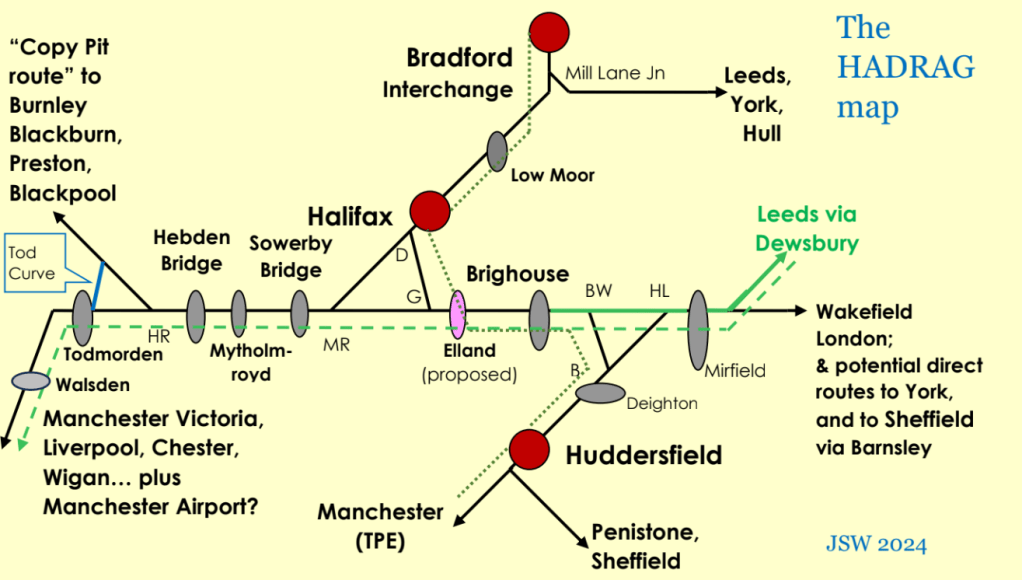
As concerned local campaigners HADRAG members would be happy to meet elected representatives or officers of the combined/local authorities either in public and/or in a small-group meeting. After the election, of course. Massive thanks to you for reading this. Map overleaf may be helpful. Looking forward to any response you are able to give or any questions you may have, with best wishes, Stephen




 Halifax and District Rail Action Group