TransPennine Express trains were diverted via Brighouse and the Calder Valley line for a month before Easter. Work was being carried out remodelling junctions at Stalybridge, a track layout that had previously been upgraded not much more than a decade ago. The effect is higher speed limits on the route towards Victoria as well Piccadilly. Which is logical since trains that don’t stop at Stalybridge are the “fast” ones to Victoria! A year ago
when the Huddersfield route was closed for engineering work the diverted trains called at Brighouse, providing an additional useful service for the town on our line as well as an alternative railhead for Huddersfield passengers. Improvements to Brighouse station had been made with more space for larger crowds to wait. This time all the diverted trains have run through Brighouse without stopping. Brighouse was the Calder Valley line station with the biggest percentage growth over more than 10 years pre-pandemic. So why is it being side-tracked by TPE now? We shall ask!
Ever think you live on a Cinderella line? The government’s “locally guided” £72 million package of Manchester improvements promises little or nothing for for the Calder Valley. It seems Leeds-Brighouse- Manchester-Wigan trains will turn back at Salford – Salford Central it would seem, just beyond Victoria and short of the junction with the lines from Piccadilly at Salford Crescent. Manchester-Wigan will be separate. Northern’s performance and planning director Rob Warnes said “We want to create a second Leeds to Salford service leading to one via Brighouse and one via Bradford, and terminate both at Salford Central.”
We can see the logic. Services would balance better across Victoria to cope with different loading levels east and west. But this smacks of “train plannery” not designed for passenger benefits.
The present Leeds-Wigan service serves Salford Crescent, wonderfully convenient for Salford University. If the cut back to Central is really the intention this link would lost. Good connections to Southport and Bolton (as well as Wigan) would be in doubt, as would south Manchester via a double-back at Crescent.
Salford Crescent is to get a third platform. Was it naive to imagine this could be used by our trains?
The plan as described would mean more, not less trains between Salford and Victoria. We presume the planners have a plan for that.
The advantage is Calder Valley services that run into the Victoria bay platform conflicting with Trans Pennine would no longer do so, removing conflicts and helping performance. But these CV trains are of course the ones originally intended to go round the Ordsall Chord to Piccadilly and the Airport. Ordsall is a new railway with just one train an hour. We aren’t that bothered about catching planes, but we could really do with trains to Deansgate, Oxford Rd and Piccadilly for employment, leisure, NHS and education destinations – plus connections beyond.
Let’s hope the planners aren’t eyeing up our Chester trains. This service has been upgraded to 7- days-a-week – a nice bit of good news.
In the Department for Transport (DfT) news release Tim Shoveller of Network Rail said “We have ambitious plans for the future of Manchester Oxford Road. We are removing our previous planning application so we can move forward with a new approach, something we’ll be consulting residents and businesses on later in the year.” No mention of extra through platforms on the revealed Network Rail to be looking at reducing the number of platforms at Oxford Rd. A new layout and signalling to increase capacity with longer platforms and “Thameslink”-style operation.
But so much wasted time. All of this has taken a decade already. GM Mayor Andy Burnham asked how long does the government “expect the people of Greater Manchester to wait”. It’s not just Greater Manchester of course. This affects us across the Pennines.
On the ITV website, rail engineer Gareth Dennis said “If the £20bn cost of Crossrail is a straight line between London Euston and Manchester Piccadilly (259.5km), then £72M only gets you 934 metres of the way there. Landing you in Beatty Street, Camden. That’s about a ten minute walk.”
Timescale for all of this is unclear. Meanwhile HS2 plods on – for what point? HS2 may never happen and – we strongly suspect – is limiting cash for improvements needed now. – JSW
Fine sunshine. Let’s have a Sunday out by train! But, first Sunday in June engineering work meant your train from Halifax was probably a bus. Halifax to Leeds took an hour to an hour and a half. Brighouse-Leeds was actually better than usual with Blackpool and Chester trains stopping – though some sources showed these stops as “unadvertised”. This gave a journey time of a little over 20 minutes. (Brighouse-Leeds by replacement bus via Halifax would take you nearly 2 hours.)
It is not clear why the whole Bradford-Huddersfield service had to replaced by buses. Could not trains have run from Halifax via Brighouse to Leeds? One did first thing in the morning. It took 29 minutes to Leeds including a stop (bizarrely shown on Real Time Trains as “unadvertised”) at Brighouse. Not bad!
We realise things may not that easy, but with lots more diversions ahead as work on the Transpennine Upgrade proceeds the companies need to make sure our line gets a fair deal.
The rolling programme is dead: long live the rolling programme! Somebody tell HM Treasury.
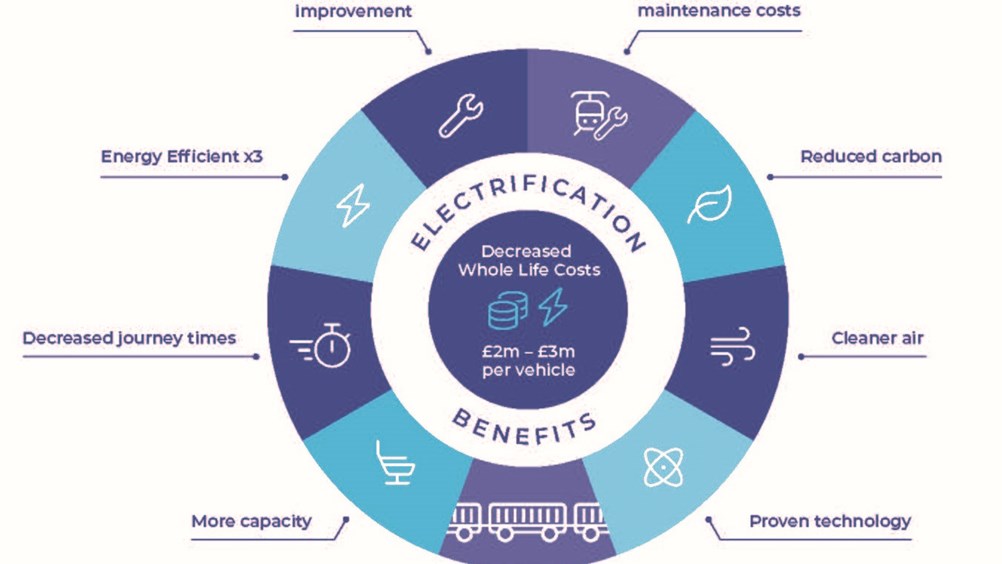
Full Midland Main Line electrification “could be shelved to pay for HS2” headlined Modern Railways magazine (Apr’2023, p9), reflecting goings on in Network Rail and the DfT. Let’s hope the they are being over- pessimistic. If not, what price electrification across the North? Two pages later the headline is the House of Commons transport committee saying government “must increase pace” of electrification in its report Fuelling the Future: motive power and connectivity. Committee chair lain Stewart MP (Con, Milton Keynes S.) strongly urged the government “to crack on with projects for electrifying train lines throughout the UK, or identify alternative lower carbon solutions where full electrification is not economically viable.” Electric trains are simple and efficient, capable of zero-carbon operation and suitable for dense passenger services and heavy freight – services with which batteries and hydrogen might never be able to cope. The hydrogen and batteries have to be manufactured and the energy has to be, converted meaning a lot more is wasted than by using renewably generated electricity directly. The report adds that hydrogen is not currently capable of producing the power needed by freight and high-speed trains. Batteries have similar limitations, have limited lifetimes in service and produce lots of greenhouse gas CO2 in manufacture. And, many of us still say, the hydrogen must be “green” not made from fossil fuels with CO2 as by-product. (Let’s not get into the argument about whether the CO2 can be buried forever.)
The government is slow to recognise the need for a rolling programme of electrification – and the benefits in terms of learning on the job and cost reductions. HM Treasury, it seems, is happy to ignore the work done by Network Rail on TDNS (traction decarbonisation network strategy), in favour of short-term financial thinking. Payback will be long term, based on lower costs of electric trains and the “sparks effect” of more people wanting to use them. TDNS of course proposed electrification of the great majority of present diesel-powered routes. In Scotland there is at least a statement of desirable outcomes. But across the UK the rolling programme seems to be “dead”. Thankfully that does not stop forward-thinking, scientifically literate bodies like the R|A (Rail Industry Association) keeping up the argument. In our Winter 2022-3 issue we reported on RIA North’s vision for a wired railway from Carlisle to Corby, Sunderland to Warrington with the Calder Valley line listed among top priorities. Now the RIA has launched RailDecarb23 calling for – yes, you guessed it – a rolling programme of cost- effective wiring, fleet orders for low-carbon rolling stock and incentives for suppliers to get on board. There is 2-side information sheet summarising the arguments (link: Rail Electrification:p The Facts – Campaigns (riagb.org.uk)).
Meanwhile a practically brand-new line is being built between Oxford and Milton Keynes without electrification. They will end up wiring it later. It’s a cliche, but you couldn’t make it up. – JSW
Elland will be served by trains that also serve neighbouring Brighouse: Wigan-Manchester-Leeds and Huddersfield-Bradford. HADRAG hopes Grand Central London trains will also call plus any possible extra services in the future towards Wakefield and York, or Dewsbury and Leeds. And of course Bradford- Sheffield trains suggested by the Greengauge 21 report could also call. Through trains Elland to Sheffield via Barnsley would take just under an hour.
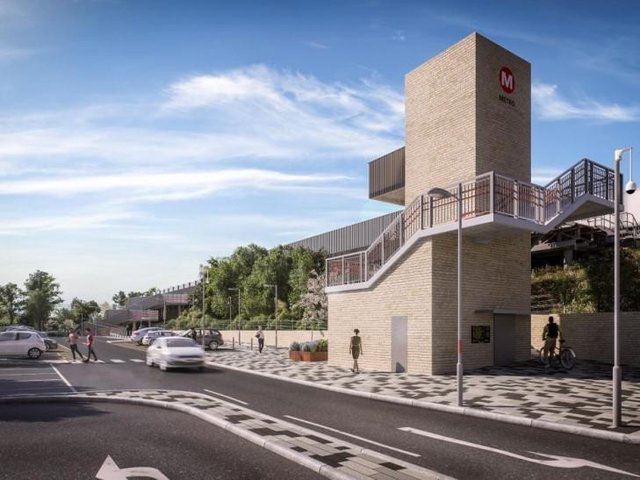
View is looking broadly west. Substantial wind breaks and decent size canopies, albeit somewhat shorter than the 4-car train shown, provide better protection than many new stations. To access the elevated platforms there will be a choice of steps and lift at this end, or ramps – true wonders of the rail world – at the far end. Lowfields Way runs northwards (left to right) from the Calderdale Way (Elland bypass) double roundabout just out of shot. Behind the view point is a large cluster of housing.
Beyond the bypass is Morrisons store and road, cycle and foot access to Elland town centre. The new active travel routes with bridges over river and canal in the access package start at the far end of the station head west.
The double decker bus depicted running into the business park presents an intriguing possibility.
The 2023 Annual General Meeting of Halifax & District Rail Action Group will be on Saturday 17 June starting at 14.15 (doors open 13.45) in the Oddfellows room, Coleridge St, Halifax HX1 2JY. Discussion will include review of HADRAG’s year and strategy. Topical issues include stations, and fares retailing. We hope the latest WY Combined Authority rail plan will be published by then. A speaker will be invited. More details to follow. Please accept this as advance notification – and see you there!
Independent research group Greengauge 21 published a report last winter proposing upgrades and new stations along a broadly defined Sheffield-Leeds corridor. For which read Sheffield not just to Leeds but also to York via Wakefield and Castleford, and – in a second stage – to Bradford via the Calder Valley line. Greengauge say some of the proposals are almost ready to go, and the hope or even expectation is that much could be completed within adecade. (Sheffield-Leeds: What’s Next? Greengage 21, December 2022 – Interim rail improvements for the Yorkshire economy – Greengauge 21)
The idea is also that – with uncertainty about high speed proposals certainly not decreasing – we need to develop improved services over existing routes. We can not wait a whole generation – maybe more – for services to be upgraded. Existing passengers need to be able to see benefits – including new services that will attract new passengers. It’s not just about connecting the big cities.
HADRAG is particularly excited by the Bradford-Sheffield proposal. We flatter ourselves that we suggested it first about 20 years ago! Reopening of the Crigglestone curve would be required – a line from Horbury, by the former station, that connected with the Wakefield-Barnsley route and carried a summer Saturday Bradford-Weymouth train until the late 1980s, when it was closed after the “Five Curves” hearings. Three of the curves reopened with Brighouse station in May 2000. The Crigglestone curve is still there, not built on. It would undoubtedly need some work to restore but the benefits for Bradford, Halifax and the lower Calder valley would be massive.
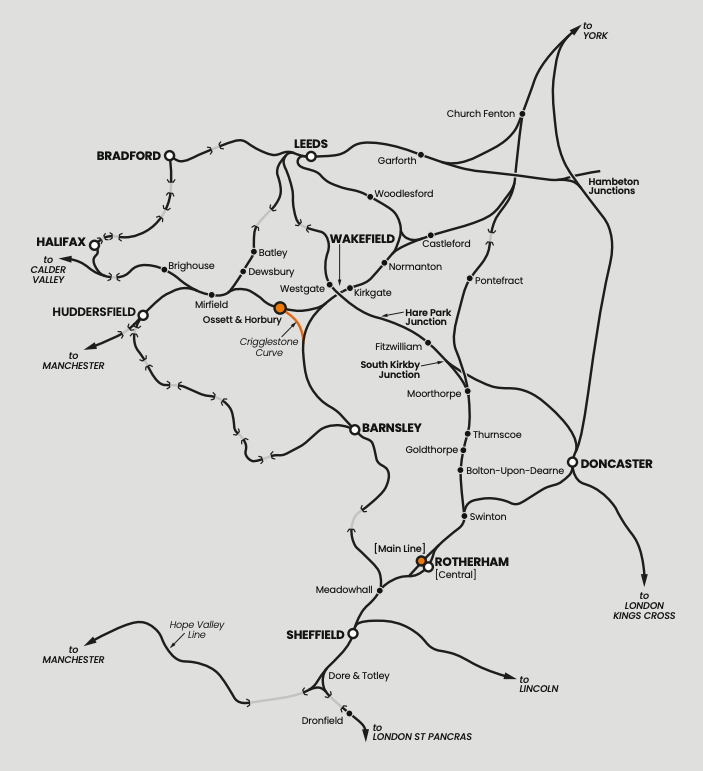
Greengauge’s map shows how the Bradford-Sheffield service would fit geographically. Note new station proposed “Ossett & Horbury”, actually in Horbury but providing for the biggest town in Yorkshire without trains, could also be served by services from Manchester, Huddersfield and the Calder Valley to Wakefield and beyond.
Greengauge suggests trains from Bradford could serve Low Moor, Halifax, Brighouse, Mirfield and Horbury before running fast to Barnsley, Meadowhall and Sheffield. We have already pointed out that Elland should be added to the list of calls. Greengauge’s director, Jim Steer, did not disagree! The table shows our estimates (not Greengauge’s) of journey times.
Looking on National Rail’s journey planner for Brig house to Sheffield times revealed what a complex journey this is under present service patterns. The Greengauge proposal would provide an hourly through train taking 50 minutes.
The benefits for Bradford are not quite as great but the proposed service avoids the need to change at Leeds, or have a through service that would require reversal in Leeds – with timetabling complications.
Big Benefits
The big benefits of the proposed service are definitely for Halifax, lower Calderdale, Mirfield and Horbury/Ossett.
Halifax-Sheffield would be only fractionally more than an hour. Elland and Brig house’s position on the national rail map would be strengthened. Connections to East Midlands, Birmingham and the South West would be eased, avoiding the oft-heard complaint “We don’t want to go by train because you have to go the long way round via Leeds.”
Further development could extend the through service from Bradford beyond Sheffield, maybe to Leicester. The whole proposal would be highly beneficial for stations in Calderdale, Kirklees (Mirfield) and Wakefield (Horbury for Ossett) districts. It would provide access to the massive potential of towns such as Barnsley, and of course direct access from South Yorkshire to the business and leisure attraction of south-west Yorkshire. Barnsley to Halifax Piece Hall in under three quarters of an hour!
As we said, Bradford-Sheffield is in the second phase of Greengauge’s proposals.
The first phase would involve immediate action to provide:
Second hourly fast service Leeds-Sheffield via Wakefield Westgate, on the opposite half-hour to Cross Country’s long-distance service to the South West – thought to be an existing ambition of Northern Trains.
New Rotherham main line station, located to offer connections with the Sheffield tram-trains and buses (which we reckon also means a new tram station). The new station could be served by trains on Leeds and Doncaster to Sheffield, Manchester and cross-country routes. It would not be on our slightly more aspirational Bradford-Barnsley-Sheffield route.
Extension of London St Pancras to Sheffield trains via Barnsley and Wakefield Kirkgate to York via
Castleford. Potential here to maximise benefits of current work to provide a second platform at Castleford. As always, an alternative could be (yet) another service to Leeds.
Phase 2 – initiate planning – alongside Bradford-Sheffield, proposes a new link from Sheffield for Manchester Airport, plus examination of extending the new Leeds-Sheffield fast to Birmingham. Is the Airport link of more or less net benefit than a new service Bradford-Sheffield with a new station for Ossett, and major improvements to regional connectivity?
Phase 3 is headed renew investigations for things like infill electrification Sheffield-Doncaster/Leeds – surely essential! – plus relieving capacity constraints north of Sheffield’s Midland station.
This matches our ambitions – but is it realistic?
So how could the Greengauge 21 proposals tie in with HADRAG’s ambitions for the Calder Valley line, not least doubling of frequency on the Elland/Brighouse line? Going beyond faults in the present timetable such as the obvious need for all Manchester and Blackpool trains to stop at Sowerby Bridge we have called for a doubling of frequency at Elland and Brighouse. All three local stations just mentioned serve populations comparable with the two main upper valley stations combined but have little if any more than half the service level. So we want more trains Halifax and Sowerby Bridge to Elland, Brighouse and beyond.
(And all upper Calderdale trains should serve Sowerby Bridge!)
Additional Calder Valley trains could go to Wakefield, Castleford (using the newly constructed platform) and York. Not everyone wants to go to Leeds! (But Leeds would be an alternative destination.) Another might take longer to develop but could go via Horbury and Barnsley to Meadowhall and Sheffield (maybe beyond) a la Greengauge 21.
So, in one model, a future service pattern at Elland and Brighouse could be
2 trains/hr to Halifax and Bradford
2 trains/hr to upper Calderdale, alternating Manchester and east Lancs, Preston etc
1 train/hr (at least) to Huddersfield
At least 2 trains/hr eastwards via existing routes, at least 1 to Leeds but maybe 1/hr to Wakefield, Castleford and York
1 train/hr to Bradford to Sheffield, maybe Leicester via Mirfield, Horbury, Barnsley and Meadowhall.
Intercity services less frequently, at least the present 4 trains/day Grand Central to London.
Will it ever happen? Greengauge’s suggested Bradford-Sheffield service would massively benefit Halifax and lower Calder valley stations – a huge improvement for Brighouse (and Elland). We shall keep up the argument with train operators, West Yorkshire Combined Authority, Transport for the North and local representatives and MPs. We can not wait for high-speed proposals which will not clearly benefit our line. We need action this decade. – JSW
Journey Times: how long would our train take?
The following times for a through service are HADRAG’s estimates. Existing times quoted are for outward times on a weekday morning.
Time (minutes)
from Bradford
to Sheffield
Typical Existing times to Sheffield for Comparison
Bradford Interchange
00
75
83 to 87 min (change at Leeds – note 1)
Low Moor
06
69
Halifax
12
63
95 to 100 min (change at Leeds – note 2)
Elland
19
56
Brighouse
25
50
82 to 120 mins via. Leeds (faster using GC train – note 2)
Mirfield
32
43
84 to 120 mins via. Leeds (faster using GC train – note 2)
Horbury for Ossett
40
35
not applicable (proposed new station)
Barnsley
52
23
Meadowhall
68
07
Sheffield
75
00
Note 1 – through train via Leeds (with train reversal) could take around 70 min, dependant on stops and pathing. Note 2 – faster times available when Grand Central gives connection at Wakefield Kirkgate e.g. on mid-morning train from Hfx 84 min, Brighs 70min, Mirfield 62min to Sheffield; but remember GC only runs 4 trains/day. Finding good times from Brighouse and Mirfield to Sheffield was a challenge! The 82 min quoted from Brighouse allows less than the recommended 10 minutes to change in Leeds. Some search results involved doubling back at Huddersfield or Dewsbury. Present Brighouse-Huddersfield trains do not connect with Huddersfield-Penistone- Sheffield trains – unless you consider a wait of almost an hour a connection!
Further factor is current suspension of Huddersfield-Wakefield service: when this service runs, journey time (change at Wakefield Kirkgate) is about 84 minutes Mirfield-Sheffield. Restoration of Huddersfield-Wakefield is expected, possibly in Dec’23, and possibly in a different form operated by TransPennine Express.
Elland station gained planning permission earlier this year. Why did this take so long you might well ask? First thing to say is there is no point trying to complete planning procedures until the plans are as near as possible final. So planning appproval is a sure sign that this project will get the go-ahead. The projected station has certainly evolved and will include access via stairs, lifts and ramps. There should be adequate protection from wind and rain.
Latest plans and details can be found in more detail on Calderdale council’s website. The associated access package will open up high quality walking and cycling routes with new river and canal bridges towards Exley and along the canal bank to Greetland (West Vale).
Yes, it has taken a long time to get this far. Recent setbacks have included redesigns due to changes to Network Rail fire regulations and waits for reponses from official consultees. Elland was deleted from the original Brighouse line reopening – expensive to build. But an early study (1990) had forecast that of the two stations Elland could attract more passengers. Choosing the best site for the station has always caused local argument. We still hear occasional voices speaking out for the station site in Exley Lane and for Greetland. Both these alternatives have the disadvatages of serving few houses within walking distance and remoteness from local urban centres. The chosen site at Elland Lane is
well served by the local road network,
close to a lot more – and more concentrated – housing,
next to Lowfields business park (which did not exist when the 1990 study was carried out),
close to Morrisons superstore, Elland town centre and a private hospital.
HADRAG has argued that local NHS facilities – Calderdale Royal Hospital and Royal Huddersfield Infirmary could be accessed from upper Calderdale towns by a minibus link from Elland station, whilst new bus routes could be developed around Elland, Greetland and Stainland to serve the station and link communities. Groundwork for a highly successful station.
We also keep saying – without apology! – that each of Elland and Brighouse stations will serve a population comparable with the two main upper Calderdale stations combined. Hence our call for doubling of the present train service frequency in lower Calderdale and opening up of new destinations.
Next stage in the station planning process will be “FBC” (full business case) later this year. The promise is completion by end of 2025, meaning trains on existing hourly routes Wigan-Manchester-Brighouse-Leeds and Bradford-Huddersfield calling at the new station perhaps to slightly adjusted timings – the extra stop will add a couple of minutes. Which will, arguably of course, be a quarter of a century late.






 Halifax and District Rail Action Group